Advance payment guarantee: what SA contractors must know

An advance payment guarantee (APG) is a bond, issued by a bank or insurer, that lets an employer recover an upfront payment if the contractor defaults, is liquidated, or misuses the funds. It is the price of admission for mobilisation money.
Employers on any contract with a mobilisation or material-advance clause should always require one. Contractors expecting an advance should expect to supply one, usually within days of contract signature.Three things to check right now:
- Does your contract or tender document actually contain an APG clause, and does it specify a form?
- Is the issuer a bank or an insurer/surety, since collateral and cost differ sharply between the two?
- If the contract is JBCC-based, have you pulled the standard Guarantee for Advance Payment form rather than drafting your own?
Key Takeaways
An advance payment guarantee protects the employer's upfront payment and diminishes as the contractor recovers it against payment certificates, with bank and insurer routes carrying very different collateral costs.
| Point | Details |
|---|---|
| Know your issuer type | Banks usually demand near-full cash cover; insurers like Blenheim or Civilsure often need far less collateral. |
| Check for JBCC compliance | Confirm whether the contract requires the standard JBCC Guarantee for Advance Payment form before submitting any bank template. |
| Negotiate wording early | Push for conditional, proof-of-default language over open-ended on-demand terms during tender clarification, not after award. |
| Document the spend | Keep procurement lists and invoices matching the advance so guarantors and auditors can trace it to mobilisation costs. |
| Prepare the pack in advance | Use Protenders to find tenders with advance payment clauses and assemble your compliance documents ahead of time. |
Table of Contents
- What does an advance payment guarantee actually cover?
- Who issues an advance payment guarantee in South Africa?
- How does an advance payment guarantee reduce over time?
- What does JBCC say about the Guarantee for Advance Payment?
- How is an APG different from a performance guarantee?
- What does an advance payment guarantee cost?
- What triggers a claim on an advance payment guarantee?
- What documents do guarantors want before they issue an APG?
- What should you negotiate before signing?
- Where contractors and employers both get this wrong
- How Protenders helps you get tender-ready before the guarantee conversation starts
- Where to verify this yourself
- Sources
- FAQ
What does an advance payment guarantee actually cover?
An APG protects the money, not the work. If an employer pays a contractor upfront to mobilise a site, buy long-lead materials, or import equipment, the guarantee lets the employer recover whatever portion of that advance the contractor hasn't accounted for if things go wrong.
The common triggers are the ones you'd expect: default, liquidation, or spending the advance on something other than what it was meant for. Mobilisation costs, early procurement of steel or specialist plant, and subcontractor mobilisation on larger packages are the usual scenarios where employers insist on one.
Treat the advance as an interest-free loan from employer to contractor. That framing explains why employers are cautious. It's their cashflow sitting exposed on-site before any value has been certified, and the guarantee is what makes that risk acceptable.
Who issues an advance payment guarantee in South Africa?
Two categories of guarantor dominate the market, and the choice between them changes your entire cost structure:
- Commercial banks such as Standard Bank, Absa, and Nedbank, which typically require full cash cover or a facility against your existing credit line.
- Specialist insurers and sureties, including Blenheim and Civilsure, which underwrite the risk instead of demanding 100% cash collateral upfront.
The employer is always the primary beneficiary, entitled to claim if the contractor defaults. The contractor benefits indirectly: without the guarantee, most employers won't release the advance at all, so the bond is really what unlocks the cashflow. Bank guarantees tend to move faster for established clients but tie up working capital; insurer-backed facilities take longer to underwrite but free up balance-sheet room for other tenders.
How does an advance payment guarantee reduce over time?
Almost every APG in South Africa is a diminishing guarantee. The value drops as the advance gets worked off against interim payment certificates, so a guarantee that starts at the full advance amount might be down to a third of that by month four, assuming the works are progressing on program.
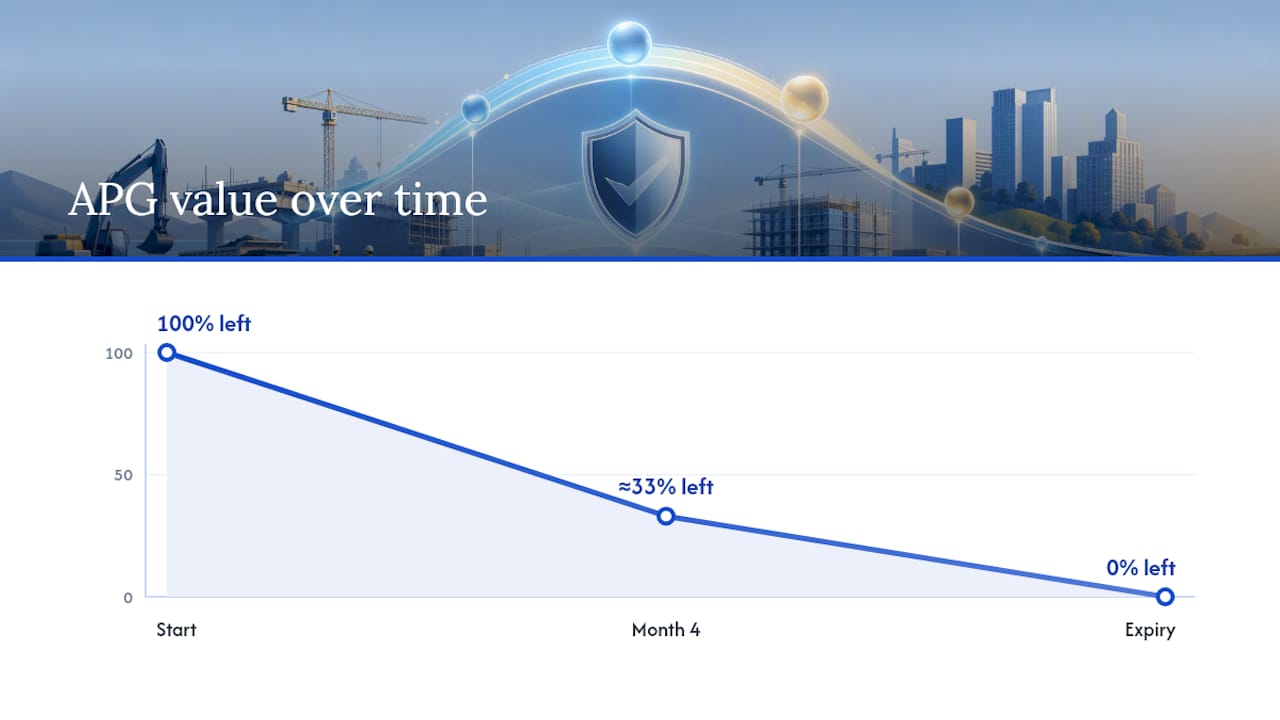
The wording around claims matters more than most contractors realise. On-demand guarantees let the employer call the full outstanding value with no proof of loss required, just a written demand. Conditional guarantees require the employer to demonstrate default or misuse before payment. The gap between those two is the difference between a manageable risk and a clause that can bankrupt a subcontractor on a technicality.
Expiry is usually tied to full recovery of the advance, meaning the guarantee falls away once payment certificates show the advance has been completely offset, or at practical completion, whichever the contract specifies first.
Pro Tip: Never sign a guarantee application that says "on-demand" without pushing for a proof-of-default clause. Insurers and even some banks will accept conditional wording if you ask for it before the tender closes, not after you've won the job.What does JBCC say about the Guarantee for Advance Payment?
Most private and public building contracts in South Africa still run on JBCC editions, and the JBCC Guarantee for Advance Payment form is the de facto standard most guarantors already recognise. It sets out diminishing liability tied to milestones and payment certificates rather than leaving that structure open to negotiation on every project.
The JBCC Guide to Completion and Payment treats the advance as a loan, with its accounting handled through recovery statements and payment certificates. Any interest or charges tied to the guarantee sit outside the contract sum and must be agreed separately between employer and contractor.
For tender teams, the practical takeaway is simple: check whether the tender data requires the JBCC form specifically. Submitting a bank's own template when the employer expects the JBCC form is a compliance failure that has cost contractors tender awards.
How is an APG different from a performance guarantee?
An APG recovers an unused advance. A performance guarantee, by contrast, covers the employer if the contractor fails to complete the works at all, and typically runs for the full contract duration rather than diminishing early. Retention guarantees cover defects liability, sitting in the background of the defects period long after the APG has expired.

It's common for a single project to run an APG and a performance bond simultaneously in the early months, before the advance has been fully recovered. Employers on larger contracts often ask for both, since they cover entirely different failure modes.
What does an advance payment guarantee cost?
Coverage typically matches the advance itself, most often a percentage of contract value that JBCC and insurer documentation both frame as reducible against milestones rather than a flat sum held for the full contract term.
Collateral is where bank and insurer routes diverge sharply. A bank will usually want cash cover close to the full guarantee value, locking up working capital for the life of the advance. Insurer-backed facilities work differently: contingency premiums and collateral can sit in the high single digits to mid-teens as a percentage, rather than full cash cover, which is why contractors chasing multiple tenders often prefer the insurer route even at a higher headline premium.
Advance payments are generally structured as loans rather than income, which affects how they're accounted for on both sides. That's a tax and accounting question specific to your entity structure, so get your accountant or tax advisor to confirm treatment before you sign anything.
What triggers a claim on an advance payment guarantee?
Guarantors don't pay out on a whim, but the list of legitimate triggers is broader than most contractors assume:
- Contractor default on contract obligations tied to the advance.
- Liquidation or business rescue, which almost automatically puts the contractor in default.
- Clear refusal to perform, even without formal insolvency.
- Misuse of the advance, spending it on something other than the agreed mobilisation or procurement items.
- Failure to repay as works progress, when payment certificates show the advance hasn't been offset on schedule.
Liquidation and outright refusal to perform are the two triggers that account for most call-ups in practice. Once the employer issues a demand notice, the guarantor investigates, pays out if the demand meets the guarantee's terms, and then pursues the contractor for reimbursement. Contractors typically get a short window, often specified in the guarantee itself, to respond before the guarantor pays regardless.
What documents do guarantors want before they issue an APG?
Underwriters are not just checking your balance sheet. They want to see that the advance is going toward something specific and verifiable, not general working capital.
- Recent financial statements and your CIDB grading.
- A copy of the signed contract and the project program.
- A procurement list matching invoices or purchase orders for the mobilisation items the advance will fund.
- Recovery statements and a draft schedule for how the guarantee will diminish against payment certificates.
- Tax clearance and bank references.
Underwriters expect this procurement list to line up with actual spend, not a rough estimate. Contractors who arrive with matching invoices and a clear program tend to move through underwriting faster and face lower collateral demands than those who show up with a bank statement and a hope. Building this pack alongside your tender documentation rather than after award saves weeks.
What should you negotiate before signing?
The clauses worth fighting over, in order of impact: on-demand versus conditional wording, the documents required to trigger a claim, whether the diminishing schedule ties cleanly to payment certificates, and whether the guarantor's total liability is capped.
Watch for unlimited on-demand language with zero proof-of-loss requirement, or collateral demands pegged to exposures that have nothing to do with this specific advance. Both are red flags worth pushing back on at tender stage, not after signature.
Pro Tip: Raise guarantee wording during the tender clarification period, not after you've won. Once you're the appointed contractor, your negotiating leverage on the guarantee terms drops to almost nothing.Where contractors and employers both get this wrong
Contractors routinely sign whatever guarantee wording the bank hands them, without asking whether conditional terms are available. They also skip documenting what the advance was actually spent on, which becomes a problem the moment a dispute starts.
Employers make the mirror-image mistake: they release large advances without any guarantee at all, usually on the strength of a long relationship, then discover that goodwill doesn't survive liquidation. Contractors should insist on conditional wording and keep a paper trail. Employers should never treat an advance as a formality just because the contractor is familiar.
How Protenders helps you get tender-ready before the guarantee conversation starts
Protenders won't issue your guarantee, that's a job for a bank or an insurer, but it solves the problem that comes before it: finding the tenders that carry advance payment terms in the first place, and having your compliance pack ready before a bank or insurer asks for it.
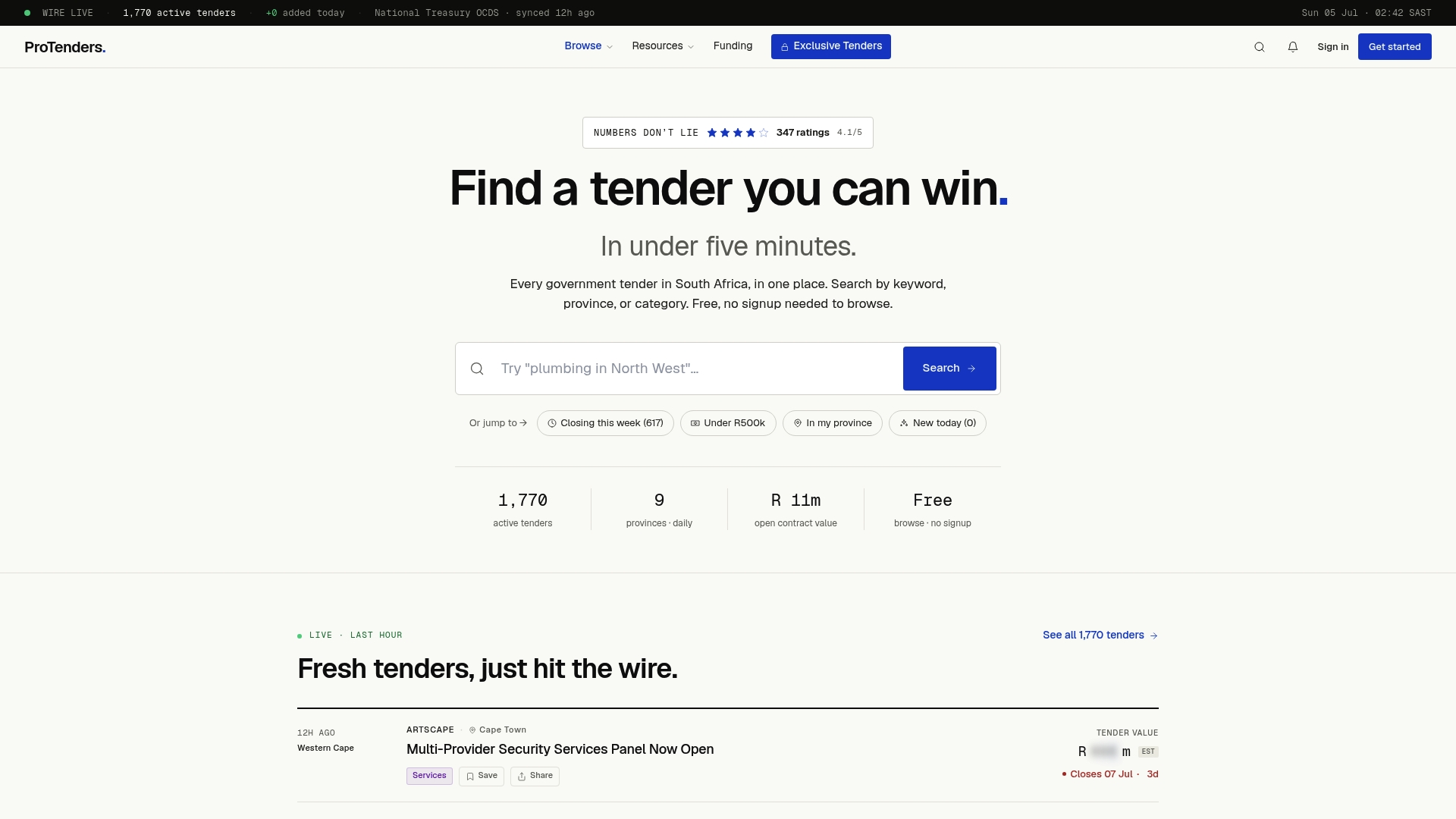
The platform aggregates live tenders from national, provincial, and municipal buyers, so you can filter for contracts with mobilisation clauses instead of scrolling through hundreds of unrelated notices. Compliance scorecards and document templates help you assemble the financial statements, CIDB records, and procurement lists a guarantor will ask for, cutting the back-and-forth that usually slows underwriting down. If you're chasing your next JBCC-based contract, start by browsing live government tenders and building your guarantor-ready pack before you submit, not after you've won.
Where to verify this yourself
The JBCC Guarantee for Advance Payment form and its accompanying Guide to Completion and Payment are the contractual baseline for most South African building projects. Insurer product pages from Blenheim and Civilsure explain how their facilities work in practice, though they naturally present their own products favourably. For legal analysis of how these instruments sit within construction contract law, Cliffe Dekker Hofmeyr's commentary is worth reading before you sign anything unusual.
This article is general information, not a substitute for advice from a qualified financial advisor. Consult a qualified financial professional about your own circumstances before acting on anything here.
Sources
- JBCC ® Guarantee for Advance Payment (PBA/NSSA/MWA) — JBCC
- Advance payment guarantees in construction contracts — Cliffe Dekker Hofmeyr
- Advance payment guarantees (APg) | CivilSure
- Guarantees in South Africa: Credit instruments for liquidity, limits and project delivery — Berkley Risk
- Advance Payment Guarantee — Blenheim
FAQ
How does an advance payment guarantee work?
An employer pays an advance to the contractor, and the bank or insurer issuing the guarantee promises to repay that advance if the contractor defaults or misuses it. The guarantee value diminishes as the contractor works off the advance against interim payment certificates.
What is an advance payment guarantee used for?
It secures mobilisation costs, early material procurement, and imported equipment purchases so an employer can release upfront funds without risking that money outright. It's most common on JBCC-based construction contracts requiring significant site setup before work begins.
What is the format of a bank guarantee for advance payment?
South African bank guarantees for advance payments typically follow either the issuing bank's standard template or the JBCC Guarantee for Advance Payment form, specifying the guaranteed amount, diminishing schedule, demand notice process, and expiry conditions.
What is a corporate advance payment guarantee?
A corporate guarantee is issued by the contracting company itself or a related corporate entity rather than a bank or insurer, and it carries less assurance for employers since it depends on that company's own solvency rather than a regulated financial institution's backing.
How long does an advance payment guarantee typically last?
Validity usually runs until the advance is fully recovered through payment certificates or until practical completion, whichever the contract specifies, so duration tracks the project program rather than a fixed calendar period.
Recommended
- Tender Glossary South Africa | Procurement Terms, Acronyms & Definitions | ProTenders
- B-BBEE Tender Requirements South Africa 2026: PPPFA 80/20 & 90/10 Explained | ProTenders
- Construction Tenders in South Africa: How to Find and Win More Projects | ProTenders
- Tender Documents South Africa: Checklist & Guide (2026) | ProTenders