Bid bonds explained for South African contractors

A bid bond is a short-term guarantee that the bidder will sign the contract and provide the required performance security if awarded — and in South Africa it is a standard requirement on many public tenders. Without one, your submission may be disqualified before it is even read.
Three parties are always involved:
- Principal (contractor/bidder): the party submitting the tender and applying for the bond
- Obligee (employer/client): the public entity or private owner who requires and benefits from the bond
- Surety (issuer): the bank, short-term insurer, or broker-backed provider that issues the guarantee
Industry practice in South Africa commonly uses bid bonds at a small percentage of the tender value, with typical validity windows spanning a few months, after which the bond is replaced by a performance guarantee on award. *
Key takeaways
| Point | Details |
|---|---|
| Check the tender instructions first | Bond requirements, amounts, and prescribed formats appear in the instructions to bidders and submission checklist. |
| Verify six wording elements | Confirm beneficiary name, maximum amount, expiry conditions, governing law, authorised signatories, and issuer credit rating. |
| Bid bonds run 2–5% of tender value | Validity is typically 90–180 days; the bond is replaced by a performance guarantee (5–10%) on contract signature. |
| Three provider types exist in South Africa | Banks, short-term insurers, and broker-facilitated guarantees each have different collateral and speed profiles. |
| A called bond triggers personal recovery | The surety pays the employer and recovers from you under your counter-indemnity — preserve mobilisation records to contest unjustified demands. |
Table of Contents
- What is a bid bond and how does it differ from a deposit?
- How a bid bond works, from submission to award
- When bid bonds are required in South African procurement
- What standard bid bond clauses actually say
- What triggers a claim and what to do if one is made
- How to get a bid bond in South Africa
- Bid bond vs performance bond vs retention guarantee
- How bid bonds help SMMEs compete in public procurement
- The part most contractors get wrong about bid bonds
- Sources
- FAQ
What is a bid bond and how does it differ from a deposit?
A bid bond is a conditional financial instrument that gives the employer legal certainty: if you win the tender but then refuse to sign the contract or fail to provide the required performance security, the employer can call on the bond and recover the resulting loss. It is not a cash deposit sitting in an account. The employer holds a right to claim, not the money itself.
The three-party structure is what separates a bid bond from a simple deposit. You (the principal) apply to a surety. The surety issues the bond to the employer (the obligee). The employer's right to claim runs against the surety, not directly against your bank account — though the surety will recover from you under a counter-indemnity agreement.
A cash deposit is simpler but ties up working capital immediately. A bid bond preserves your liquidity while giving the employer equivalent protection. A performance bond, by contrast, covers the employer's risk during contract execution, not at the point of award. These are distinct instruments used at different stages of the procurement lifecycle.
*How a bid bond works, from submission to award
The sequence is predictable once you know it. Here is how it plays out on a typical South African public tender:
- Tender issued. The employer publishes the tender and specifies that a bid bond is required, stating the amount or percentage and the validity period.
- Bond obtained. Before the closing date, you approach a bank, insurer, or broker and obtain the bond. The surety issues a bond document addressed to the employer.
- Tender submitted. You include the original bond document with your bid submission. Missing or defective bonds are usually grounds for immediate disqualification.
- Validity period runs. The bond stays in force for the stated period, which may range over several months. During this window, you are bound by your bid price and conditions.
- Award or rejection. If you are unsuccessful, the bond lapses at expiry with no claim. If you win, the employer notifies you formally.
- Obligations triggered. From the date of award notification, you must sign the contract and deliver the performance guarantee within the timeframe the tender specifies. Failure at either step can trigger a claim.
- Bond replaced. Once you sign the contract and the performance guarantee is accepted, the bid bond is released and expires. The performance guarantee (commonly set at a moderate percentage of contract value) takes over.
If you win but refuse to sign, the employer re-tenders and awards to the next bidder at R10.8 million. The employer's loss is R800,000, capped at R500,000 under the bond. The surety pays the employer and then recovers R500,000 from you under your counter-indemnity. Procore's industry guidance describes this protection role as the core reason employers require bid bonds on larger public and commercial projects. *
When bid bonds are required in South African procurement
Bid bonds are most common on public sector tenders and large commercial projects. State-owned entities, national and provincial government departments, and municipalities regularly require them, particularly where the contract value is significant or the employer has experienced bidder withdrawal in the past.
Standard contract forms used in South Africa — JBCC, FIDIC, and NEC — all accommodate bid security requirements, though the specific obligation depends on what the employer inserts into the contract data or special conditions. Not every JBCC contract will require a bid bond; the employer's instructions to bidders will say so explicitly.
Where to look in a tender document:
- Instructions to bidders (ITB): usually the first place a bond requirement is stated, including the amount, format, and validity period
- Returnable schedules / submission checklist: the bond document is typically listed as a mandatory returnable
- Contract data or special conditions: may specify the bond format, issuer credit rating, and governing law
- Guarantee clause or annexure: some employers attach a prescribed bond format that must be used without amendment
PRASA is a useful benchmark for what public-sector bond requirements look like in practice. Its bid bond template sets a maximum aggregate amount, requires payment within two weeks of a written demand, and specifies that the issuing financial institution must hold a minimum credit rating of A(ZA). The format is non-amendable — contractors cannot negotiate its terms. You can browse live PRASA tenders on Protenders to see which active procurements carry similar requirements. Pro Tip: Check the tender documents checklist on Protenders before submission day. Bond documents are among the most common reasons for disqualification, and the checklist flags mandatory returnables so nothing slips through. *
What standard bid bond clauses actually say
The PRASA template is a payment-on-demand bond, which is the format most South African public-sector employers prefer. Payment-on-demand means the surety must pay when the employer presents a conforming written demand — it does not need to prove the contractor's default in court first.
Before you submit any bid bond, verify each of these elements in the document:
- Exact beneficiary name and address: a mismatch between the bond and the tender notice can invalidate a demand
- Maximum aggregate amount: confirm it matches the tender's stated requirement to the cent
- Expiry conditions: the bond should expire on a specific date or on a defined event (e.g., signing of contract and delivery of performance guarantee), whichever comes first
- Governing law: South African law should be stated; cross-border issuers sometimes insert foreign law clauses
- Who may sign demands: some bonds restrict who at the employer's organisation can issue a valid demand
- Non-transferability: confirm the bond is not transferable to a third party without the surety's consent
- Issuer credit rating: check the rating requirement in the tender and confirm your issuer meets it
The autonomy principle is why precise wording matters so much. South African courts, following authorities such as Lombard Insurance v Landmark, treat independent demand guarantees as separate from the underlying contract. The MJ Kotze Inc guidance on South African guarantees confirms that the only narrow defence available to a surety is clear, established fraud or strict non-compliance with the bond's own terms. A contractor cannot instruct the surety to withhold payment simply because a dispute exists about the underlying contract. *
What triggers a claim and what to do if one is made
A valid call on a bid bond is not automatic — the employer must present a conforming written demand within the bond's validity period. The common legitimate triggers are:
- Failure to sign the contract within the specified period after award notification
- Failure to deliver the performance guarantee within the required timeframe
- Withdrawal of the bid during the validity period
- Material misrepresentation in the tender submission
When a conforming demand arrives, the surety pays the employer within 14 days (per PRASA-style wording) and then exercises its right of recovery against you under the counter-indemnity you signed when the bond was issued. That recovery can include legal costs. Beyond the financial hit, a called bid bond damages your relationship with the issuer and can affect your ability to obtain future bonds — which in practice limits your ability to bid on public tenders at all.
If you believe a demand is unjustified, act fast:
- Notify your surety immediately and provide all supporting documents (award letter, correspondence, proof of performance guarantee delivery)
- Check whether the demand strictly conforms to the bond's terms — an incorrectly addressed demand or one signed by an unauthorised person may not be conforming
- Seek legal advice before the 14-day payment window closes; an urgent interdict is the usual route to pause payment while a dispute is resolved
- Preserve all records: emails, courier receipts, signed contract pages, and performance bond acceptance letters
Pro Tip: Keep a mobilisation file from the moment you receive an award notification. Date-stamp every action — contract signing, performance bond submission, employer acknowledgement. If a demand ever arrives, this file is your first line of defence. *
How to get a bid bond in South Africa
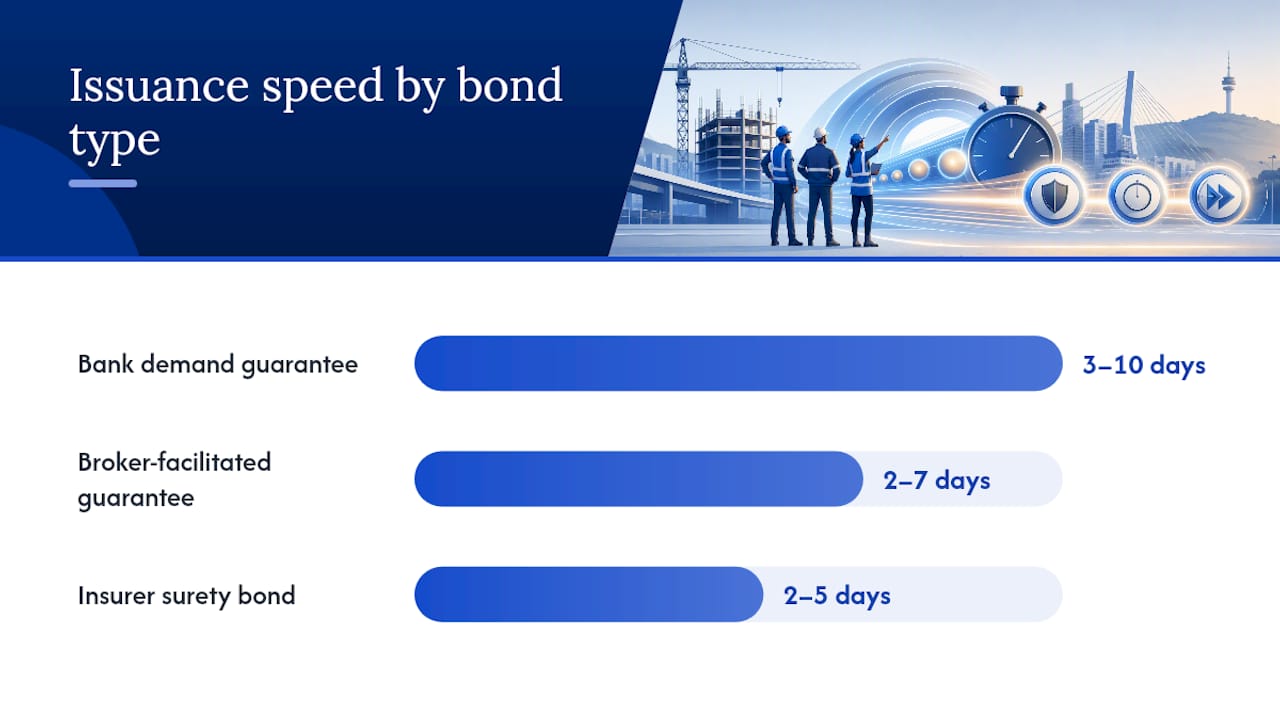
Three types of providers issue bid bonds in South Africa, and they work differently:
| Bond source | Speed | Collateral typically required | Key cost driver |
|---|---|---|---|
| Bank demand guarantee | 3–10 business days | Often full cash cover or asset security | Facility fee plus collateral cost |
| Insurer surety bond | 2–5 business days | Counter-indemnity; less cash collateral | Annual premium on bond amount |
| Broker-facilitated guarantee | 2–7 business days | Varies by underlying insurer | Broker fee plus insurer premium |
 Standard Bank, ABSA, Nedbank, and FNB all issue demand guarantees through their trade finance or structured finance divisions. Banks tend to require strong balance sheets or significant collateral — sometimes full cash cover — because a demand guarantee is an unconditional payment obligation on their books. For contractors with limited assets, this can be a barrier.
Short-term insurers and specialist surety providers (including those arranged through brokers such as Aon South Africa and Civilsure) often issue bonds for a premium without requiring full cash collateral. The underwriting decision turns on financial health, track record, and the directors' willingness to sign personal counter-indemnities. As Civilsure's guidance notes, underwriters look beyond the current balance sheet to references, past project performance, and directors' credit history.
Documents you will typically need to apply:
- Company registration documents (CIPC) and tax clearance certificate
- Latest two to three years of audited or reviewed financial statements
- CIDB grading certificate (relevant grade for the tender value)
- Tender documents showing the bond requirement and amount
- List of current and completed projects with contract values and references
- Directors' personal financial statements and consent for credit checks
- Existing contingent liabilities schedule (other bonds currently in force)
Your CIDB grading matters more than many contractors realise. A higher grading signals capacity to underwriters and can reduce collateral requirements. If your grading does not yet match the tender's required grade, address that before applying for the bond — the underwriter will ask. *
Bid bond vs performance bond vs retention guarantee
These three instruments cover different risks at different stages of the same project. Confusing them in a tender response is a common and costly mistake.

| Instrument | Purpose | Typical value | When provided | What a call means |
|---|---|---|---|---|
| Bid bond | Contractor will sign and provide security if awarded | 2–5% of tender value | With bid submission | Contractor failed to sign or provide performance bond |
| Performance bond/guarantee | Contractor will complete the works to contract standard | 5–10% of contract value | On contract signature | Contractor is in material breach or has abandoned works |
| Retention guarantee | Replaces cash retention held by employer | ~10% of contract value | During execution or at practical completion | Contractor failed to remedy defects in defects liability period |
How bid bonds help SMMEs compete in public procurement
Aon South Africa makes a point that many SMME contractors overlook: a properly structured bid bond is not just a compliance document. It is a credibility signal. When a procurement officer sees a bond issued by a reputable insurer or bank, it tells them the contractor has passed an independent financial and capacity check. That matters in a competitive field where many bidders look similar on paper.
To use bid bonds strategically rather than just reactively:
- Get your CIDB grading right first. Underwriters use it as a proxy for capacity. A grading that matches your target tender range makes the bond application faster and cheaper.
- Prepare a standard financial pack. Audited statements, a project reference list, and a directors' profile document should be ready before any tender closes, not assembled in a panic the day before.
- Build a broker relationship before you need one. A broker who knows your business can place a bond faster and sometimes negotiate better terms than a cold bank application.
- Understand your counter-indemnity exposure. Every bond you have in force is a contingent liability. Track them and disclose them honestly in new applications — underwriters find out anyway, and concealment damages trust.
- Negotiate tender wording where the employer allows it. Some private-sector employers will accept minor amendments to bond format. Public-sector templates like PRASA's are non-negotiable, but it is worth asking on commercial projects.
- Seek legal review for high-value bonds. On bonds above R1 million, a one-hour legal review of the bond wording against the tender requirements is cheap insurance against a drafting error that could cost far more.
Pro Tip: Use Protenders' compliance scorecard tools to identify gaps in your documentation before you approach a surety. Underwriters and procurement officers are looking at the same things — a clean compliance profile speeds up both processes. *
The part most contractors get wrong about bid bonds
There is a persistent assumption among smaller contractors that a bid bond is just a formality — a box to tick before submission. That framing is dangerous, and it leads to two predictable mistakes.
The first is treating the bond as something to sort out at the last minute. Underwriters need time. Banks need more. A contractor who approaches a bank two days before tender close, with incomplete financials and no existing facility, will either get a refusal or a demand for full cash collateral that defeats the purpose of the bond entirely. The contractors who consistently win public tenders have their bond facility arranged before the tender is even published — because they have built the relationship with a broker or insurer over time.
The second mistake is not reading the bond wording carefully enough. The autonomy principle is not theoretical. South African courts have consistently upheld the employer's right to call a payment-on-demand bond without proving default in the underlying contract. A contractor who believes a dispute about the contract will protect them from a bond call is wrong. The only protection is strict non-conformity of the demand with the bond's own terms — and that requires knowing those terms in detail before you submit.
What actually matters is preparation: financial statements ready, CIDB grading current, broker relationship established, and bond wording reviewed against the tender's requirements before submission day. That is the difference between a bid bond that works for you and one that becomes a liability.
*This article is general information, not a substitute for advice from a qualified lawyer. Consult a qualified legal professional about your own circumstances before acting on anything here.
Sources
These are the primary references contractors should consult when verifying bid bond requirements or seeking provider guidance:
- Guarantees in South Africa: Credit Instruments for Liquidity, Limits and Project Delivery
- Bid Bonds | CivilSure®
- Surety bonds and guarantees 101 | Aon South Africa
- Bid Bonds & Their Role in Construction | Procore
- Guarantees in South Africa | MJ Kotze Inc
*
FAQ
How does a bid bond work?
A bid bond is issued by a bank or insurer to the employer on behalf of the contractor. If the contractor wins the tender but fails to sign the contract or provide the required performance guarantee, the employer submits a written demand and the surety pays within 14 days, then recovers from the contractor under a counter-indemnity.
Is a bid bond refundable?
A bid bond is not a cash payment, so there is nothing to refund. If you are unsuccessful, the bond simply lapses at expiry. If you win and fulfil your obligations (sign the contract and deliver the performance guarantee), the bond is released and expires without any claim.
What is an example of a bid bond in South Africa?
PRASA's published bid bond template is a real example: it sets a maximum amount, requires payment within two weeks of a first written demand, and specifies that the issuing institution must hold a minimum credit rating of A(ZA). Contractors can find similar wording in most large public-sector tenders.
What are the advantages of having a bid bond?
For the employer, a bid bond removes the financial risk of a preferred bidder walking away after award. For the contractor, Aon South Africa notes that a properly structured bond acts as a credibility signal, demonstrating financial stability and mobilisation capacity to procurement officers — which can improve evaluation scores in competitive fields.
What is the difference between a bid bond and a performance bond?
A bid bond covers the period from tender submission to contract signature, guaranteeing the contractor will sign and provide security if awarded. A performance bond covers the construction period itself, guaranteeing the contractor will complete the works to contract standard. The two instruments are sequential: the bid bond is replaced by the performance guarantee on contract signature.
Recommended
- Tender Glossary South Africa | Procurement Terms, Acronyms & Definitions | ProTenders
- CIDB Tenders & Grades Explained - South Africa 2026 | ProTenders
- Construction Tenders in South Africa: How to Find and Win More Projects | ProTenders
- B-BBEE Tender Requirements South Africa 2026: PPPFA 80/20 & 90/10 Explained | ProTenders