Compulsory Briefing Sessions in SA Tenders: A Bidder's Guide

A compulsory briefing session is a meeting the buyer holds for prospective bidders, and if the tender says attendance is compulsory, you must attend and be recorded as present, or your bid can be thrown out before anyone looks at your price. It is the cheapest disqualification to avoid and one of the most common ways small businesses lose a tender they could have won. This guide explains what happens at these sessions, how to check whether one is compulsory, how to prove you were there, and what to do in the days afterwards.
TL;DR
- A compulsory briefing is a buyer-hosted meeting for bidders. If the tender notice says attendance is compulsory, missing it can mean automatic disqualification, whatever your price.
- Check the tender notice for the date, time, venue or virtual link, and whether the session is compulsory, before you invest time in the bid.
- Sign the attendance register in the name of the entity that will submit the bid, arrive before the start, and keep any certificate of attendance for your submission.
- After the session, read the minutes and addenda, ask your written questions early, and only then finalise your documents.
- Calendar every briefing date the day you find the tender. Late discovery is the quiet killer.
Table of Contents
- What a compulsory briefing session actually is
- Why missing one disqualifies you
- How to tell whether a briefing is compulsory
- Who must attend: the entity, not just a person
- Before the day: preparation checklist
- Attending virtual briefings
- On the day: how to behave and what to record
- After the session: the work that wins bids
- Common mistakes, and the fix for each
- Our perspective
- Finding tenders before the briefing passes
- FAQ
- Sources
What a compulsory briefing session actually is
A briefing session (also called a clarification meeting, site meeting or site inspection, depending on the buyer) is a pre-bid meeting. The buyer uses it to give bidders information they need to compile their bids. Land Bank's terms put it plainly: a briefing may be held to give bidders additional information, and where the request for proposal indicates one will be held, attendance is compulsory.
Two things follow from that wording. First, "compulsory" is not a courtesy label. It is a condition of the tender, and it sits alongside other mandatory requirements. Second, the tender documents are the authority. What a colleague told you, or what a tender website summarised, does not replace what the buyer wrote.
The Government Communication and Information System explains the general pattern: every advertised tender indicates where documents can be collected, where and when any briefing will be held, and where completed proposals must be delivered. The briefing details therefore sit in the advert itself. You never have to guess.
Compulsory versus non-compulsory

A non-compulsory briefing is an opportunity, not a gate. Bidders who skip it are still allowed to submit, but they give up the answers and context everyone else heard. A compulsory one is a gate: no attendance, no valid bid.
The practical rule is simple. Treat both seriously, but treat a compulsory session as a hard deadline that arrives earlier than the closing date. Briefings are often held days or weeks before closing, so a tender you find late may already have passed its compulsory session.
Why missing one disqualifies you
Buyers use attendance as a mandatory (sometimes called pre-qualification) requirement, checked before price or functionality is scored. The evidence in actual tender documents is consistent:
- A Gauteng Department of Roads and Transport notice states that failure to attend the compulsory briefing disqualifies the bid.
- The Department of Water and Sanitation's minutes treat attendance, and your name on the register, as a mandatory requirement. Its evaluation is phased, so attendance is tested first, before compliance, functionality and price.
- A Transnet request for proposals lists attendance at the compulsory briefing, or the attendance register, as a technical prequalification criterion and includes a certificate of attendance as a returnable section.
The logic is that of a gate. If you fail the first stage, your later stages are never read. A brilliant methodology and a sharp price count for nothing.
How to tell whether a briefing is compulsory
Do this check the moment a tender catches your eye, before you read the specification in detail.
- Find the briefing line in the advert. It normally appears near the closing date and the collection point for documents. Look for the words "compulsory", "mandatory" or "non-compulsory".
- Check the bid document, not just the advert. The detailed terms, such as the procurement timetable or the special conditions, sometimes add requirements. A 2026 request for proposals on eTenders, for example, lists a compulsory online briefing in its procurement timetable and encourages written clarification questions.
- Note the format. In person on site, in a boardroom, or virtual. Each has different failure points.
- Note any registration step. Some buyers require you to register interest before the session. An Armaments-sector entity's request for proposals (AEMFC) required interested bidders to register interest first, then complete and sign a certificate during the session with a representative present, and submit the signed certificate with the bid.
- Note the start time and punctuality rule. The same AEMFC notice said the session would start punctually and information would not be repeated for latecomers. Failure to submit the certificate before closing made the bid non-responsive.
If the advert and the bid document seem to conflict, write to the contact person named in the tender and keep the reply. Do not assume.
Who must attend: the entity, not just a person
This is where many small businesses slip. Attendance is tied to the bidding entity, not merely to an individual who happened to be in the room.
A SANRAL tender document, published for a terminal refurbishment project, states that tenderers must sign the attendance list in the name of the tendering entity. It also states that addenda will be issued to, and tenders received only from, entities appearing on that list. In other words, the buyer uses the list to control who gets updates and who may submit.
For joint ventures, the rules are specific. Minutes from a compulsory briefing for a fire building upgrade at the Port of Cape Town say an authorised representative of the tendering entity, or of an entity intending to form a joint venture, must attend.
What this means for you:
- Send someone who can speak for the company and who is clearly linked to it. If a colleague or consultant attends, check the tender documents on whether a representative is acceptable, and carry a letter of authority from the company.
- Write the registered company name on the register, not only your own name. If you plan a JV, make sure the buyer's rule allows a partner's attendance to count, and say so in writing beforehand.
- If you are bidding as a JV, our board resolution template helps you document who is authorised to act for the entity.
Before the day: preparation checklist
GCIS says advertised tenders indicate where and when briefings will be held, when applicable. Turn that line into a plan.
Logistics- Put the date and time in your calendar with a reminder the day before. A bid calendar template keeps briefing dates, clarification deadlines and closing dates in one place.
- For site briefings, plan your travel with a buffer. Remote sites, road works and security gates eat time, and a punctual start means latecomers may be turned away.
- Confirm the venue by phone or email if the address is vague. Some sites need ID or vehicle details at the gate; the notice will say.
- Company registration documents and your ID.
- A letter of authority if the attendee is not a director or owner.
- A printed copy of the tender document, with the sections you want to query marked.
- A notebook, or a laptop, and a pen that works. The register is signed by hand at many sessions.
- Any certificate of attendance form the tender document includes, if the buyer asks you to bring it.
Read the specification before you go. Write down scope doubts, quantities, access to the site, timing, evaluation criteria and the exact documents to be returned. The session may be the only chance to hear the buyer's own answers in front of competitors, which also helps you understand the competition.
Attending virtual briefings
More buyers now hold online sessions. They are convenient, but the risk shifts to you. A CCMA bid document states that bidders are responsible for making sure they can access the virtual briefing link and that failure to attend leads to disqualification. A dead link is your problem, not theirs.
A Transnet request for proposals template explains how attendance may be confirmed online: through the Teams attendance register and by bidders adding their details in the chat box. So for a virtual session:
- Join early and test your audio and connection.
- Join with the company name displayed, not a nickname or a phone number.
- Add your company name, your name and contact details to the chat if the buyer asks for it.
- Request written confirmation of attendance afterwards if the process is unclear.
- Have a backup connection, such as a mobile hotspot.
On the day: how to behave and what to record
Arrive before the start. Sign in as soon as the register opens. Do not leave signing until the end of the session unless the buyer says to. Sign correctly. Use the full registered name of the company, your name, your role and a contact number and email. Write legibly. The register is the proof. A Gauteng tender notice said the attendance register is completed and used as proof of attendance. Get the certificate signed if there is one. Where the tender includes a certificate of attendance, complete it during the session and have the buyer's representative sign it before you leave. Keep it safe, because it goes back in your submission. Take notes of everything. Record who spoke, what changed, what the buyer promised to confirm in writing and any figures quoted. Verbal statements are normally not binding unless they appear in the minutes or an addendum, so your notes tell you what to chase. Ask good questions, carefully. Ask about scope and interpretation. Do not give away your pricing strategy in front of competitors. If a question is sensitive, send it in writing later. Photograph the site, if allowed. Notes and photos help you price access, logistics and risk. Your risk register starts here.
After the session: the work that wins bids
The briefing is a gate, not a finish line. What you do next matters.
1. Collect and read the minutes
Buyers often publish briefing minutes, including questions and answers, on the tender page. The Department of Water and Sanitation's minutes, for instance, tell bidders to complete the bid document fully, sign where required and initial each submitted page. Instructions like these are easy to miss in the middle of a long document.
2. Check the documents for completeness
The SANRAL document asks bidders to check the tender documents for completeness, tell the employer about discrepancies or omissions, acknowledge addenda, and request clarification, if needed, at least five working days before closing. Other buyers set different periods, so read your own document, but the habit of asking early is universal.
3. Acknowledge every addendum
Addenda change dates, scope or forms. Many documents require you to acknowledge each one. Because addenda go to entities on the attendance list, keep your contact details legible and monitor the email you gave.
4. Build the submission pack
GCIS says submissions must include a comprehensive proposal addressing the bid requirements, the associated SBD forms and the required tax-clearance documentation. Add your certificate of attendance if one is required. Work through our electronic submission checklist if the buyer takes bids online, and follow the wider bid management process so nothing slips between the briefing and the closing date.
5. Re-check mandatory items last
Before you submit, go back to the list of mandatory requirements. Attendance sits there, with tax compliance, registration and returnable forms. Tick each one against the actual document.
Common mistakes, and the fix for each
| Mistake | Why it hurts | Fix |
|---|---|---|
| Finding the tender after the briefing | You cannot attend, so you cannot bid | Set up alerts and check the briefing date first |
| Arriving late | Some buyers will not repeat information or admit latecomers | Arrive early, with travel buffer |
| Signing with a personal name only | The register is by entity | Write the registered company name |
| Sending an unauthorised person | Attendance may not count | Carry a letter of authority and check the rules |
| Virtual link failure | The bidder carries the risk | Test early, join with company name, have a backup |
| Not keeping the certificate | It may be a returnable document | File it with the bid pack straight away |
| Ignoring the minutes and addenda | Requirements change | Read all, acknowledge each |
Our perspective
We see the same pattern again and again. Small businesses do the hard work: they price carefully, assemble tax and registration documents, and write a solid proposal. Then they lose on a line in the advert they never read. The briefing date is the first deadline in any tender, and most bidders only plan for the last one.
The fix is a habit, not a tool. When you open a tender, read the briefing line before the specification. If the session is compulsory, ask three questions: can we attend, who is authorised to sign for us, and what does the buyer need to see from us afterwards? If the answer to any of these is unclear, resolve it that day.
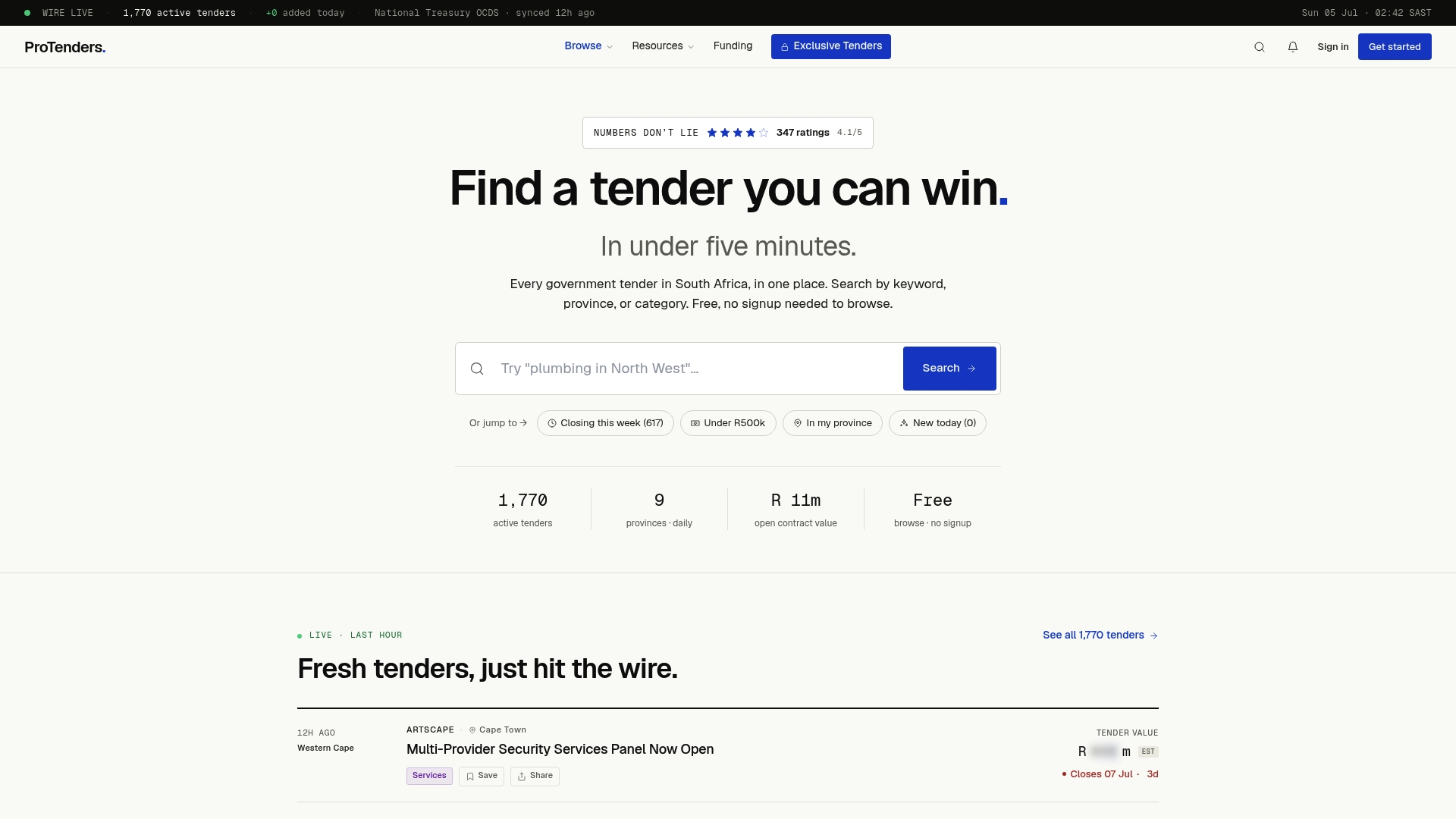
We built ProTenders around the idea that SMMEs need the whole lifecycle, from finding the opportunity to delivering the work, and the briefing sits at the start of that. Seeing every live tender in one place, searchable by keyword, region or category without signing up, means you can check briefing details early rather than discovering a missed session after the fact. Treat the briefing as a real commitment, give it a calendar slot, and send someone who can sign for the company.
— Dolene April
Finding tenders before the briefing passes
The biggest briefing problem is timing. If you find a tender a day before the session, you have a day to arrange travel, authority and questions. If you find it a week before, you have a plan.
ProTenders lists government tenders from national, provincial and municipal buyers, and you can browse and search them free, without creating an account. Paid plans add advanced tools and alerts: Pro is R1 990 per year, Business is R3 990 per year, and Enterprise starts from R999 per month. You can compare them on our pricing page, or start with the government tenders search. If you want a daily nudge instead of a daily search, see our tender alerts.
Sector pages help you focus. If you work in construction, our building tenders page gathers opportunities where site briefings are especially common. Planning ahead? Our procurement plans page shows upcoming opportunities so you can prepare before an advert appears. And if a win needs working capital, the business funding programs page lists options to explore.
FAQ
Can I still bid if I missed a compulsory briefing session?
Usually not. Buyers such as the Department of Water and Sanitation treat attendance as a mandatory requirement, and others state that failure to attend disqualifies the bid. If you think there are grounds, such as the notice being unclear, write to the contact person named in the tender promptly and keep the reply, but do not plan on an exception.
Can someone else attend the compulsory briefing for my company?
Often yes, but only if the tender documents allow it and the person signs in the name of your entity. Documents like SANRAL's tie the attendance list to the tendering entity. Send an employee or authorised representative, carry a letter of authority, and check the wording in your tender first.
What proof of attendance do I need to keep?
The attendance register is the buyer's main record, and some tenders also require a certificate of attendance that you complete, have signed during the session, and return with your bid. Keep a copy of anything you sign, and note the date, venue or link, and the buyer's representative.
What if the briefing is online and my connection fails?
The risk is yours. A CCMA bid document makes bidders responsible for accessing the virtual link. Join early, use your company name, add your details in the chat if asked, and keep a backup connection ready.
Does a non-compulsory briefing matter?
You will not be disqualified for missing it, but you lose the buyer's clarifications and the chance to hear other bidders' questions. For complex or site-based work it is usually worth attending anyway.
Sources
- Land Bank terms and conditions (briefing sessions)
- GCIS tender procedures
- Gauteng Department of Roads and Transport tender advert
- Department of Water and Sanitation compulsory briefing minutes
- Transnet RFP, plant hire
- eTenders request for proposals RFP072.2026
- AEMFC request for proposals AE/VLAK011/2021
- SANRAL tender and contract document
- Port of Cape Town compulsory briefing minutes
- CCMA bid document
- Transnet RFP template, goods