Contract works insurance: a practical guide for SA contractors

Contract works insurance, formally known as Contractors All Risk (CAR) insurance, is a specialist short-term policy that covers physical loss or damage to works-in-progress, materials on site, and third-party liability during construction. On South African projects governed by JBCC, NEC3, GCC, or FIDIC contracts, it is not optional — it is a standard contract requirement. Your immediate next step: pull the insurance schedule from your contract, confirm who must arrange the policy, and get a joint-names quote before you take possession of the site.
Documents to have ready before approaching a broker:- Signed contract or letter of intent showing the contract value (sum insured)
- Project start date, anticipated completion date, and maintenance/defects period
- Site address and description of construction type
- Letter of Good Standing (COIDA registration)
- Claims history for the past three to five years
Key takeaways
Contract works / CAR insurance must be placed in joint names, matched to contract data, and supported by a current COIDA Letter of Good Standing before site possession.
| Point | Details |
|---|---|
| Joint names from day one | JBCC clause 10.1 requires joint-names placement from site possession to practical completion. |
| Match policy to contract data | Sum insured, SASRIA, and defects period must mirror the contract schedule exactly to avoid repudiation. |
| COIDA is non-negotiable | A current Letter of Good Standing is required before work starts and for most tender submissions. |
| Plant needs separate cover | CAR covers the works; mobile plant usually needs a Plant All Risk (PAR) policy or explicit endorsement. |
| Get the full policy wording | A policy schedule is not enough — have a specialist review the full wording against your contract data. |
Table of Contents
- What does contract works / CAR insurance actually cover?
- What CAR policies cover, what they exclude, and what you must request
- What does the JBCC require from your insurance?
- Statutory compliance: COIDA and what you must carry on site
- Single-project CAR policy versus an annual portfolio policy
- How to get a CAR insurance quote: what brokers need and realistic timelines
- How to check your policy wording before you sign
- Common claims pitfalls and how to avoid them
- Where to place CAR cover in South Africa: choosing the right broker
- Tender-ready insurance checklist for SMMEs and bidders
- Protenders helps you bid with confidence
- An honest take on where contractors get this wrong
- Sources
- FAQ
What does contract works / CAR insurance actually cover?
Contractors All Risk insurance is built around one core idea: the contractor carries the risk of the works until practical completion, and the policy must reflect that exposure. The main cover sections are:
- Contract works (the permanent works): physical loss or damage to the structure being built
- Materials and goods: on-site stock, prefabricated elements, and materials in transit to the site
- Temporary works: scaffolding, formwork, site offices, and hoardings
- Surrounding property: accidental damage to adjacent structures or infrastructure
- Public liability: third-party bodily injury or property damage arising from construction activities
- Transit and storage: materials in transit between supplier, storage yard, and site
CAR cover typically runs from site establishment to practical completion. It sits alongside, but does not replace, a Plant All Risk (PAR) policy for mobile plant and equipment. SASRIA cover, which protects against riots, strikes, and public disorder, is a separate endorsement that many government and public-sector contracts require by default.
Why contract forms specify CAR by name: JBCC, NEC3, GCC, and FIDIC each attach insurance schedules that set minimum sums insured line by line. A mismatch between those figures and your policy is not a technicality — under NEC forms it can constitute a breach of contract. The policy must reflect the contract schedule values precisely.*
What CAR policies cover, what they exclude, and what you must request
Core sections and common extensions
Most CAR policies in South Africa offer the sections listed above as standard, with the following extensions available on request or by endorsement:
- SASRIA: riots, strikes, civil commotion, and public disorder — required on most government projects
- Maintenance/defects extension: extends the works cover through the defects liability period after practical completion
- Delay in start-up / advanced loss of profits (DSU/ALOP): covers consequential financial loss if the project is delayed by an insured event
- Hired-in plant: covers plant the contractor rents rather than owns, if not covered by a separate PAR policy
Standard exclusions to watch
CAR policies routinely exclude defective workmanship, design error, wear and tear, and certain high-risk activities. Specifically:
- Defective workmanship or faulty design (the cost to fix the defect itself is excluded; consequential damage to surrounding work may be covered)
- Wear and tear, gradual deterioration, and inherent vice
- Underground or mining works, shaft sinking, and tunnelling unless specifically declared and endorsed
- Vehicles licensed for road use (these fall under motor insurance)
- Plant and heavy equipment unless specifically endorsed or covered by a separate PAR policy
Pro Tip: If your project started before you arranged cover, disclose this immediately. Insurers can issue "take-on" cover for already-started sites, but only if you make full disclosure of the current state of the works, any existing damage, and the value of work already completed. Concealing this is grounds for repudiation. *
What does the JBCC require from your insurance?
The JBCC Principal Building Agreement (Edition 6.2) is the most widely used building contract in South Africa, and its insurance clause is specific. Clause 10.1 requires insurance to be held in the joint names of the employer and contractor from the date of site possession until practical completion. The required covers include:
- Contract works insurance
- Supplementary insurance (riots and strikes — effectively SASRIA)
- Public liability
- Removal of lateral support (where applicable)
Joint-names placement matters because it prevents one party from suing the other's insurer and ensures both parties are protected under the same policy. The employer can ask for proof of insurance at any time, and the contractor must produce the policy schedule, endorsements, and cover notes on request.
On direct contractors: The JBCC advisory note for Edition 6.2 flags a common gap — when an employer appoints direct contractors, the principal contractor's CAR policy may not cover their work. The advisory note recommends the employer take responsibility for insuring direct-contractor works in many cases, to avoid fragmented coverage and recovery disputes across multiple insurers.Practical steps when contract data differs from a standard policy:
- Check whether the contract schedule lists sums insured that exceed the insurer's standard limits and request endorsements accordingly
- Confirm the maintenance/defects period length in the contract data and match it to the policy expiry
- Verify that direct contractors are named or that the employer has arranged separate cover for them
- Ask the insurer to confirm SASRIA inclusion in writing if the contract requires it
Statutory compliance: COIDA and what you must carry on site
Beyond the contract itself, South African law imposes its own insurance obligations. All contractors and subcontractors must register under the Compensation for Occupational Injuries and Diseases Act (COIDA) and maintain a current Letter of Good Standing. Without it, work cannot legally commence on most sites, and many principal contractors will turn subcontractors away at the gate.
The Occupational Health and Safety Act and the Construction Regulations also require contractors to maintain a health and safety file on site, which typically includes:
- Current Letter of Good Standing (COIDA)
- CAR policy schedule showing joint-names placement
- Public liability certificate of insurance
- Any SASRIA endorsement if required by the contract
On public liability limits: Contract schedules vary, but many government and municipal projects specify a minimum of R10 million or R20 million in public liability cover. Check your specific contract schedule — the figure is stated there, not in a standard policy default. Construction and engineering law resources confirm that public liability and contract works insurance are both commonly required, alongside compulsory COIDA compliance.
Your CIDB registration grade also affects which contracts you can bid on, and insurance compliance is part of the pre-qualification picture.
*Single-project CAR policy versus an annual portfolio policy
The choice between a project-specific policy and an annual CAR policy is mostly a volume question, but the compliance implications differ.
A single-project (project-specific) policy is priced on the specific contract value, duration, and risk profile of one project. It is the right choice when:
- A tender or contract requires project-specific wording with the exact contract data on the schedule
- The project is high-value or has unusual risk characteristics (unusual construction type, remote location)
- You are a one-off or occasional contractor without a regular pipeline
An annual (portfolio) CAR policy covers multiple projects up to a declared maximum contract value per project and an annual aggregate. Premiums are calculated on projected annual turnover and maximum single-contract value. The advantages are real: you do not risk forgetting to insure a new site, administration is simpler, and for contractors running three or more projects simultaneously, the cost per project is usually lower.
| Point | Single-project policy | Annual portfolio policy |
|---|---|---|
| Best for | One-off or high-value projects | Contractors with multiple concurrent projects |
| Who arranges | Employer or contractor per contract | Contractor arranges; employer noted as joint insured |
| Cost shape | Priced per contract value and duration | Based on annual turnover and max contract value |
| Flexibility | Wording tailored to one contract | Declarations required per new project; check limits |
| Common pitfall | Forgetting to renew or extend for defects period | Maximum contract value cap — declare large projects separately |
How to get a CAR insurance quote: what brokers need and realistic timelines
Getting a quote is straightforward if you arrive with the right information. Brokers and underwriters need the following to price a CAR policy:
Step-by-step quote checklist:- Contract value (sum insured for the works)
- Full project description: construction type, materials, number of storeys
- Site address and province
- Contract start date and anticipated completion date
- Maintenance/defects liability period (in months)
- Contractor details: company name, CIDB grade, years in operation
- Claims history: any CAR or public liability claims in the past three to five years
- Letter of Good Standing (COIDA)
- Any special requirements from the contract schedule (SASRIA, DSU/ALOP, direct contractors)
How to check your policy wording before you sign
Receiving a policy schedule is not the same as having the right cover. Before accepting any CAR policy, work through this checklist:
Policy wording checklist:- Joint names: confirm both the employer and contractor are named as joint insureds, not just the contractor
- Sum insured: matches the contract value in the contract schedule, including escalation if the contract runs more than 12 months
- SASRIA: included and confirmed in writing if the contract requires it
- Maintenance/defects extension: expiry date matches the defects liability period in the contract data
- Public liability limit: meets or exceeds the minimum stated in the contract schedule
- Plant and hired-in plant: confirm whether covered under this policy or excluded and needing a separate PAR policy
- Direct contractors: confirm whether their works are covered or excluded
- Who is the appointed claims adjuster, and what is the claims notification period?
- How are deductibles applied when both joint-named parties have a claim?
- Does the policy cover removal of debris and professional fees, or are these sub-limited?
- Is the policy wording acceptable to the employer's legal team or funder?
Proof of insurance and the full policy wording must be available to the employer on request under JBCC — so having the document ready is not just good practice, it is a contract obligation.
*Common claims pitfalls and how to avoid them
Most CAR claim disputes in South Africa trace back to a handful of avoidable errors.
The most common reasons claims are rejected or reduced:- Sum insured mismatch: the policy was placed at a lower contract value than the actual works, leaving the contractor underinsured at the time of loss
- Non-disclosure on take-on: existing damage or partially completed works were not disclosed when cover was arranged
- Incorrect joint names: the employer is not named, or the name differs from the contract — insurers can use this to limit recovery
- Missing SASRIA: a riot or strike event occurs and the contractor assumed SASRIA was included when it was not
- Plant vs. works confusion: mobile plant is damaged or stolen and the contractor discovers it is not covered by the CAR policy because no PAR endorsement was arranged
Where to place CAR cover in South Africa: choosing the right broker
The South African CAR insurance market is served by a mix of specialist construction brokers and general commercial brokers with construction desks. The difference matters. A specialist broker understands JBCC clause numbering, knows which insurers are on municipal and government-approved panels, and can issue a cover note quickly when site possession is imminent.
When evaluating a broker, look for:
- Demonstrated experience placing CAR policies on South African construction projects of similar size and type
- Access to insurers accepted by municipalities, development finance institutions, and government departments
- Ability to arrange project-specific and annual portfolio policies
- In-house claims support or a named claims contact
Providers such as CivilSure, MBFS (MB Financial Services), and Hallmark Risk & Financial Services operate in the South African construction insurance space and offer CAR-specific products. CivilSure publishes detailed CAR policy explainers that are worth reading alongside your policy wording. Hallmark Risk & Financial Services offers CAR placement with broker support. For general insurance intermediary services that include CAR placements and JBCC compliance guidance, StappInsurance is another option worth considering.
Before you rely on a product summary page: always request the full policy wording. Product pages and brochures describe cover in general terms; the actual policy document defines what is and is not covered in your specific situation. A specialist broker should be able to walk you through the wording clause by clause against your contract data.*
Tender-ready insurance checklist for SMMEs and bidders
Winning a government tender and then losing it at compliance verification because your insurance documentation is incomplete is a painful and avoidable outcome. Use this checklist to make sure your submission is ready.
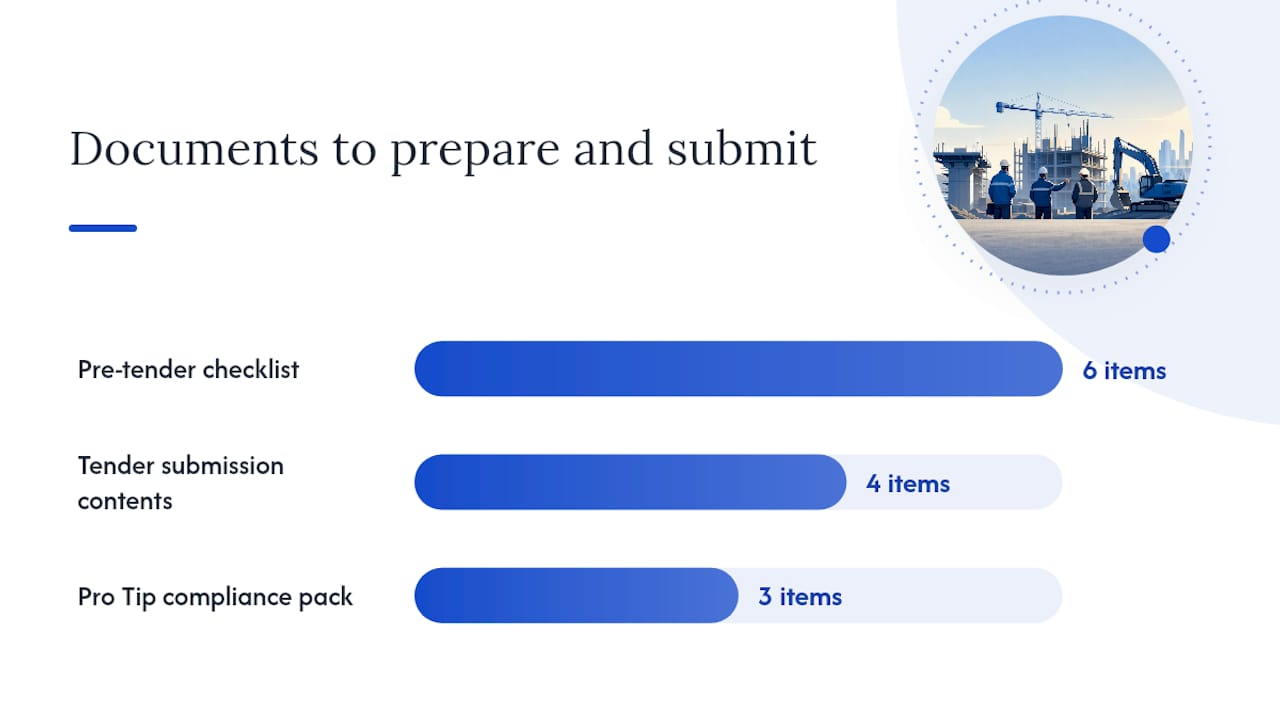
Numbered checklist for tender submissions:- Obtain a current Letter of Good Standing from the Compensation Fund (COIDA) — renew it before it expires, not after
- Arrange a CAR policy in joint names with the employer (or confirm the employer is arranging it and you will be noted)
- Confirm SASRIA is included if the contract schedule or tender document requires it
- Obtain a public liability certificate showing the minimum limit stated in the contract schedule
- Get a cover note or policy schedule from your broker confirming placement
- Scan all documents and keep digital copies ready for upload or email
- Copy of the CAR policy schedule or cover note, showing joint names and sum insured
- Letter of Good Standing (not older than the validity period stated in the tender document)
- Public liability certificate
- A short cover note (one paragraph) mapping each insurance clause in the contract data to the corresponding document you are submitting
For SMMEs looking at smaller contract values, SME tender opportunities under R1 million are listed on Protenders and often have proportionally simpler insurance requirements — a good starting point if you are building your compliance track record.
 *
*
Protenders helps you bid with confidence
Getting your insurance right is one part of winning government construction tenders. Finding the right tenders, submitting compliant bids, and tracking your pipeline is the other part. Protenders aggregates live government tenders from national, provincial, and municipal buyers across South Africa, so you can search by keyword, region, or category without signing up. Compliance scorecards, document templates, and bid workspaces mean you arrive at submission with everything in order, including your insurance documentation.
*An honest take on where contractors get this wrong
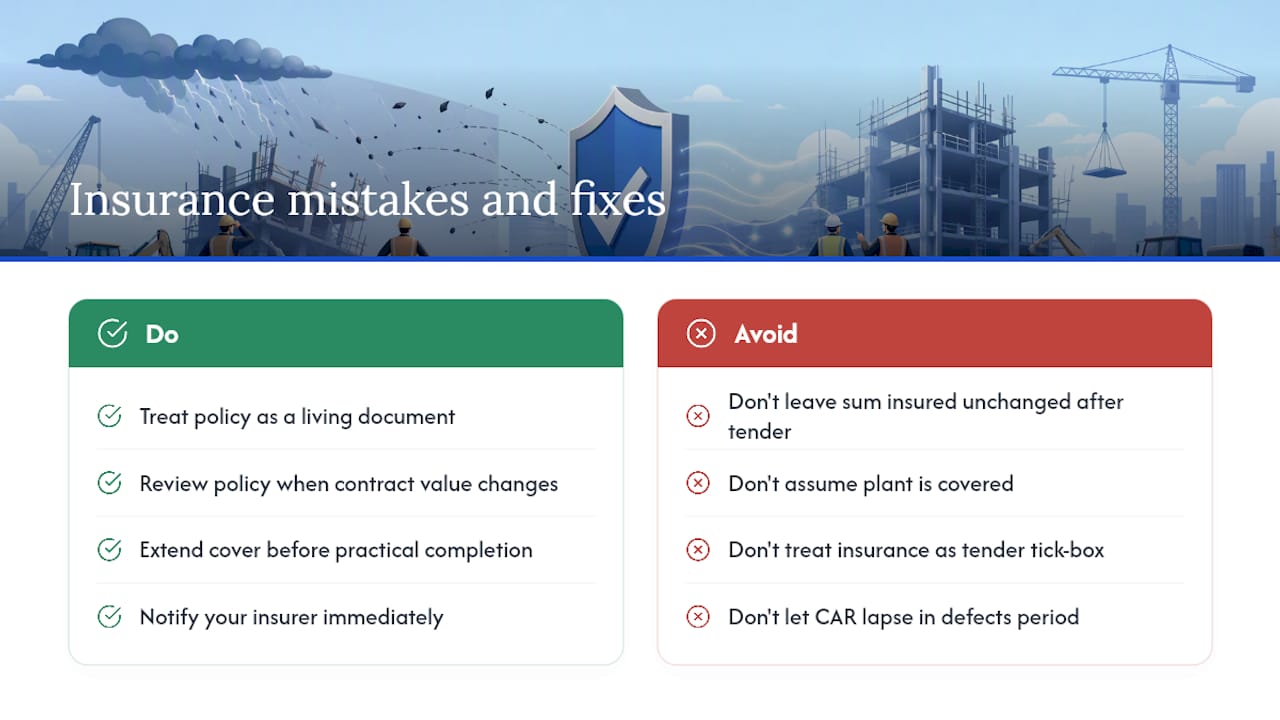
Most contractors who run into CAR insurance problems did not choose the wrong policy. They chose the right policy and then failed to keep it aligned with the contract. The sum insured was set at tender stage and never updated when the contract value changed. The defects extension was not requested. The plant was assumed to be covered. These are not insurer tricks — they are administrative gaps that compound over the life of a project.
The other pattern worth naming: contractors who treat insurance as a box to tick for tender submission and then forget about it. The Letter of Good Standing expires mid-project. The CAR policy lapses during the defects period. A claim arises and the documentation is thin. The insurer does not need to be adversarial to reduce a payout — the contractor's own record-keeping does the work for them.
What actually protects you is treating the policy as a living document. Review it when the contract value changes. Extend it before practical completion if the defects period is not yet covered. Keep your COIDA registration current. And when something goes wrong on site, notify your insurer immediately — late notification is one of the most common grounds for reduced settlements, and it is entirely within your control.
The construction insurance market in South Africa has specialist brokers who understand JBCC clause numbering and municipal approval panels. Use one. A generalist broker who places your CAR policy alongside your office contents and vehicle fleet is not the right fit for a R15 million building contract.
*This article is general information, not a substitute for advice from a qualified financial advisor. Consult a qualified financial professional about your own circumstances before acting on anything here.
Sources
Primary sources worth bookmarking for contract and statutory verification:
- What Is Contractors All Risk Insurance? A Guide for SA Contractors
- Principal building Agreement edition 6.2 (June 2024)
- JBCC advisory note edition 6.2
- Construction & Engineering Laws and Regulations Report 2025 - 2026 South Africa
*
FAQ
What is the difference between contract works insurance and Contractors All Risk insurance?
They refer to the same product. "Contract works insurance" describes what the policy protects (the works under construction), while "Contractors All Risk" is the industry term for the policy class. Both names appear in South African contracts and broker documentation.
Who arranges CAR insurance — the employer or the contractor?
Under the JBCC Principal Building Agreement, the contractor typically arranges the policy, but it must be held in the joint names of both parties. For direct contractors appointed by the employer, the JBCC advisory note recommends the employer arrange cover to avoid fragmented liability.
What is a Letter of Good Standing and why do you need it?
A Letter of Good Standing is proof that a contractor is registered and up to date with COIDA (Compensation for Occupational Injuries and Diseases Act) contributions. It is required by law before work starts on most South African construction sites and is a standard document in government tender submissions.
Does CAR insurance cover plant and equipment?
Not automatically. CAR policies cover the works being constructed; mobile plant and heavy equipment usually require a separate Plant All Risk (PAR) policy or a specific endorsement to the CAR policy. Confirm this with your broker before mobilising.
What happens to CAR cover after practical completion?
Standard CAR cover ends at practical completion. If the contract includes a defects liability period, you need a maintenance or defects extension on the policy to remain covered for damage that occurs during that period. Without it, the contractor carries uninsured exposure until the defects certificate is issued.