How to find subcontractors in South Africa: 2026 guide

The fastest way to find subcontractors in South Africa is to search three channels in parallel: Protenders for compliance-ready tender and subcontractor discovery, Bidly for marketplace-style project posting, and the cidb i-Tender service for public-sector opportunities. Before you call anyone, request their COIDA letter of good standing, SARS tax clearance, and Certificate of Insurance. Those three documents separate serious subcontractors from the rest in under 24 hours.
Start here:
- Protenders: Search by keyword, region, or trade category to surface pre-qualified subcontractors and live government tenders without signing up first.
- Bidly: Post your project scope and collect competitive bids from vetted contractors across South Africa, including cross-border into Lesotho, Botswana, and Namibia.
- cidb i-Tender / Government Tender Bulletin: The primary public-sector channel for subcontracting opportunities on government works.
- Referrals and jobsite walk-throughs: Still the most reliable route for specialist trades on private projects. Ask your site foreman who they have seen do clean work on nearby sites.
Verify compliance before any conversation about price. A subcontractor who cannot produce a current COIDA letter is a liability risk you carry as the prime contractor. *
Table of Contents
- Where should you search for subcontractors in South Africa?
- What documents should you request before hiring a subcontractor?
- How do you invite and score subcontractor bids?
- What are the standard payment terms for subcontractors in South Africa?
- What contracts and CIDB subcontractor types do you need to know?
- How do you onboard and manage subcontractors effectively?
- Key takeaways
- Why relationships and pre-qualification pay off more than you think
- Protenders gives you a compliance-first head start on subcontractor discovery
- Useful sources and further reading
- FAQ
Where should you search for subcontractors in South Africa?
The right channel depends on your project type, timeline, and whether the work is public or private. Public-sector opportunities flow through the Government Tender Bulletin and cidb i-Tender, while private work is won through relationships, marketplaces, and trade networks. Here is how the main channels compare:

| Channel | Speed | Compliance trust | Reach | Cost |
|---|---|---|---|---|
| Protenders (tender & sub discovery) | Fast | High (compliance scorecards built in) | National, all sectors | Freemium |
| Bidly (marketplace) | Fast | Medium (vetted, not pre-qualified) | National + cross-border | Free to post |
| cidb i-Tender / Gov Tender Bulletin | Moderate | High (public-sector standard) | National, public works | Free |
| Trade associations / professional forums | Slow | Medium (member-based, self-reported) | Trade-specific | Membership fee |
| Local municipality tender boards | Slow | High (formal procurement) | Local/regional | Free |
| Referrals and jobsite walk-throughs | Immediate | Variable (depends on your network) | Local | Free |
- Protenders works best when you need a searchable subcontractor database with compliance visibility and want to cross-reference tender opportunities at the same time. It is the most efficient starting point for contractors who run multiple projects simultaneously. For a broader view of top platforms for finding tenders and quotations in South Africa, Protenders covers the comparison in detail.
- Bidly suits project owners who want to post a scope and let the market come to them. Good for civil, building, and fit-out work where price competition is the primary driver.
- cidb i-Tender and the Government Tender Bulletin are non-negotiable for public works. According to cidb contractor management guidelines, these are the designated channels for public procurement notices, and subcontracting opportunities on government contracts originate here.
- Trade associations (Master Builders South Africa, ASAQS, CESA) are worth joining if you repeatedly need specialist subcontractors in a specific discipline. Members tend to be more professionally accountable.
- Referrals and site walk-throughs remain the gold standard for private residential and commercial work. If you see a tiling crew finishing a floor cleanly on a neighbouring site, that is a better signal than any online profile.
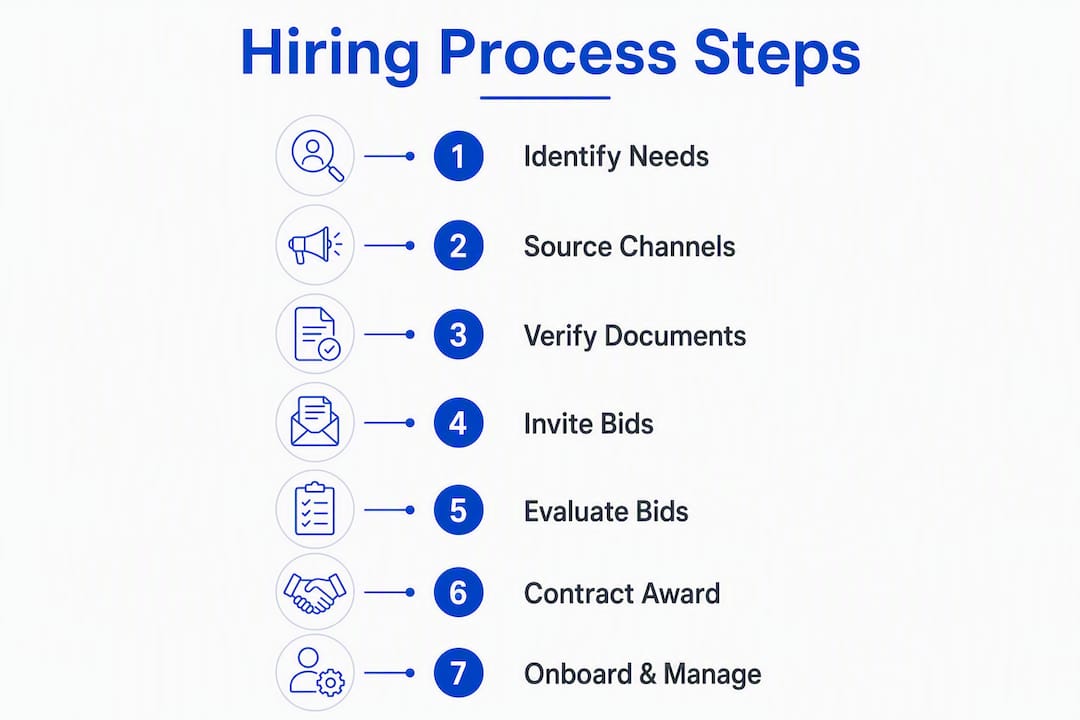
What documents should you request before hiring a subcontractor?
South Africa's construction sector has specific compliance obligations, and the prime contractor carries the risk when a subcontractor falls short. Even where CIDB registration is not mandatory for a subcontractor, you remain accountable on public contracts. Request these documents before any work begins:
- COIDA letter of good standing — confirms the subcontractor is registered with the Compensation Fund and current on contributions. Expires annually; check the date.
- CIPC company registration — confirms the entity is legally registered. Check at cipc.co.za in minutes.
- CIDB grading certificate (where required) — subcontractors are not required to register on the CIDB Register of Contractors in most cases, but when the main contract requires it, verify the grade on the official CIDB website. The CIDB website is the only reliable method for authenticating registration status.
| Document | Where to verify | Typical turnaround / expiry |
|---|---|---|
| COIDA letter of good standing | Compensation Fund / Department of Labour | Annual renewal; check issue date |
| SARS tax clearance | SARS eFiling portal (PIN verification) | Valid 1 year from issue |
| CIDB grading | cidb.org.za (official portal only) | Grade 1: quick online process; higher grades: several working days at provincial office |
| CIPC registration | cipc.co.za | Immediate online check |
| COI | Contact insurer directly | Policy renewal date on certificate |
| B-BBEE certificate | SANAS-accredited verification agency | Annual for verified; EME/QSE affidavit valid 12 months |
Red flags to act on immediately: no paperwork at all, references who cannot recall the project details, expired documents presented as current, and any reluctance to sign a written subcontract. That last one is the clearest signal of a subcontractor who has had disputes before. Pro Tip: Cross-check CIDB status on cidb.org.za rather than relying solely on a third-party verification tool. Third-party services draw from the central CIDB register, but the official portal is always the most current source. For high-value subcontracts, a paid background check through a service like GovChain adds a second layer of confirmation in a fraction of the time it takes to chase documents manually. *
How do you invite and score subcontractor bids?
A structured invitation process protects you from selecting on price alone and gives you defensible records if a dispute arises later.
The invitation-to-quote template
Send this via email or WhatsApp, and attach the scope of work document:
Subject: Invitation to Quote — [Project Name / Reference Number]>
We are inviting your company to submit a quote for the following scope of work on [Project Name], located at [Site Address], with a planned start date of [Date].>
Scope summary: [2–3 sentences describing the trade, quantities, and key deliverables]>
Please include in your submission:>
— Itemised pricing (labour and materials separated where applicable)
— Proposed programme / timeline
— Names and contact details of two recent references for similar work
— Copies of: COIDA letter, COI, SARS tax clearance, CIPC registration
Submission deadline: [Date and time]>
Site inspection: [Date and time — attendance mandatory / optional]
Queries: [Your name, phone number, email]
Bid evaluation process
- Send invitations to at least three subcontractors per trade.
- Hold a site inspection within five working days of the invitation. Attendance tells you something about seriousness.
- Set a firm submission deadline. Late bids without prior notice are a signal of poor scheduling discipline.
- Score each bid against four criteria: technical capacity (40%), price (30%), safety record and compliance (20%), responsiveness (10%).
- For any bid more than 15% below the next lowest, ask the subcontractor to walk you through their labour and material assumptions line by line. A low-ball bid that cannot be explained usually means missing scope, underpriced labour, or a plan to claim variations later.
- Award in writing, referencing the accepted quote number and any clarifications agreed during negotiation.
What are the standard payment terms for subcontractors in South Africa?
Payment structure is where most subcontracting relationships break down. Getting it right upfront costs nothing; fixing it mid-project costs time, money, and often the relationship.
Common pricing models:- Fixed price (lump sum): — Best for well-defined scopes. The subcontractor carries the risk of underestimating. Requires a detailed scope of work document before signing.
The Government Standard for minimum requirements for engaging contractors and subcontractors sets a clear benchmark: payment must be made no later than 30 days after a valid claim is submitted. Private-sector contracts often negotiate 45 or 60 days, but pushing beyond 30 days creates cash-flow pressure that leads to subcontractors cutting corners or abandoning site.
Practical negotiation points: *What contracts and CIDB subcontractor types do you need to know?
Written contracts are not optional. The Government Standard explicitly requires a written subcontract between the principal contractor and every subcontractor, and recommends using standard forms with minimal amendments. The recognized forms in South Africa are the CIDB standard subcontract (GCSC), JBCC NSSA, NEC subcontracts, and FIDIC conditions where applicable. Using a standard form reduces disputes and aligns payment timing and liability provisions with industry norms.
CIDB subcontractor types (as defined in cidb contractor management guidelines and FIDIC PN07):- Domestic subcontractor: Selected entirely by the prime contractor. The prime carries full responsibility for their performance. Most private-sector subcontracting falls here.
- Nominated subcontractor: Specified by the employer or engineer. The prime contractor must accept them but retains liability for their work. Negotiate carefully — you are accountable for someone else's choice.
- Selected subcontractor: Chosen from a pre-approved list provided by the employer. The prime has some selection discretion but is still responsible for performance.
- Detailed scope of work with drawings and specifications referenced by revision number
- Payment schedule tied to milestones, with the 30-day payment window stated explicitly
- Safety and compliance obligations (OHS Act compliance, site induction requirements)
- Warranties and defects liability period (typically 12 months from practical completion)
- Dispute resolution mechanism (adjudication or mediation before arbitration)
- Termination for non-performance clause with notice periods and step-in rights
How do you onboard and manage subcontractors effectively?
The gap between a good subcontractor and a great project outcome is almost always in the first two weeks. What happens before the first tool hits the ground determines whether delivery stays on programme.
Pre-start checklist:- Signed subcontract on file before day one — no exceptions
- Insurance certificates and COIDA letter physically on site (not just emailed)
- Nominated supervisor identified and contact details shared with your site team
- Site induction completed and signed off (OHS Act requirement)
- Toolbox talk schedule agreed for the first month
- Initial KPIs set: daily output targets, quality hold points, and reporting format
- Weekly site meeting with written minutes (even a WhatsApp voice note summary counts if it is documented)
- Fortnightly compliance document check: confirm insurance and COIDA have not lapsed
- Monthly payment certificate tied to measured progress, not goodwill
- Documented corrective action for every quality or safety non-conformance
Key takeaways
Finding and hiring a compliant subcontractor in South Africa comes down to using the right channels, verifying the right documents, and locking in the right contract before work starts.
| Point | Details |
|---|---|
| Start with three channels | Search Protenders, Bidly, and cidb i-Tender simultaneously to cover public and private sector opportunities. |
| Verify compliance first | Request COIDA, COI, and SARS tax clearance before any price discussion; the prime contractor carries the risk if a sub is non-compliant. |
| Use standard contract forms | GCSC, JBCC NSSA, NEC, or FIDIC subcontracts reduce disputes and align payment terms with the 30-day Government Standard. |
| Score bids objectively | Weight technical capacity (40%), price (30%), safety/compliance (20%), and responsiveness (10%) to avoid selecting on price alone. |
| Protenders for compliance-first discovery | Protenders aggregates live South African tenders and provides compliance scorecards, making it the fastest starting point for contractors running multiple projects. |
Why relationships and pre-qualification pay off more than you think
The conventional wisdom in subcontractor sourcing is to cast the net wide and take the lowest compliant bid. That approach works once. It rarely builds the kind of subcontractor pool that makes you competitive on the next bid.
Here is what the data and experience actually show: the cost of onboarding an unvetted subcontractor who fails mid-project is not just the remedial work. It is the delay claim from your client, the insurance excess on any incident, the time your project manager spends managing the fallout instead of the programme, and the reputational damage that follows a late handover. A single bad subcontractor appointment on a R5 million contract can absorb the margin on the entire project.
Contrast that with a subcontractor you have worked with twice before, whose COIDA and insurance you already have on file, whose supervisor knows your site standards, and who you can call at 7 AM on a Monday and get a straight answer. That relationship has a value that does not appear on any tender scorecard.
The contractors who consistently win and deliver government work treat pre-qualification as an ongoing process, not a once-off checklist. They keep a live register of vetted subcontractors, update compliance documents annually, and conduct post-project reviews that feed back into the next selection decision. A 30-minute debrief after practical completion, asking what worked and what did not, is worth more than any amount of pre-bid due diligence.
The upfront investment in verification and a trial scope is not a cost. It is the cheapest insurance you can buy on a construction project.
*Protenders gives you a compliance-first head start on subcontractor discovery
Tracking down subcontractors across fragmented sources, chasing compliance documents, and cross-referencing CIDB status manually takes hours you do not have when a bid deadline is three days away.
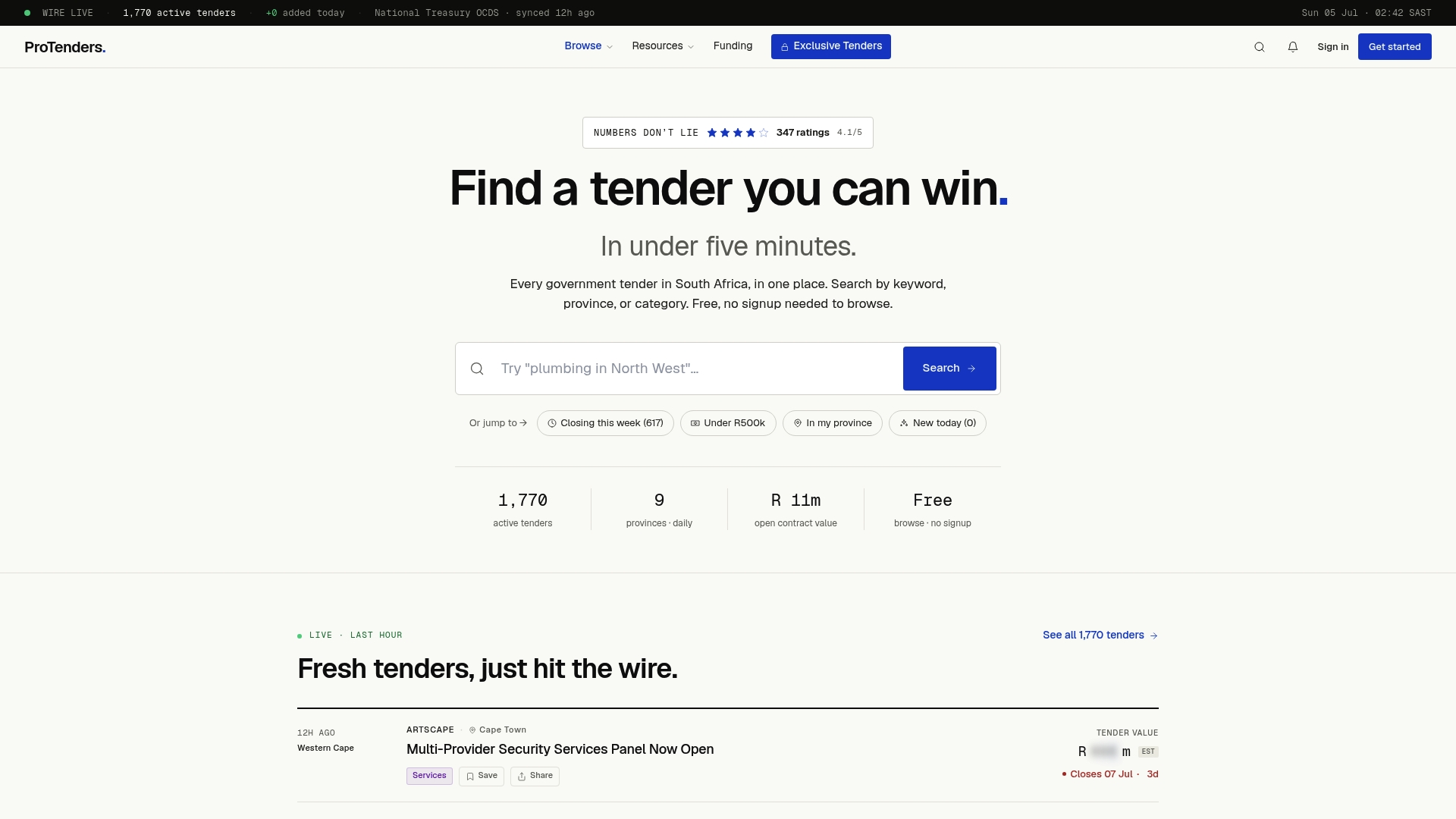
Protenders aggregates all live South African government tenders from national, provincial, and municipal buyers into a single searchable platform, and layers compliance scorecards and document templates on top of the discovery process. You can search by keyword, region, or trade category without signing up, and when you are ready to go deeper, the platform's bid workspace and automated alerts keep your pipeline moving without the administrative drag.
For contractors who need to find and pre-qualify subcontractors quickly, Protenders removes the two biggest friction points: fragmented tender sources and missing compliance documents. Start searching on Protenders and see which subcontractors and opportunities are live in your region right now.
*Useful sources and further reading
These are the primary sources to bookmark for subcontractor compliance and procurement in South Africa:
- cidb Register of Contractors overview: — The authoritative source for CIDB registration status, grading levels, and processing timeframes. Use this to verify any subcontractor's CIDB grade before awarding a contract.
- Government Standard for minimum requirements for engaging contractors and subcontractors: — Sets the mandatory floor for written contracts, COIDA compliance, and the 30-day payment rule. Download and keep a copy; it is the reference document for any dispute about payment timing or contractual minimums.
- cidb Contractor Management Guidelines 2026: — Covers subcontractor types (domestic, nominated, selected), public procurement channels, and contractor management best practice. Useful for understanding your obligations on public-sector projects.
- Protenders blog: how to find government tenders in South Africa: Practical walkthrough of tender discovery workflows, useful for contractors who are new to public procurement or want to systematize their search process.
- Protenders blog: construction tenders in South Africa: Covers how to assemble a competitive team, including subcontractor selection, to improve bid success rates on construction tenders.
*
FAQ
Is there a website for finding subcontractors in South Africa?
Yes. Protenders, Bidly, and the cidb i-Tender service are the primary online channels. Protenders offers a searchable subcontractor and tender database with compliance scorecards; Bidly connects project owners with vetted contractors through competitive bidding.
Who typically hires subcontractors on construction projects?
Prime or main contractors hire subcontractors to fill specialist trade gaps or meet capacity requirements on a specific project. On public-sector contracts, the prime contractor remains fully accountable for subcontractor performance and compliance, even when the subcontractor is nominated by the employer.
How much should a contractor pay a subcontractor in South Africa?
Rates vary significantly by trade, region, and project complexity. The Government Standard requires payment within 30 days of a valid claim. Always obtain at least three local quotes; Gauteng, Western Cape, and KwaZulu-Natal rates for the same scope can differ by 20–30%.
Is there an app for managing subcontractor compliance?
Protenders provides a web-based platform with compliance scorecards and document templates that contractors can use to track subcontractor pre-qualification status. For on-site document management, platforms like Subcontractor.co.za offer a Compliance Passport that consolidates key documents and their expiry dates in one place.
Does a subcontractor need to be CIDB-registered?
In most cases, no. The CIDB Register currently covers prime and main contractors only; subcontractors and labour-only contractors are generally exempt. However, the prime contractor must still verify compliance through COIDA, insurance, and tax clearance documents, and some public contracts specify CIDB registration as a condition for subcontractors.
Recommended
- How to Find Government Tenders in South Africa (2025 Complete Guide) | ProTenders
- How to get government tenders in south africa: 2026 Guide | ProTenders
- How to Apply for a Tender in South Africa: Step-by-Step (2026) | ProTenders
- How can I find open government tenders in South Africa? : 2026 Guide | ProTenders