Method statement tender guide for South African contractors

A tender method statement is your task-by-task plan that proves you can deliver the work safely, on time, and to specification. Evaluators read it to answer one question: does this contractor actually know what they are doing? Get it right, and it scores you functionality points across approach, H&S, programme, and quality criteria. Get it wrong, and no price will save you.
Every compliant method statement needs these six elements:
- Scope and deliverables — what you are doing and what is excluded
- Sequence of works — mobilisation through to demobilisation, with milestone dates
- Resources and plant — crew structure, key CVs, plant list, subcontractor roles
- Risk identification and controls — each significant risk mapped to a specific, measurable control
- Health and safety appointments — legal appointments under the Construction Regulations 2014 and site-specific controls
- Quality checks — inspection hold-points, test regimes, and linked procedures
Evaluators call the risk-to-control mapping "see-through" planning. When they can trace every hazard straight to a named control and a responsible person, it signals competence. A vague statement like "appropriate safety measures will be applied" tells them nothing and scores nothing. Pro Tip: Open with a three-line executive summary or "approach paper" paragraph before any section heading. State what you are building, how long it will take, and your single biggest risk and how you will manage it. This paragraph alone can secure functionality points before the evaluator reads further. *
Key takeaways
A winning method statement maps every significant risk to a specific, named control and a responsible person — that single behaviour drives more functionality points than any other drafting decision.
| Point | Details |
|---|---|
| See-through risk mapping | Link every hazard to a specific control, monitoring method, and named responsible person — vague controls score zero. |
| Legal appointments are mandatory | Name your Construction Manager, H&S Officer, and First Aider with registration numbers, referencing Construction Regulations 2014. |
| Programme consistency | Cross-check every activity duration in the method statement against your Gantt before submission — contradictions are a common red flag. |
| Evidence wins points | Attach CVs, ISO certificates, CIDB registration, and insurance for every claim you make in the document. |
| Protenders templates | Use Protenders' compliance scorecards and method statement templates to check your returnable against evaluation criteria before you submit. |
Table of Contents
- What role does a method statement play in a tender submission?
- What must you include in a tender method statement?
- Which South African laws and standards must you reference?
- How do evaluators score your method statement?
- What does a South African method statement skeleton look like?
- Common mistakes that cost you points
- Pre-submission checklist for your method statement
- What evaluators actually want (and what most bidders miss)
- Protenders gives you the templates and live tenders in one place
- Useful sources
- FAQ
What role does a method statement play in a tender submission?
A method statement is not the same as your approach paper, your H&S plan, or your programme — though all four must align. Think of it as the operational backbone that the other documents hang off. The approach paper states your methodology at a high level; the method statement proves it activity by activity.
According to OCPO's Standard for Infrastructure Procurement and Delivery Management, returnable documents sit in Volume 2 (T2) of the tender pack. That is where your method statement lives, alongside the list of returnable schedules that tenderers must complete and sign. The CIDB's procurement document guidance reinforces this partition: Tender Documents (T1) contain the invitation and data; Returnable Documents (T2) contain everything the bidder completes, including method statements, programmes, and CVs.
A method statement must convince evaluators of four things:
- Feasibility — your sequence is logical and achievable within the stated programme
- Safety — legal appointments are made and site-specific controls are in place
- Resourcing — you have the people, plant, and subcontractors to execute
- Quality — you have defined inspection points and test regimes, not just good intentions
Tender prompts that typically trigger a method statement requirement include:
- "Provide a detailed method statement for each major activity"
- "Submit an approach paper not exceeding 20 pages"
- "Complete Returnable Schedule X: Construction Methodology"
- "Provide evidence of your H&S management system and site-specific plan"
- "Describe your quality assurance and inspection regime"
If the tender references any of these, a method statement is mandatory. Missing it, or submitting a generic one copied from a previous bid, is one of the fastest ways to score zero on functionality. *
What must you include in a tender method statement?
The official eTenders method-statement template provides the baseline structure South African organs of state expect. Use it as your starting point, then expand each section to match the specific scope. Here is every section you need, with notes on what to put in each:
| Section | What to include | Evidence to attach |
|---|---|---|
| Title / version / approvals | Document title, revision number, date, author, reviewer, approver signatures | Signed cover page |
| Scope and deliverables | What is included and explicitly excluded; reference to the employer's scope of works | Tender drawings or BOQ reference |
| Sequence of works | Step-by-step activity list from mobilisation to demobilisation; reference milestone dates | Gantt chart or bar programme |
| Resources and plant | Crew structure by trade, key personnel CVs, plant list with capacities, subcontractor roles and supplier lead times | CVs, plant certificates, subcontractor letters |
| Risk identification and controls | Each significant risk mapped to a specific control, monitoring method, and responsible person | Risk register |
| Health and safety | Legal appointments (Construction Manager, H&S Officer, First Aider), reference to OHS Act 85 of 1993 and Construction Regulations 2014, site-specific controls, training records | H&S plan, appointment letters, training matrix |
| Quality management | Inspection and test plan, hold-points, non-conformance procedure, linked quality procedures | ITP, ISO certificate if held |
| Environment and waste | Waste management plan, spill controls, statutory references (NEMA, NEMWA) | Environmental method statement |
| Interfaces and temporary works | Traffic management, lifting plans, exclusion zones, permits required | Lifting plan, TMP |
| Document list | All attachments listed with page references | Combined annex index |
For minor tasks, one paragraph plus a simple sketch is enough. For high-risk activities like work at height, confined space entry, or deep excavation, go deeper: a full risk register page, a method diagram, and named responsible persons.
 *
*
Which South African laws and standards must you reference?
South African tender evaluators expect to see specific legal and standards references, not generic mentions of "applicable legislation." Here is what to cite and where.
Core legal references:- Occupational Health and Safety Act 85 of 1993 — cite in your H&S section as the governing legislation. Reference the specific regulations that apply to your scope (Construction Regulations 2014, General Safety Regulations, etc.).
- OCPO Standard for Infrastructure Procurement and Delivery Management — defines the returnable schedules and tender volumes that organs of state must use. Knowing this standard helps you anticipate what the employer's Volume 2 will require.
If the tender references FIDIC conditions of contract (common in donor-funded or international projects), cite the relevant FIDIC clause when describing your contractual obligations. Most South African public-sector tenders use GCC 2015 rather than FIDIC, so check the contract data before citing it.
Key standard to cite in every construction method statement: Regulation 7 of the Construction Regulations 2014 requires the Principal Contractor to prepare a Health and Safety Plan before work commences. Reference this regulation by number in your H&S section and attach the plan or a summary as an annex.Pro Tip: Cite standards by clause number, not just by name. "Construction Regulations 2014, Regulation 7(1)(a)" is more credible than "the Construction Regulations." One sentence per standard is enough — state what the standard requires and how your method statement complies. *
How do evaluators score your method statement?
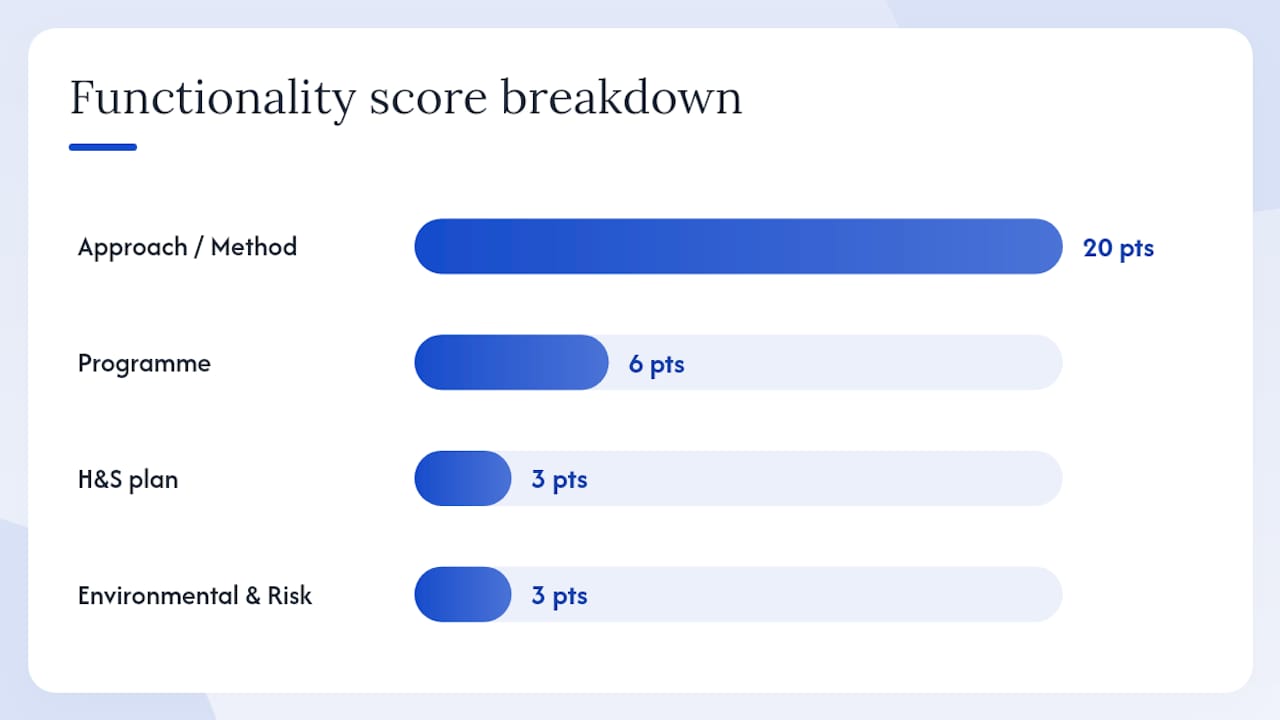
The University of South Africa's tender specification illustrates a common scoring architecture: approach paper / method statement 20 points, programme 6 points, H&S plan 3 points, environmental and risk management plan 3 points. That is 32 points on functionality before price is even considered. Lose half of those to a generic submission and you are unlikely to recover.
| Evaluation criterion | What evaluators look for | How to demonstrate it |
|---|---|---|
| Approach / methodology | Project-specific sequence, logical activity order, realistic assumptions | Activity-by-activity narrative + Gantt |
| Programme | Realistic durations, milestone dates, resource loading | Bar programme or CPM schedule with resource histogram |
| H&S plan | Legal appointments named, site-specific controls, reference to Construction Regulations 2014 | Signed H&S plan, appointment letters, ISO 45001 certificate if held |
| Environmental and risk management | Identified risks mapped to controls, NEMA references, waste management | Risk register, environmental method statement |
| Experience and CVs | Similar projects completed, key personnel qualifications, CIDB grading | CVs with project lists, CIDB registration certificate |
| Quality management | ITP, hold-points, non-conformance procedure | ITP document, ISO 9001 certificate if held |
- A project-specific H&S plan (not a generic company document)
- Named legal appointments with registration numbers
- A realistic programme tied to the method statement activities
- ISO 45001 or ISO 9001 certification attached as evidence
- CVs that reference similar projects by name, value, and your CIDB grading
Vague control: "Safety measures will be implemented for all high-risk activities."
See-through control: "Work at height above 2 m: scaffolding erected to SANS 10085 by certified scaffolding contractor; fall arrest harnesses worn at all times; exclusion zone demarcated with barrier tape; weekly scaffold inspection by H&S Officer (name: T. Dlamini); inspection tag displayed on scaffold."
The second version names the standard, the responsible person, the monitoring frequency, and the physical control. An evaluator can tick every box on their checklist from that one paragraph. The first version gives them nothing to tick.
Practical tips that change scores: attach a short, project-specific programme rather than a generic template; include a resource histogram showing peak labour; cross-reference CVs to the specific activities in your sequence of works. These three actions alone address the programme, resourcing, and experience criteria simultaneously.
*
What does a South African method statement skeleton look like?
Use this structure as your starting point. Adapt the depth of each section to the project size and risk profile.
Copyable skeleton:- Resources and plant — crew structure table (role, number, qualifications); plant list (item, capacity, certification); subcontractor schedule (trade, company, CIDB grade)
| Project size | Depth guidance |
|---|---|
| Small (under R1 million) | 3–5 pages; one paragraph per activity; combined risk register and H&S section |
| Medium (R1 million–R10 million) | 8–15 pages; activity-by-activity narrative; separate H&S plan annex; short Gantt |
| Large (over R10 million) | 15–30 pages; full CPM programme; resource histograms; separate quality and environmental plans |
Common mistakes that cost you points
Most method statements fail for the same reasons. Here is what evaluators flag most often, and how to fix each one quickly.
- Vague controls. "Appropriate safety measures will be applied" scores zero. Fix: name the specific control, the standard it references, and the responsible person.
- Missing CVs or certificates. Stating "our team is qualified" without attaching CVs is not evidence. Fix: attach CVs for every key person named in the method statement; include CIDB registration, ISO certificates, and trade certificates.
- Contradictions with the programme. If your method statement says the structure phase takes six weeks but your Gantt shows four, evaluators notice. Fix: cross-check every duration in the method statement against the programme before submission.
- Generic H&S statements. A company H&S policy pasted into the method statement is not a site-specific H&S plan. Fix: write a one-page site-specific H&S section that names the appointments, the site hazards, and the controls for this project.
- Missing version control and signatures. An unsigned, undated document looks unprofessional and may be treated as non-compliant. Fix: use a cover page with revision number, date, author, reviewer, and approver signatures.
- No responsible persons named. "The supervisor will monitor" is not enough. Fix: name the person, state their qualification, and give their SACPCMP or relevant registration number.
- Scope that does not match the tender. Copying a method statement from a previous bid without updating the scope is a red flag. Fix: read the employer's scope of works and reference it explicitly in your scope section.
Red flags that trigger clarification requests or disqualification:
- Missing returnable schedules (the method statement is listed but not submitted)
- Uninsurable risks described without controls (evaluators flag these as liability issues)
- No appointed responsible persons for high-risk activities
- Programme dates that predate the tender closing date
24–48 hour sanity checks before submission:
- Does the scope in the method statement match the employer's scope of works?
- Is every person named in the method statement covered by an attached CV?
- Are all certificates (ISO, CIDB, insurance) attached and current?
- Is the document signed, dated, and version-controlled?
- Does the programme align with the activity durations in the method statement?
*
Pre-submission checklist for your method statement
Run through this list in the 24 hours before you upload. It catches the omissions that cost points after weeks of preparation.
Content checks:- Scope matches the employer's scope of works exactly
- Sequence of works is logical and complete (mobilisation to demobilisation)
- Every risk in the risk register has a specific control, monitoring method, and named responsible person
- Legal appointments named with registration numbers (Construction Manager, H&S Officer, First Aider)
- Programme attached and consistent with method statement durations
- CVs attached for every key person named in the document
- ISO 45001 / ISO 9001 certificates attached if held
- CIDB registration certificate attached
- Insurance certificates attached and current
- H&S plan is project-specific, not a generic company document
- Document named according to the tender's returnable schedule (e.g., "RS-04 Method Statement Rev 1")
- PDF bookmarks added for each section
- All annexes combined into a single PDF or clearly referenced
- File size within the portal's upload limit
- No password protection on the PDF
- All addenda acknowledged in writing
- Closing time confirmed (not just the date)
- Submitter's contact details included on the cover page
- Delegated signatory has signed the method statement and the returnable schedules
- Submission confirmation email or receipt saved
What evaluators actually want (and what most bidders miss)
Most bid writers spend their energy on price and miss the fact that functionality scoring often determines whether you even reach the price evaluation stage. A method statement that scores 14 out of 20 on approach and methodology, when your competitor scores 18, is a gap that no price advantage can close if the minimum functionality threshold is 70%.
The single most underestimated element is the executive summary paragraph at the top of the method statement. Evaluators read dozens of submissions. The ones that open with a clear, project-specific three-line summary — what you are building, how long it takes, and what your primary risk management approach is — immediately signal that the writer understood the brief. The ones that open with a company history or a generic definition of a method statement signal the opposite.
The second thing most bidders miss is the resource histogram. A bar programme shows what you will do and when. A resource histogram shows that you have the people to do it. Evaluators who score resourcing criteria are looking for that histogram, and when it is absent, they default to a lower score. It takes 30 minutes to produce in any scheduling tool and answers a criterion worth several points.
One practical shortcut: a single A3 diagram showing your sequence of works, with activities in swim lanes and key risks annotated, can answer the methodology question, the programme question, and the risk question simultaneously. Three scoring criteria, one diagram.
*Protenders gives you the templates and live tenders in one place
Finding the right tender and submitting a compliant method statement are two separate problems. Protenders solves both. The platform aggregates live South African government tenders from national, provincial, and municipal buyers, so you can search by keyword, region, or category without signing up. When you find a tender that matches your CIDB grading and trade, you move straight to the compliance tools: downloadable method statement templates, returnable schedule checklists, and compliance scorecards that map your draft against the evaluation criteria before you submit.
The workflow is straightforward: find the tender on Protenders, download the relevant template, run the compliance scorecard to identify gaps, attach your evidence, and submit. For contractors who bid regularly, the automated alerts mean you never miss a closing date. For SMMEs bidding on their first construction tender, the templates and checklists remove the guesswork from what to include and how to structure it. Browse current government tenders or check today's newly published opportunities to find a tender where your method statement strengths match the buyer's requirements.
*Useful sources
- Construction tender basics — Meyer Attorneys
- Standard for Infrastructure Procurement and Delivery Management (OCPO Annexure A)
- fidic.org
- iso.org
- Tender Documents South Africa: Checklist & Guide (2026) | ProTenders
FAQ
What is a method statement for a tender?
A tender method statement is a contractor's written plan that describes, activity by activity, how they will execute the work safely, on time, and to the required quality standard. It forms part of the returnable documents (Volume 2 / T2) and is scored by evaluators on approach, H&S, programme, and resourcing criteria.
What is a tender statement?
A tender statement is a general term for any formal written document submitted as part of a bid. In construction procurement, it most often refers to the approach paper or method statement that describes how the contractor intends to deliver the works.
What are the legal requirements for method statements in South Africa?
The Occupational Health and Safety Act 85 of 1993 and Construction Regulations 2014 require the Principal Contractor to prepare a Health and Safety Plan before work commences (Regulation 7). The method statement must name all legal appointments (Construction Manager, H&S Officer, First Aider) with registration numbers and reference the specific regulations that apply to the scope of work.
How long should a tender method statement be?
Aim for 2–5 pages per major activity. A small project (under R1 million) typically needs 3–5 pages in total; a large project (over R10 million) may run to 15–30 pages with separate H&S, quality, and environmental annexes. The approach paper is commonly capped at 20 pages — always check the tender's stated page limit.
How does Protenders help with method statement preparation?
Protenders provides downloadable method statement templates, compliance scorecards, and returnable schedule checklists that map directly to South African evaluation criteria. Contractors can find a live tender on the platform, download the relevant template, check their draft against the scorecard, and submit with confidence that the document covers the required sections.