Red team review for South African tenders: SMME guide
 *
*
TL;DR:>
- A red team review is an independent scoring simulation of your near-final tender draft against Section M evaluation criteria. It aims to identify compliance gaps and weak scoring arguments before submission, not to proofread grammar or formatting.*
A red team review is an independent scoring simulation of your near-final tender draft against the evaluation criteria in Section M, not a grammar check. Run one before submission to catch gaps that could cost marks. Three things to do right now: build a Section M scoring sheet, verify your SBD/MBD forms, B-BBEE certificate, and CSD registration are current and signed, then schedule at least two independent reviewers who had no hand in writing the bid.
- Extract every evaluation factor and subfactor from Section M and build a scoring rubric.
- Confirm all mandatory returnables (SBD/MBD, B-BBEE, CSD) are complete and consistent.
- Book independent reviewers and block time in your bid schedule for rewrites.
- Allow several business days between the Red Team session and your submission deadline.
Table of Contents
- What does a red team review actually test?
- Red Team checklist for South African government tenders
- How to run the scoring simulation step by step
- Who should be on your Red Team?
- Common errors that lose points in South African tenders
- When to schedule the Red Team and what it costs
- After the Red Team: turning findings into a final submission
- Key takeaways
- Why the "Critical Friend" approach changes outcomes
- Protenders gives you the tools to run a faster Red Team
- Useful sources and further reading
- FAQ
What does a red team review actually test?
A Red Team review is a structured, independent evaluation that scores your draft the way a government evaluator would, using the tender's own Section M criteria as the rubric. It is not about catching typos. That is pink-team work, and it belongs earlier in the cycle when the document is still being polished for readability and grammar.
The distinction matters because the two reviews fix different problems. A pink team review corrects language, formatting, and flow. A Red Team scoring simulation reveals whether your technical narrative actually earns the marks the evaluation criteria award. You can have flawless prose and still score poorly if your evidence does not map to the subfactors an evaluator is ticking off.
The "Critical Friend" concept captures this well. A Critical Friend reviewer understands what a high-scoring tender looks like but has had zero involvement in drafting yours. That distance is the whole point: it forces the document to stand on its own evidence, the same way it will when it lands on an evaluator's desk.
Red Team checklist for South African government tenders
Before your reviewers open the draft, run through this checklist. Missing any item can cost marks or trigger disqualification.
Compliance checks- SBD/MBD declaration forms signed, dated, and consistent with your CSD data.
- CSD registration active and supplier details current.
- B-BBEE certificate valid, correctly rated, and from an accredited verification agency.
- No expired tax clearance or professional registration certificates.
- No blank mandatory fields anywhere in the returnable schedules.
- Totals in the pricing schedule add up correctly.
- All annexes named and referenced as specified in Section L.
- Page limits and formatting instructions from Section L respected.
- Every evaluation factor in Section M has a corresponding section in your response.
- Claims are supported by named examples, dates, and measurable results.
- Staffing commitments in the technical narrative match the priced schedule exactly.
- Win themes appear consistently across the executive summary, technical sections, and pricing narrative.
- Version number and date on every page.
- Final sign-off authority confirmed before submission.
How to run the scoring simulation step by step
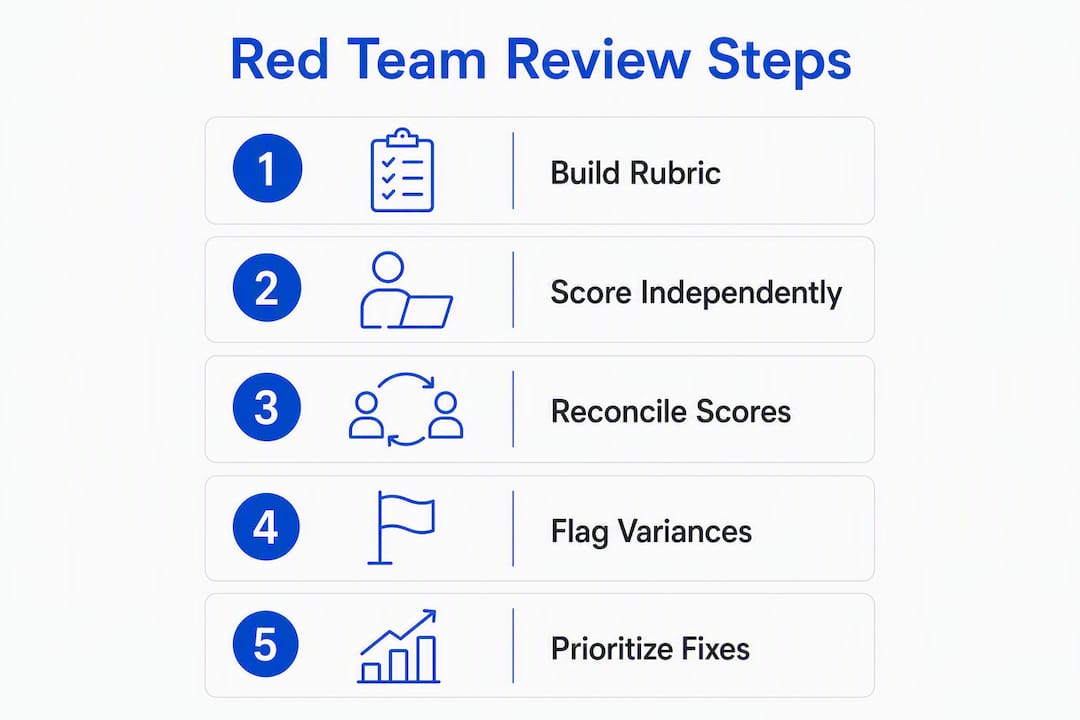
The scoring simulation is the core of any Red Team proposal review. Build the scoring sheet before reviewers read a single page of the draft.
Step 1: Build the rubric from Section M
Extract every evaluation factor, subfactor, and its allocated mark weighting. Create a spreadsheet with one row per subfactor, columns for each reviewer's score, and a notes field. This sheet becomes the only lens reviewers use.
Step 2: Score cold and independentlyEach reviewer scores the draft without discussing it with other reviewers first. They use the rubric you built, not their personal preferences. Adjectival scales (Excellent / Good / Adequate / Poor) mapped to numerical ranges work well for South African 80/20 and 90/10 evaluations.
Step 3: Reconcile and flag varianceCompare scores across reviewers. Wide variance on any subfactor almost always signals ambiguous writing, not reviewer disagreement. Treat it as a rewrite priority, not a debate to win.
Priority matrix for fixes| Priority | Issue type | Action |
|---|---|---|
| 1 (Fatal) | Compliance failure | Fix before anything else — disqualification risk |
| 2 (High) | Scoring gap vs Section M | Rewrite section, add evidence |
| 3 (Medium) | Win-theme inconsistency | Align narrative across sections |
| 4 (Low) | Clarity and grammar | Pink-team pass |
Who should be on your Red Team?
| Role | Responsibility | Independence rule |
|---|---|---|
| Red Team lead | Facilitates the session, manages the scoring sheet, owns the fix list | Must not have drafted any section |
| Independent scorer (x2 minimum) | Scores the draft cold against Section M rubric | Zero drafting involvement |
| Compliance checker | Verifies SBD/MBD, CSD, B-BBEE, and Section L returnables | Can be internal if not a drafter |
| Pricing/finance reviewer | Checks pricing schedule totals, price/technical alignment | Separate from the technical author |
| Senior approver | Signs off the final submission after fixes are implemented | Must have signatory authority |
When selecting external reviewers, look for demonstrable experience with South African public procurement, familiarity with the PPPFA 80/20 or 90/10 framework relevant to your tender, and no conflict of interest with the contracting authority.
Common errors that lose points in South African tenders
These are the mistakes Red Teams catch most often, and the ones evaluators penalise most consistently.
- Inconsistent staffing claims. Promising a dedicated project lead in the executive summary but describing shared cover in the implementation plan. Evaluators catch this and it raises questions about your actual delivery capacity.
- Unsupported claims. Statements like "we have extensive experience" with no client name, contract value, date, or outcome. Evaluators cannot award marks for assertions.
- Compliance misses. Unsigned SBD 4 or SBD 6.1, an expired B-BBEE certificate, or a CSD profile that does not match the entity submitting the bid. These are often fatal to a submission.
- Price/technical mismatch. A technical methodology that proposes a large specialist team but a price that cannot cover those resources. Evaluators notice the gap.
- Missing returnables. An annex referenced in the body but not included, or a mandatory schedule left blank.
Fatal errors (compliance failures, missing mandatory forms) cannot be recovered after submission. Scoring gaps and clarity issues can be fixed if you catch them in time.
When to schedule the Red Team and what it costs
Schedule your Red Team when the draft is 75–90% complete. Run it earlier and you waste reviewers' time on a document that will change substantially. Run it later and findings become a post-mortem rather than a rehearsal.
In practical terms, that means blocking the Red Team session several business days before your submission deadline. Allow sufficient time for independent scoring, reconciliation and creating the fix list, and rewrites and a final compliance pass.
Cost considerations for SMMEsInternal Red Teams require a significant amount of staff time for a mid-size tender. External consultant day rates in South Africa vary depending on complexity and sector. A late, rushed external review is both more expensive and less effective than one scheduled at the right point in the bid cycle. The cost of losing a tender almost always exceeds the cost of a proper review.
After the Red Team: turning findings into a final submission
A Red Team that produces a list of findings but no owners or deadlines is just an expensive read. Convert findings into a fix list immediately after the session.
- Categorise every finding by the priority matrix: compliance (fatal), scoring gap (high), win-theme inconsistency (medium), grammar/layout (low).
- Assign an owner and a deadline to every item. No owner means it will not get done.
- Lock the version before fixes begin. Name it clearly (e.g., v2.0_RedTeam_[date]) and work only in that version.
- Implement fixes in priority order. Compliance failures first, then scoring gaps, then clarity.
- Run a final Section L compliance pass once all fixes are in. Check page limits, formatting, and that all returnables are present and correctly named.
- Get sign-off from the authorised signatory before packaging. Confirm they have the authority to bind the entity.
- Freeze the document. No changes after the final sign-off. Last-minute edits reintroduce errors.
For a practical starting point on what your tender documents package must include, use a verified South African tender checklist as your final packaging reference.
Key takeaways
A Red Team review is a scoring simulation against Section M, not a proofreading pass. Run it at 75–90% draft completion, use independent reviewers, and convert every finding into an assigned fix before submission.
| Point | Details |
|---|---|
| Score against Section M | Build the rubric from Section M before reviewers read the draft; score cold and independently. |
| Check SBD/MBD, CSD, B-BBEE | Compliance failures are fatal; verify all forms are signed, consistent, and current. |
| Time it at 75–90% draft | Running the review too late turns findings into a post-mortem with no time to act. |
| Treat variance as a rewrite signal | Wide disagreement between reviewers means ambiguous writing, not reviewer error. |
| Protenders for mechanical checks | Use Protenders compliance scorecards and templates to automate Section L/M checks before human reviewers start. |
Why the "Critical Friend" approach changes outcomes
The most underrated part of a Red Team is not the scoring sheet. It is the psychological shift that happens when someone who genuinely wants you to win tells you your evidence is weak. That is the Critical Friend role, and it is harder to replicate internally than most SMMEs expect.
Writers are too close to their own work. They know what they meant to say, so they read what they intended rather than what is on the page. An independent reviewer reads only what is there. When that reviewer cannot award a mark because the evidence is missing or buried, the problem is visible in a way no amount of self-review will surface.
The practical implication: do not use your bid manager as a Red Team scorer. Even with the best intentions, someone who shaped the narrative will defend it rather than score it. The improvement in bid quality after a genuine independent review, particularly in the alignment between the technical solution and the pricing narrative, tends to be substantial. For SMMEs bidding on competitive government tenders, that alignment is often the difference between a shortlisted bid and one that scores below the threshold.
When to hire external reviewers versus training internal staff depends on bid volume and value. For high-value or complex tenders, external reviewers pay for themselves. For recurring, lower-value bids, investing in internal Red Team skills through structured practice and peer review builds a sustainable capability over time.
Protenders gives you the tools to run a faster Red Team
Preparing a government tender in South Africa means managing compliance, documents, and deadlines simultaneously. Protenders brings those together in one place so your Red Team can focus on scoring arguments rather than hunting for forms.
With Protenders, you get compliance scorecards that flag gaps in your SBD/MBD and B-BBEE documentation before your reviewers start, plus Section L/M-aligned document templates that reduce the mechanical preparation time. The bid workspace keeps your documents versioned and organised, and the procurement intelligence tools help you understand the evaluation context before you write a single word. For SMMEs targeting Gauteng opportunities, the Gauteng tenders page gives you filtered, live results in seconds.
Find your next government tender on Protenders and use the compliance tools to run a tighter, faster Red Team on every bid you submit.Useful sources and further reading
The guidance in this article draws on the following sources. Each is worth bookmarking for your bid team.
- Red Team Review Best Practices for GovCon Success, GovEagle: scoring simulation methodology, Section M alignment, and automation guidance.
- Red Review Bid Management, Hudson Succeed: Critical Friend concept and independence requirements.
- Red Team Reviews, Impart: practical Red Team structure and the value of peer review sessions.
- Winning Tender Proposal, Meyer Attorneys: South African compliance checklist and common errors.
- Red Team Review for Bids, Bidsmithery: pink team vs Red Team distinction.
Protenders resources to use alongside this guide: the tender documents checklist, the B-BBEE requirements guide, and the how to write a winning tender proposal guide cover the preparation steps that feed directly into a strong Red Team review.
FAQ
What is a red team review in tendering?
A red team review is an independent scoring simulation of your draft tender against the evaluation criteria in Section M, run before submission to identify compliance gaps and weak scoring arguments. It is not a proofreading exercise.
When should you run a red team review?
Run the review when your draft is 75–90% complete, leaving enough time to implement structural fixes before the submission deadline.
Who should conduct the red team review?
Reviewers must have had no involvement in drafting the bid. For SMMEs, a minimum of two independent scorers plus a compliance checker is practical; external reviewers are advisable for high-value or complex tenders.
What is the difference between a pink team and red team review?
A pink team review focuses on grammar, formatting, and readability earlier in the writing cycle. A red team review scores the near-final draft against the tender's evaluation criteria to test whether the arguments actually earn marks.
How does Protenders support the red team process?
Protenders provides compliance scorecards, SBD/MBD and Section L/M document templates, and a bid workspace that keeps documents versioned, reducing the mechanical preparation time before human reviewers start scoring.
Recommended
- SMME Tenders South Africa 2026: Government Opportunities for Small Businesses | ProTenders
- Tender Documents South Africa: Checklist & Guide (2026) | ProTenders
- How to Apply for a Tender in South Africa: Step-by-Step (2026) | ProTenders
- How to Find Government Tenders in South Africa (2025 Complete Guide) | ProTenders