South Africa tender process: your step-by-step SMME guide

Government tenders in South Africa are formal competitive procurement processes run by organs of state, and the first 72 hours of your tender journey matter more than most SMMEs realise. Before you touch a single bid document, you need three things in place: an active Central Supplier Database (CSD) supplier number, a valid SARS Tax Compliance Status (TCS) PIN, and a compliance folder with your core company documents. Once those are ready, set up a daily scan on Etenders and identify one or two tenders that genuinely match your capacity.
Your immediate action list:
- Register on the CSD at secure.csd.gov.za and obtain your supplier number and Unique Registration Reference Number (URRN).
- Confirm your SARS tax compliance status and download your TCS PIN.
- Assemble your mandatory documents: CIPC company registration, bank confirmation letter, B-BBEE certificate or affidavit, and any sector licences.
- Bookmark eTenders.gov.za and check it daily for new notices in your category.
- Identify one or two high-fit opportunities and confirm whether a compulsory briefing is scheduled. Attend it. Missing a compulsory briefing is an automatic disqualification under the Preferential Procurement Policy Framework Act (PPPFA) and related municipal rules.
*
Key takeaways
Winning government tenders in South Africa requires a verified CSD record, current tax compliance, a complete document pack, and a technical response that maps directly to the evaluation criteria.
| Point | Details |
|---|---|
| Register on the CSD first | Obtain your supplier number and URRN before bidding — an unverified CSD record means instant disqualification. |
| Keep tax compliance current | Your SARS TCS PIN must be valid at the time of evaluation, not just at submission. |
| Build a compliance folder | Maintain certified copies of CIPC, bank letter, B-BBEE certificate, and all SBD/MBD forms ready to deploy. |
| Read the specific goals section | Organs of state must stipulate specific goals per tender — claim the right preference points by supplying the exact proof each goal requires. |
| Protenders aggregates live tenders | Search national, provincial, and municipal tenders by keyword or category on Protenders without signing up, and use compliance scorecards to check your bid before submission. |
Table of Contents
- How does the South African tender process work from start to finish?
- Where to find tender opportunities and how to register on the CSD
- What documents does every South African tender submission require?
- How are bids evaluated? PPPFA, preference points and functionality explained
- How to structure a bid that actually wins
- How to submit on time and avoid disqualification at the gate
- What happens after the tender is awarded?
- Most common reasons bids fail and how to fix them before submission
- How Protenders supports SMMEs through the full tender process
- Treat tendering as a system, not a one-off sprint
- Protenders makes the tender process faster and less stressful for SMMEs
- Sources
- FAQ
How does the South African tender process work from start to finish?
Every government tender follows a predictable lifecycle. Understanding each stage tells you where your effort goes and what the buyer is actually doing while you wait.
| Stage | What happens | Typical duration |
|---|---|---|
| Need identification | Organ of state confirms budget and procurement method | Internal — not visible to bidders |
| Advertisement | Tender notice published on eTenders, municipal portals or Government Gazette | 30 days minimum for open tenders |
| Briefing / site visit | Compulsory or optional session; addenda issued afterward | Usually within the first week of advert |
| Bid submission | Bidders deliver sealed bids to the tender box or upload electronically by closing time | Closing time stated in notice (often 11:00 or 12:00) |
| Administrative compliance check | Bid committee verifies mandatory forms, signatures, CSD number, tax PIN | 1–3 weeks post-closing |
| Technical / functionality evaluation | Evaluators score methodology, CVs, references against stated criteria | 2–6 weeks |
| Price and preference scoring | Price points and B-BBEE / specific-goal points allocated per PPPFA rules | Concurrent with or after technical |
| Adjudication | Bid adjudication committee makes the award recommendation | 1–4 weeks |
| Award and standstill | Award letter issued; standstill period allows for objections | 5 working days minimum |
| Contract management | Contract signed, mobilisation begins, invoices submitted per milestones | Duration of contract |
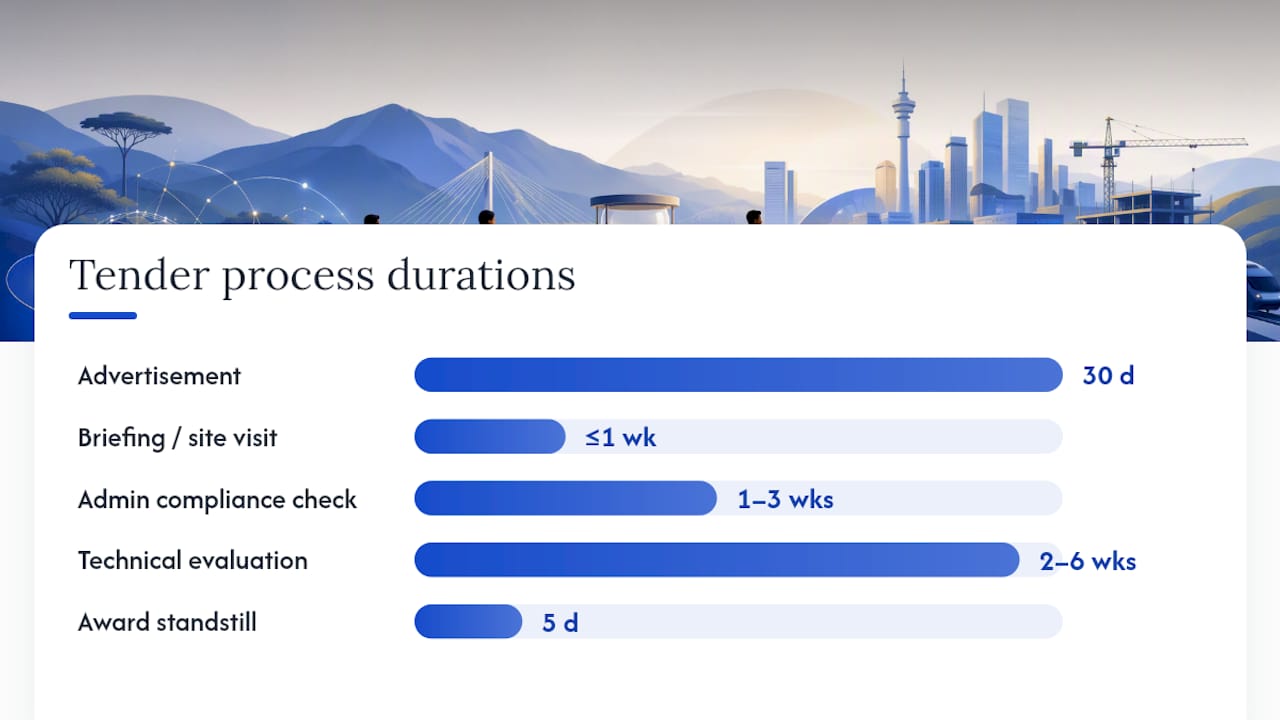
The Public Procurement Act, 2024 now provides the overarching statutory framework for this process, assigning oversight to the Public Procurement Office and provincial treasuries. The draft General Public Procurement Regulations, 2026 propose stricter bid committee structures, formal debarment registers, and security vetting requirements. Bidders should expect tighter administrative controls as these regulations are finalised.
Timelines vary sharply by procurement type. A Request for Quotation (RFQ) under the threshold can close within three days. A complex infrastructure tender may run for 60 days or longer. Panels and multiple-award frameworks are also used, particularly by larger departments, which means SMMEs can be appointed to a panel and then called off it for specific work orders without a fresh tender each time.
Pro Tip: At every briefing, sign the attendance register and collect any addenda issued on the day. Briefing notes and addenda form part of the tender document — evaluators will check whether your bid reflects them. If an addendum changes a specification and your bid ignores it, you will score zero on that criterion. *Where to find tender opportunities and how to register on the CSD
Primary portals to monitor
The National Treasury eTenders portal is the single most important place to start. It lists notices from national and provincial departments, public entities, and many municipalities. Beyond eTenders, check:
- State-owned entity portals. Eskom, Transnet, and similar entities run their own procurement portals.
- CIDB (Construction Industry Development Board) portal for construction-grade tenders, where CIDB grading is a pre-qualification requirement.
- Protenders. The platform aggregates live tenders from all four tiers of government into a single searchable feed, so you can search by keyword, region, or category without visiting a dozen portals. You can browse South African government tenders without signing up.
Build a weekly scanning habit: 15 minutes every Monday morning on eTenders and your target municipal sites, filtered by your sector keywords. Practical SME-focused guides recommend this weekly cadence as one of the highest-return habits for building a sustainable tender pipeline.
CSD registration: step by step
The CSD is the single verified supplier record that organs of state use to confirm your legitimacy before awarding a contract. Without a valid CSD number, your bid will not pass administrative compliance.
- Go to secure.csd.gov.za and click "Register User."
- Complete the user registration form and verify your identity via OTP (one-time PIN sent to your mobile number or email).
- Log in and add your supplier details: legal entity name, registration number, tax reference number, bank account details, and contact information.
- Submit for verification. The CSD cross-checks your data against CIPC, SARS, and your bank. Mismatches trigger a validation error.
- Once verified, download your CSD registration report. This document contains your supplier number and URRN — keep a PDF copy in your compliance folder at all times.
Common validation problems include bank account mismatches (the account name must match the registered entity name exactly) and tax PIN errors where the SARS reference on the CSD does not match the entity's current TCS status. Resolve these before you bid. A bid submitted with an unverified or lapsed CSD record will be disqualified at the administrative stage. Pro Tip: Assign one named person in your business as the CSD account owner. When that person leaves, update the primary user immediately. A locked or inaccessible CSD account at bid time is a common and entirely avoidable crisis. *
What documents does every South African tender submission require?
Getting the document pack right is where most SMMEs either win or lose before evaluation even begins. An evaluator's first job is to check administrative compliance — if a required document is missing or unsigned, the bid is set aside immediately.
Core mandatory documents
| Document | What it proves | Common issue |
|---|---|---|
| CIPC company registration certificate | Legal existence of the entity | Trading name differs from registered name |
| Bank confirmation letter | Active business account in entity's name | Letter older than 3 months, wrong account name |
| SARS Tax Compliance Status (TCS) PIN | Current tax compliance | PIN expired or entity has outstanding returns |
| CSD supplier number / registration report | Verified supplier record | Unverified status, outdated report |
| B-BBEE certificate or sworn affidavit | Transformation status | Certificate issued by unaccredited verifier, expired |
| CIDB grading certificate | Construction capacity (where required) | Wrong grading level for the tender value |
| COIDA / Compensation Fund letter of good standing | Employer compliance | Expired letter of good standing |

Standard bid forms
Every tender document will list its own set of returnables. The most common are the SBD (Standard Bidding Document) or MBD (Municipal Bidding Document) forms. Read the returnable schedule carefully — the forms required vary by institution and tender type. Typical forms include:
- Declaration of interest (SBD 4 / MBD 4)
- Declaration of bidder's past supply chain management practices (SBD 8)
- Certificate of independent bid determination (SBD 9)
- Pricing schedule or Bill of Quantities (BoQ)
- Authorising resolution confirming who may sign on behalf of the entity
Structuring your compliance index
A compliance index is a cover page that lists every required document with the page number where it appears in your submission. Evaluators work through a checklist — make their job easy and they are less likely to miss a document you included. The index should mirror the returnable schedule in the tender document, line by line.
Pro Tip: Keep both a certified paper set and a scanned PDF set of every compliance document. Certifications must be recent (most institutions require certification within the last three months). Assign one person to do the final document check 48 hours before closing — not the bid writer, but someone who can read the returnable schedule cold and tick off each item against what is physically in the envelope or upload folder. For a detailed checklist of standard returnables, see Protenders' tender documents guide. *How are bids evaluated? PPPFA, preference points and functionality explained
South African public procurement scoring rests on three pillars: price and preference points, specific goals, and functionality. Getting any one of them wrong costs you points you cannot recover.
The statutory framework
Section 217 of the Constitution requires procurement to be fair, equitable, transparent, competitive, and cost-effective, while allowing for preferential procurement to advance transformation. The PPPFA gives effect to that mandate, and the B-BBEE and PPPFA framework from the Department of Trade, Industry and Competition explains how preference targets interact with industrial policy and local content designations.
The OCPO FAQ on Preferential Procurement Regulations, 2022 confirms that organs of state must stipulate specific goals in every tender invitation and that preference points must be allocated using the relevant MBD or SBD forms.
Preference point systems
- 80/20 system: 80 points for price, 20 points for specific goals. Applies to tenders below the threshold set by the Minister.
- 90/10 system: 90 points for price, 10 points for specific goals. Applies to tenders above that threshold.
Specific goals vs B-BBEE status
This is where many bidders misread the rules. Organs of state no longer rely purely on a bidder's general B-BBEE status level as the preference criterion. Instead, they must specify the goals for each tender in the invitation — for example, a percentage of subcontracting to youth-owned businesses, local content requirements, or women ownership thresholds. Read the specific goals section of every tender document carefully and supply the exact proof each goal requires. A Level 1 B-BBEE certificate does not automatically earn you all 20 points if the tender's specific goals call for something different.
For a deeper breakdown of how the 80/20 and 90/10 systems work in practice, Protenders' B-BBEE tender requirements guide walks through the point allocation mechanics with worked examples.
Functionality scoring
Some tenders include a functionality gate: bidders must score above a minimum threshold on technical criteria before their price and preference points are even counted. Functionality criteria typically cover methodology, key personnel CVs, relevant experience, and references. If the tender includes a functionality score, treat it as the first hurdle — a technically weak bid that scores below the threshold is eliminated regardless of price.
Map every evaluation criterion to a specific piece of evidence in your bid. If the criterion asks for three contactable references for similar projects, supply three, with contact names, numbers, and project values. Vague claims about "extensive experience" score nothing.Procurement experts consistently advise bidders to read the specific goals section of each tender before writing a single word of their technical response. Organs of state increasingly set tender-specific goals tied to local content, youth ownership, or women-owned business thresholds — and a bid that ignores those goals leaves preference points on the table that a competitor will claim.*
How to structure a bid that actually wins
A winning bid is not the cheapest or the longest. It is the one that answers every evaluation criterion with evidence, prices realistically, and arrives on time with every form signed.
Bid structure template
- Cover letter — one page, entity name, CSD number, brief statement of offer.
- Compliance index — mirrors the returnable schedule; page references for every document.
- Technical response — methodology, workplan, team CVs, relevant project experience.
- Quality and safety plan — where required by the specification.
- Pricing schedule or BoQ — itemised, with assumptions stated clearly.
- Supporting documents — licences, certificates, subcontractor agreements.
- Signed declarations — all SBD/MBD forms, authorising resolution.
Writing the technical proposal
Use the buyer's own language. If the specification says "project management methodology," your heading should say exactly that. Respond to every criterion in the order it appears in the evaluation matrix. Evaluators score against a rubric — if your response does not address a criterion, the score is zero, regardless of how impressive the rest of your bid is.
Quantify outcomes wherever possible. "We delivered a 45-kilometre road rehabilitation project in Limpopo within budget and 12 days ahead of schedule" is evidence. "We have extensive road construction experience" is not.
Pricing
Price to cover your actual costs, including cashflow gaps between invoice submission and payment. Underbidding to win and then struggling to deliver is one of the most common SMME failure modes in public procurement. State your assumptions clearly — if your price excludes VAT, say so. If it assumes a specific scope, define the scope. Evaluators and contract managers will hold you to what you wrote.
For proposal drafting support, tools like RFP Forge AI can help structure responses consistently and reduce formatting errors across multiple bids.
Subcontracting and joint ventures
If your entity does not meet a pre-qualification criterion on its own (CIDB grading, turnover threshold, or a specific goal), a joint venture or consortium arrangement can bridge the gap. The lead entity submits the bid, but the joint venture agreement must be signed and attached, and each party's compliance documents must be included. Subcontractor agreements must name the subcontractor, the scope, and the value. Vague subcontracting claims without supporting documentation score nothing and may trigger a declaration of non-compliance.
Dos and don'ts:- Supply contactable referees with current phone numbers and email addresses.
- Never submit generic capability statements that could apply to any tender.
- Never omit a required form, even if you think it is not applicable — mark it N/A and sign it.
- Never alter the pricing schedule format; use the one provided in the tender document.
How to submit on time and avoid disqualification at the gate
Submission mechanics are where bids die for entirely preventable reasons. A technically excellent bid delivered five minutes after closing is not evaluated.
- Confirm the submission method. The tender document will specify physical delivery to a tender box, electronic upload via eTenders or a departmental portal, or both. Never assume.
- Label your submission correctly. Physical bids must be sealed in an envelope or box labelled with the tender number, description, closing date, and your entity name. Unlabelled bids are routinely set aside.
- Deliver physical bids early. Tender boxes are locked at closing time. Arrive at least two hours before closing to allow for traffic, parking, and building access.
- For electronic submissions, upload all documents and confirm the upload is complete before closing time. Save screenshots of the upload confirmation and any acknowledgement email.
- Get a stamped receipt for physical deliveries if the institution provides one. If not, photograph the tender box with your bid inside and the timestamp visible.
- Monitor corrigenda. If the organ of state issues an addendum after the original advertisement, it changes the tender document. Check eTenders and the institution's portal regularly for corrigenda, and update your bid accordingly before closing.
Late bids are not accepted under South African procurement rules. The City of Cape Town's tender guide makes this explicit: closing time is absolute, and no exceptions are made for traffic, courier delays, or technical difficulties on the bidder's side. Build your submission timeline backward from the closing time, not forward from when you finish writing.Pro Tip: Submit by 09:00 on the closing day if closing time is 11:00. Keep a single master PDF of your complete submission — the exact version you submitted — saved with the date and tender number in the filename. If a dispute arises, that file is your evidence. *
What happens after the tender is awarded?
Winning the award letter is the beginning of a new set of obligations, not the finish line.
- Appointment letter or purchase order. The organ of state issues a formal appointment. Do not mobilise or incur costs before this document is in hand.
- Contract signature. Review the contract carefully before signing. Key clauses to check: mobilisation timeline, payment terms (30 days is standard; some departments run longer), retention percentages, performance guarantees, and penalty provisions for late delivery.
- Kickoff meeting. Most contracts require a formal kickoff with the client's project manager. Use this meeting to confirm deliverables, reporting lines, and the invoicing process.
- Invoicing discipline. Submit invoices on the date specified in the contract, with all supporting documents attached. Late or incomplete invoices delay payment and create cashflow problems.
- Cashflow management. If payment terms are 30 days or longer and you need to mobilise staff or materials upfront, explore tender funding options early. Protenders offers funding matching tools that connect SMMEs with lenders who understand government contract cycles.
Pro Tip: If your bid is unsuccessful, request a debrief in writing within five working days of the award notice. Ask specifically which criteria you scored low on and what the winning bid offered. That information is worth more than any generic bid-writing course. Log the feedback, update your standard capability statement, and apply the lesson to the next submission.
Grounds for review
If you believe the award was procedurally irregular, you can lodge an administrative review. Grounds include failure to follow the PPPFA, bias in evaluation, or non-disclosure of conflicts of interest. The timeframe for review is tight — act within 30 days of becoming aware of the irregularity. Judicial review through the High Court is available but expensive; the preferred first step is a formal objection to the accounting officer of the organ of state, followed by a Promotion of Administrative Justice Act (PAJA) review if unresolved.
*Most common reasons bids fail and how to fix them before submission
Administrative disqualification is the most common and most avoidable outcome. These are the errors that appear repeatedly across bid evaluation reports:
- Missing or unsigned SBD/MBD forms. Every form listed in the returnable schedule must be present and signed by the authorised signatory.
- Wrong signatory. The person who signs must be authorised by a board resolution or equivalent. A director who is not listed in the authorising resolution cannot sign.
- Missing CSD number or unverified CSD status. If your CSD record shows as unverified on the day of evaluation, the bid fails administrative compliance.
- Expired or invalid TCS PIN. SARS tax compliance must be current at the time of evaluation, not just at submission.
- Not attending a compulsory briefing. The attendance register is checked. If your name is not on it, your bid is disqualified regardless of quality.
- Expired B-BBEE certificate. Certificates must be valid at the time of submission. An expired certificate from an unaccredited verifier is worse than no certificate.
- Pricing schedule errors. Submitting a modified BoQ format, leaving items unpriced, or failing to include VAT treatment clearly.
- Generic technical responses. Failing to answer evaluation criteria specifically, or copying a response from a previous bid without adapting it to the current specification.
- Missing subcontractor documentation. Claiming subcontracting for specific goals without attaching the signed subcontractor agreement and the subcontractor's compliance documents.
Quick fix: Build a pre-submission checklist that mirrors the returnable schedule exactly. Assign one person to run through it 48 hours before closing. That person's only job is to verify that every item is present, signed, and current — not to improve the writing. *
How Protenders supports SMMEs through the full tender process
Protenders is built specifically for the South African SMME that wants to bid smarter without hiring a full-time tender department.
- Aggregated live tender feed. National, provincial, and municipal tenders in one searchable place, updated daily. Search by keyword, region, or category without creating an account.
- Compliance scorecards. Before you submit, the platform flags gaps in your compliance folder — missing documents, expired certificates, unverified CSD status.
- Document templates. Standard bid forms, capability statement templates, and pricing schedule formats ready to adapt for each tender.
- Automated alerts. Set keyword and category alerts so new tenders matching your profile reach you the day they are published, not three weeks later.
- Bid workspace. A shared workspace where your team can collaborate on a submission, track document versions, and manage the compliance checklist in one place.
- Funding partnerships. For SMMEs that win contracts but need mobilisation funding, Protenders connects you with lenders who understand government payment cycles.
- SMME subcontractor network. If a larger contractor needs a verified SMME subcontractor to meet specific goals, Protenders surfaces your profile.
Protenders also publishes practical how-to guides — including step-by-step walkthroughs for CSD registration, B-BBEE scoring, and municipal tender rules — so you are not starting from scratch on every new bid. *
Treat tendering as a system, not a one-off sprint
The single biggest mistake SMMEs make in public procurement is treating each tender as a standalone event — scrambling for documents, writing a proposal in three days, and then going quiet until the next opportunity appears. That approach produces inconsistent results and burns out the people doing the work. What actually works is building tendering as a repeatable operational system. That means a named compliance owner who keeps the CSD record current and the document folder updated. It means a weekly 15-minute scan of eTenders and your target municipal portals, logged in a simple spreadsheet. It means a standard capability statement that is reviewed and updated every quarter, not rewritten from scratch for each bid. The investment is small. A tender-ready folder, two or three targeted categories where you have genuine track record, and a fixed slot in the weekly calendar for bid work. SMMEs that operate this way submit more bids, make fewer administrative errors, and accumulate the debrief feedback that gradually improves their win rate. The ones that treat tendering as a crisis activity every time a deadline appears spend most of their energy on avoidable problems. Focus on two or three categories where you have real experience and real references. A focused bidder with a strong track record in one sector will consistently outperform a generalist who submits thin responses across ten sectors. Depth beats breadth in tender evaluation, every time. *Protenders makes the tender process faster and less stressful for SMMEs
Finding, preparing, and submitting a compliant government tender takes time that most SMME owners do not have to spare. Protenders cuts the search time to seconds with a live feed of all South African government tenders across national, provincial, and municipal buyers — no sign-up needed to browse.
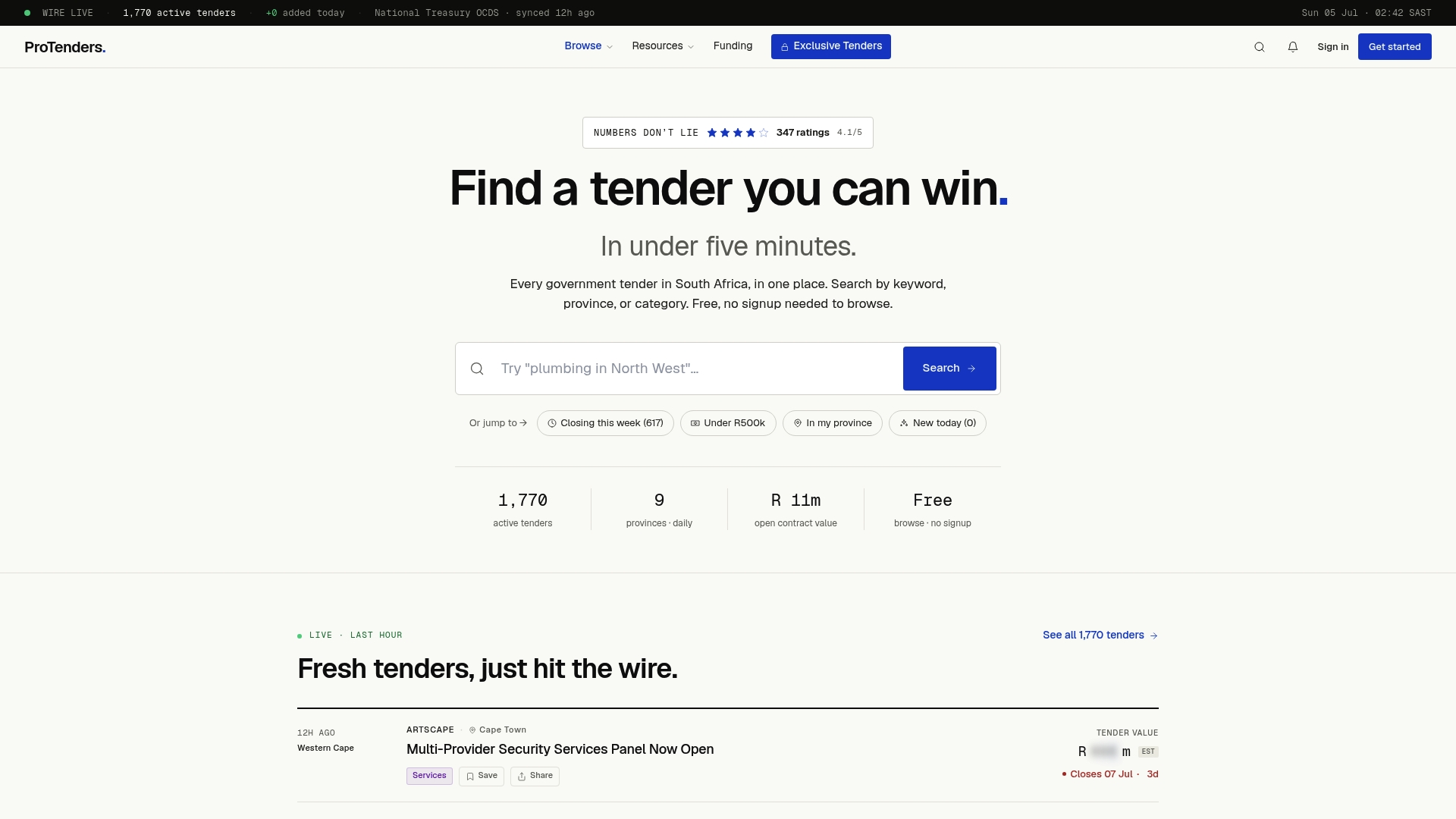
Where Protenders goes further is in the compliance layer. The platform's scorecards flag document gaps before you submit, not after. Templates for standard bid forms, pricing schedules, and capability statements mean you are not rebuilding from zero for each bid. Automated alerts deliver new tenders matching your category and region directly to your inbox the day they are published. And if you win a contract but need mobilisation funding, the fund finder tool matches you with lenders who understand government payment cycles.
Start with a free search on Protenders today and see which live tenders match your business right now.
*Sources
Official portals and statutory documents referenced in this guide:
- Central Supplier Database — Registration process
- eTenders Portal: Home Page
- Public Procurement Act, 2024 — Parliament
- DRAFT GENERAL PUBLIC PROCUREMENT REGULATIONS, 2026: INVITATION FOR PUBLIC COMMENT
- Central Supplier Database supplier leaflet — OCPO
*
FAQ
What are the main stages of the South African tender process?
The tender process moves through need identification, advertisement, briefing or site visit, bid submission, administrative compliance check, technical and price evaluation, adjudication, award with a standstill period, and contract management. The Public Procurement Act, 2024 provides the overarching statutory framework for these stages.
What do you need to apply for a government tender in South Africa?
At minimum: an active CSD supplier number, a valid SARS Tax Compliance Status PIN, a CIPC company registration certificate, a bank confirmation letter, and a B-BBEE certificate or sworn affidavit where required. Sector-specific licences such as a CIDB grading certificate apply for construction tenders.
How long does it take for a tender to be awarded in South Africa?
It depends on the complexity of the procurement. A simple RFQ can be awarded within two to three weeks. An open competitive tender for a large contract typically takes three to six months from advertisement to award, accounting for evaluation, adjudication, and the standstill period.
How does the 80/20 preference point system work?
Under the 80/20 system, 80 points are allocated for price competitiveness and 20 points for specific goals set by the organ of state in the tender invitation. The system applies to tenders below the threshold set by the Minister under the PPPFA. The OCPO FAQ on Preferential Procurement Regulations, 2022 confirms that specific goals must be stipulated in the invitation and scored using the relevant MBD or SBD forms.
Where is the best place to find government tenders in South Africa?
eTenders.gov.za is the National Treasury's central portal and the first place to check for national and provincial tenders. For a single aggregated view across all four tiers of government, Protenders pulls live tenders from national, provincial, and municipal buyers into one searchable feed, searchable by keyword, region, or category without requiring sign-up.
Recommended
- South Africa business opportunities: SMME tender guide | ProTenders
- How to Apply for a Tender in South Africa: Step-by-Step (2026) | ProTenders
- How to Apply for Government Tenders in South Africa: 2026 Guide | ProTenders
- SMME Tenders South Africa 2026: Government Opportunities for Small Businesses | ProTenders