Tender proposal format for South African contractors

A compliant South African tender proposal follows a fixed structure: cover page, table of contents, executive summary, scope of work, methodology, pricing schedule, delivery timeline, company credentials, legal terms, and annexures. The three sections that most directly determine whether you clear the functionality threshold and score well under price are the executive summary, scope and methodology, and the pricing table.
Before you write a single word, download an editable template and compliance scorecard from Protenders. Then find the actual tender notice on the eTenders portal and pull the prescribed pricing schedule and returnable forms directly from the buyer's document pack. National Treasury sets the procurement rules, the Construction Industry Development Board (CIDB) governs grading for construction contracts, and the Central Supplier Database (CSD) is where your supplier registration lives. Every section of your proposal must speak to at least one of those frameworks.
Mandatory sections for a South African tender submission:- Cover page (project title, tender reference, buyer name, submission date, authorised signatory)
- Table of contents with page numbers
- Executive summary (one page, outcomes-focused)
- Scope of work and deliverables
- Project methodology and phases
- Pricing schedule and cost estimate (ZAR, VAT stated)
- Delivery timeline and milestones
- Company profile, key personnel CVs, and references
- Legal terms, warranties, and insurance
- Annexures: B-BBEE certificate, tax clearance, CSD registration, CIDB grading (construction), signed reference letters, completion certificates
Table of Contents
- What does each section of the template actually contain?
- How to write a cover page, cover letter, and executive summary
- How to write scope, methodology, and project phases
- How to present pricing, VAT, and payment terms
- How to structure a delivery schedule and milestones
- What company credentials and compliance documents do you need?
- Legal terms, submission rules, and what causes disqualification
- How to organise annexures so evaluators can find evidence fast
- How to map your proposal to evaluation criteria and clear the functionality threshold
- Common tender mistakes that cause disqualification
- Short filled example: executive summary and cost table
- Key takeaways
- What the compliance matrix taught me about winning bids
- Protenders gives you the template, the scorecard, and the live tender feed
- Useful sources for South African tender submissions
- FAQ
What does each section of the template actually contain?
Think of the template as a scoring map. Evaluators work through your document against a rubric, and every section either earns points or creates doubt. Here is what belongs in each part and why it matters to the scorer.
Cover page and table of contents. The cover page is administrative, but a missing tender reference number or unsigned cover page can trigger disqualification before the document is even read. The table of contents must list every section with accurate page numbers so evaluators can jump directly to the evidence they need. Executive summary. This is the one section every evaluator reads in full. It should state what you will deliver, how, by when, and at what value. Keep it to one page.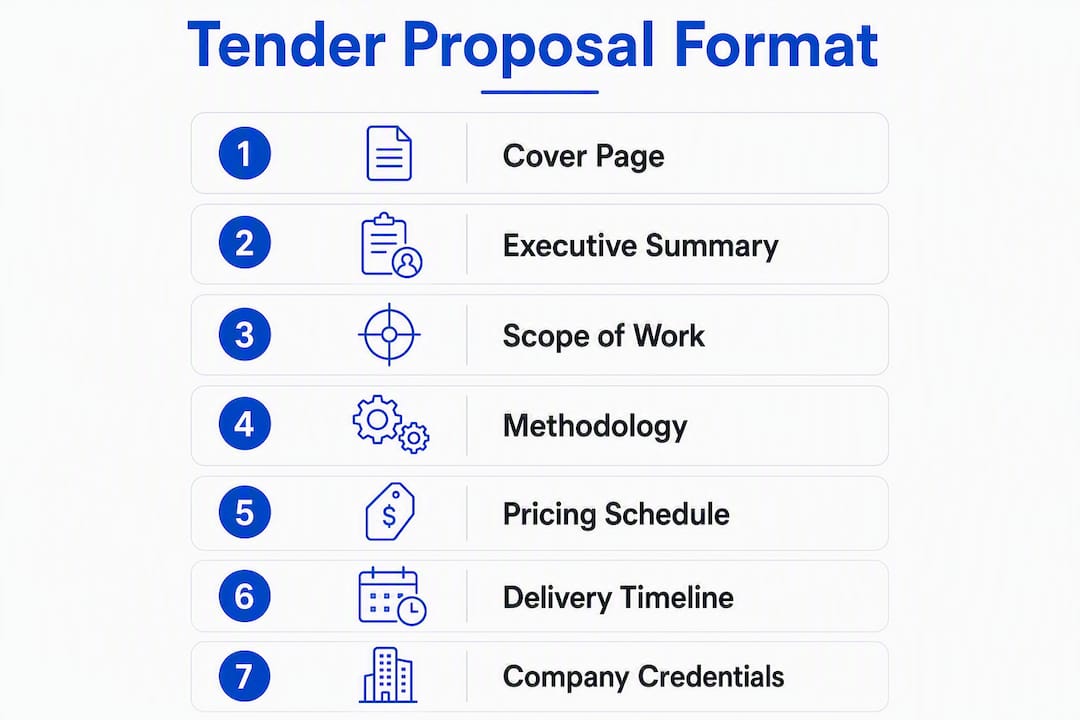 Scope of work and deliverables. Restate the buyer's scope in your own words, then confirm your specific outputs. Precision here prevents scope disputes later and shows the evaluator you understood the brief.
Methodology and phases. This is where functionality points are won or lost. A phase-by-phase breakdown with responsible parties and acceptance criteria gives evaluators something concrete to score.
Scope of work and deliverables. Restate the buyer's scope in your own words, then confirm your specific outputs. Precision here prevents scope disputes later and shows the evaluator you understood the brief.
Methodology and phases. This is where functionality points are won or lost. A phase-by-phase breakdown with responsible parties and acceptance criteria gives evaluators something concrete to score.
 Pricing schedule. Use the buyer's exact columns and units. Any deviation from the prescribed format is a red flag and can result in your price being set aside.
Delivery timeline. A milestone table or simple Gantt view showing deliverables, durations, and handover points. Evaluators check whether your timeline is realistic given your stated team size.
Company profile and credentials. Relevant projects, brief case studies, and a capacity statement. Not a generic company history.
Legal terms and annexures. Warranties, insurance, and the mandatory returnable forms (SBDs and equivalents). Annexures must be labelled, paginated, and cross-referenced to the main body.
Formatting rules that help evaluators:
Pricing schedule. Use the buyer's exact columns and units. Any deviation from the prescribed format is a red flag and can result in your price being set aside.
Delivery timeline. A milestone table or simple Gantt view showing deliverables, durations, and handover points. Evaluators check whether your timeline is realistic given your stated team size.
Company profile and credentials. Relevant projects, brief case studies, and a capacity statement. Not a generic company history.
Legal terms and annexures. Warranties, insurance, and the mandatory returnable forms (SBDs and equivalents). Annexures must be labelled, paginated, and cross-referenced to the main body.
Formatting rules that help evaluators:
- Number every section and sub-section (1.0, 1.1, 1.2)
- Use the same heading labels the tender document uses
- Include a page reference in your compliance matrix for every criterion
- Keep fonts consistent (Arial or Calibri 11pt is standard) and avoid colour-heavy design that does not print cleanly
How to write a cover page, cover letter, and executive summary
The cover page is a formality that carries real risk. A missing tender reference, wrong closing date, or unsigned authorisation block has ended otherwise strong bids. Include: the full project title as it appears in the tender notice, the buyer's name and department, the tender reference number, the bid closing date and time, your company's registered name and CSD supplier number, and the name and signature of the authorised signatory.
The cover letter is one page. Its job is to confirm you are submitting a compliant bid, identify any deviations, and give the evaluator a reason to read on. Open with a direct statement of intent, not a paragraph about your company history.
The executive summary follows the cover letter and should not exceed one page. Structure it in four short blocks:
- What you will deliver: name the outputs, not the activities
- How you will deliver it: one or two sentences on your methodology
- Why you are the right choice: one differentiator tied to the evaluation criteria (relevant experience, CIDB grading, specialist capacity)
- Value for money: confirm your price is within budget and state any cost-saving assumptions
Bold the outcomes. Evaluators scan before they read, and a bolded deliverable or timeline figure catches the eye before a paragraph of prose does. *
How to write scope, methodology, and project phases
The methodology section is where most bids are won or eliminated at the functionality stage; practical advice on presenting staff qualifications and structuring methodology is available at askHayley.com.au tendering. Verifiable evidence for technical functionality is what keeps your bid alive past the first evaluation gate; without it, a competitive price is irrelevant.
Step 1: Restate the scope. Open with a paragraph that mirrors the buyer's scope statement, using their exact terminology. This is not plagiarism; it is proof you understood the brief. Step 2: Confirm deliverables. List every output the buyer specified, numbered to match the tender document. Add a brief note on the acceptance criterion for each. Step 3: Present your methodology by phase. A three-to-five phase structure works for most projects:- Inception and planning (site visits, stakeholder engagement, programme confirmation)
- Design or development (technical work, interim submissions)
- Implementation or construction (execution, progress reporting)
- Testing and quality assurance (inspections, sign-offs)
- Handover and close-out (final deliverables, as-built documentation, training)
- Use the buyer's language verbatim when describing deliverables
- State measurable success criteria (e.g., "final report submitted within 5 business days of site handover")
- Identify dependencies explicitly so evaluators see you have planned for risk
How to present pricing, VAT, and payment terms
Price evaluation in South Africa runs on the 80/20 or 90/10 preference point systems set by National Treasury, where 80 or 90 points go to price and the remainder to B-BBEE preference. Getting the pricing format wrong does not just cost you points; it can invalidate your submission entirely.
Match the prescribed schedule exactly. If the tender includes a Bill of Quantities or a pricing schedule template, use it. Do not reformat, add columns, or change units. Fill every cell; leave nothing blank. State VAT clearly. Show subtotals excluding VAT, the VAT amount at 15%, and the total including VAT. If you are not VAT-registered, state that explicitly and confirm your price is VAT-exclusive.
Include payment terms and assumptions. State your assumed payment terms (e.g., 30 days from invoice), any retention percentage, and performance guarantee requirements. Note the currency as South African rand (ZAR) on every page of the pricing schedule.
State VAT clearly. Show subtotals excluding VAT, the VAT amount at 15%, and the total including VAT. If you are not VAT-registered, state that explicitly and confirm your price is VAT-exclusive.
Include payment terms and assumptions. State your assumed payment terms (e.g., 30 days from invoice), any retention percentage, and performance guarantee requirements. Note the currency as South African rand (ZAR) on every page of the pricing schedule.
| Line item | Unit | Qty | Unit rate (ZAR excl. VAT) | Total (ZAR excl. VAT) |
|---|---|---|---|---|
| Project management | Month | 3 | — | — |
| Site survey and assessment | Lump sum | 1 | — | — |
| Report preparation | Per report | 2 | — | — |
| Travel and disbursements | Lump sum | 1 | — | — |
| Total (incl. VAT) | R104,305 |
- Reference the annexure that supports each cost line (e.g., "see Annex D: team CVs for staff rates")
- Flag any contingency separately and explain the basis
- Never include costs the buyer has not asked for; unexplained line items raise audit flags
How to structure a delivery schedule and milestones
A milestone schedule does two things: it shows evaluators your timeline is realistic, and it creates the payment trigger framework for the contract. Evaluators check whether your milestones align with the deliverables you named in the scope section.
- Milestone 1 — Inception report: Week 2. Deliverable: signed inception report confirming programme and methodology. Acceptance: written approval from client project manager.
- Milestone 2 — Interim submission: Week 6. Deliverable: draft report or design drawings. Acceptance: written comments returned within 5 business days.
- Milestone 3 — Revised submission: Week 9. Deliverable: revised document incorporating client comments. Acceptance: written sign-off.
- Milestone 4 — Final deliverable: Week 12. Deliverable: final report, as-built drawings, or completed works. Acceptance: completion certificate signed by both parties.
- Milestone 5 — Close-out: Week 13. Deliverable: handover of all project documentation, training records, and warranties. Acceptance: final payment certificate issued.
For each milestone, show float where it exists. Evaluators know projects slip; a schedule with zero float looks optimistic rather than credible. Link each milestone explicitly to the payment trigger in your pricing schedule so the financial and technical sections tell a consistent story.
For construction projects, align your milestone dates with CIDB reporting requirements and any hold points specified in the scope. For IT or professional services, align with the buyer's programme review cycle.
*What company credentials and compliance documents do you need?
Your company profile section is not a brochure. Evaluators are looking for evidence that you have done this before, that your team has the right qualifications, and that your compliance documents are current. Advisory guides for South African tenders consistently flag that a clearer, easier-to-score submission often wins when two bidders meet the same technical requirements.
Company profile (two pages maximum):- Registered company name, registration number, and CSD supplier number
- Three to five relevant completed projects with contract values, client names, and completion dates
- A brief capacity statement confirming current workload and available resources for this contract
- Full name, professional registration number (where applicable), and years of experience
- Roles on two or three projects directly comparable to this tender
- Qualifications relevant to the evaluation criteria, not a full academic history
- Valid B-BBEE certificate (issued by an accredited verification agency or sworn affidavit for EMEs)
- Tax clearance certificate or SARS Tax Compliance Status PIN
- CSD registration confirmation (active status)
- CIDB grading certificate (for construction tenders; see CIDB grading requirements for the applicable grade)
- COIDA letter of good standing (construction and labour-intensive contracts)
Legal terms, submission rules, and what causes disqualification
Submission mechanics are where compliant bids die. A practical response checklist for South African tenders identifies submission format errors and missing returnables as among the most common causes of disqualification.
Legal and contractual terms to address:- Warranty period and scope (state the duration and what is covered)
- Performance guarantee (confirm whether a bank guarantee is required and at what percentage)
- Limitation of liability (align with the buyer's draft contract where one is provided)
- Insurance: professional indemnity, public liability, and employer's liability minimums should match the tender's stated requirements; attach a certificate of currency
- File format: most government portals accept PDF; some require original hard copies plus a USB drive. Check the tender document.
- File naming: use the convention the buyer specifies. A common format is: TenderRef_CompanyName_SectionName.pdf
- Signatures: original wet signatures are still required on most South African government submissions. E-signatures are accepted on some municipal and SOE tenders; confirm in the tender document before assuming.
- Physical submission: seal the envelope, label it with the tender reference and closing date, and submit before the stated time. Late submissions are not accepted.
- SBD 1: invitation to bid
- SBD 3.1 and 3.3: pricing schedule
- SBD 4: declaration of interest
- SBD 6.1: preference points claim (B-BBEE)
- SBD 8: declaration of bidder's past supply chain management practices
- SBD 9: certificate of independent bid determination
- Any sector-specific forms listed in the tender document
How to organise annexures so evaluators can find evidence fast
Annexures are where evaluators verify every claim you made in the body. A disorganised annexure pack does not just slow them down; it creates doubt about whether the evidence exists at all.
Standard annexure structure:- Annex A: Key personnel CVs
- Annex B: Signed reference letters and completion certificates
- Annex C: B-BBEE certificate
- Annex D: Tax clearance certificate / SARS TCS PIN
- Annex E: CSD registration confirmation
- Annex F: CIDB grading certificate (construction)
- Annex G: Insurance certificates (professional indemnity, public liability, COIDA)
- Annex H: Company registration documents (CIPC certificate)
- Annex I: Any additional supporting documents referenced in the body
- Add a tab or divider page at the start of each annex with the annex letter and title
- Paginate annexures separately (A-1, A-2, B-1, B-2) so page references in the body remain stable if sections are updated
- Every claim in the body that relies on documentary evidence should carry a bracketed reference: "(see Annex B: Completion Certificate, Project X)"
How to map your proposal to evaluation criteria and clear the functionality threshold
South African government tenders typically require bidders to achieve a minimum functionality score before price is considered. National Treasury procurement regulations specify that functionality and price points are calculated and combined, and that only bids meeting the minimum functionality score proceed to price evaluation. Failing that threshold means your price is never seen.
The most reliable way to clear it is a compliance matrix built before you write a single section.
| Evaluation criterion | Weight | Where addressed in proposal | Supporting evidence |
|---|---|---|---|
| Relevant experience (similar projects) | 30% | Section 5: Company profile | Annex B: Completion certificates |
| Key personnel qualifications | — | Section 6: CVs | Annex A: CVs with registration numbers |
| Methodology and approach | 30% | Section 4: Methodology | Body text, phase table |
| Capacity and resources | 15% | Section 5: Capacity statement | Annex A: CVs, organogram |
For preference points, confirm your B-BBEE level and complete SBD 6.1 accurately. Under the 90/10 system, a portion of points is available for B-BBEE preference; under 80/20, a larger portion is allocated. These are not trivial margins in a competitive field.
*Common tender mistakes that cause disqualification
Most bids do not lose on price. They lose on compliance gaps that could have been caught in a 30-minute final check.
Compliance mistakes:- Missing or unsigned SBD forms (SBD 4, 8, and 9 are the most frequently omitted)
- Expired B-BBEE certificate or tax clearance (check the expiry date, not just whether the document exists)
- CSD registration showing inactive or pending status on the submission date
- Missing CIDB certificate for construction tenders, or submitting a grade lower than the tender requires
- Unsigned annexures, particularly reference letters and completion certificates
- A generic company profile that does not reference the specific project being tendered
- Methodology written as a list of activities with no acceptance criteria or responsible parties
- Pricing schedule with blank cells or totals that do not reconcile with line items
- No page references in the compliance matrix, forcing evaluators to search for evidence
- Two-person quality check: one person checks compliance documents, the other checks technical content
- Arithmetic verification: re-total every column in the pricing schedule independently
- File integrity check: open every PDF after saving to confirm it is not corrupted or password-protected
- Cross-reference check: confirm every annex reference in the body points to the correct document
Short filled example: executive summary and cost table
Here is a short example of an evaluator-focused executive summary for a professional services tender, followed by a correctly formatted cost table.
That is 110 words. It names the deliverable, the timeline, the price, the team's relevant experience, the methodology framework, the B-BBEE level, and the CSD number. An evaluator can score it against every functionality criterion without reading further.
Sample cost table (ZAR):| Line item | Unit | Qty | Unit rate (ZAR excl. VAT) | Total (ZAR excl. VAT) |
|---|---|---|---|---|
| Lead practitioner (EAP) | Day | 15 | — | — |
| Junior practitioner | Day | 20 | — | — |
| Specialist sub-consultant | Lump sum | 1 | — | — |
| Report production and printing | Lump sum | 1 | — | — |
| Travel and accommodation | Lump sum | 1 | — | — |
Key takeaways
A compliant South African tender proposal must clear the functionality threshold before price is considered, which means your methodology, credentials, and evidence sections carry more weight than your price in the first evaluation gate.
| Point | Details |
|---|---|
| Functionality threshold first | Most South African tenders require a minimum functionality score before price evaluation begins; methodology and evidence sections determine this. |
| Compliance matrix is non-negotiable | Build a matrix mapping every evaluation criterion to a proposal section and an annexure before you write anything. |
| Preference points matter | Under the 80/20 system, 20 points go to B-BBEE preference; under 90/10, it is 10 points. Complete SBD 6.1 accurately. |
| Missing returnables disqualify | Unsigned SBDs, expired certificates, and inactive CSD status are the most common causes of elimination before scoring. |
| Protenders tools speed compliance | Protenders provides downloadable templates, compliance scorecards, and a live SA tender feed to help bidders structure and check submissions. |
What the compliance matrix taught me about winning bids
The conventional wisdom is that winning tenders comes down to price. After working through dozens of South African government bid submissions, the pattern is different: bids fail at the compliance gate, not the pricing gate.
The single most time-efficient habit is building the compliance matrix before opening a blank document. Pull the evaluation criteria table from the tender, assign a section number and an annexure reference to every criterion, and only then start writing. Every section you draft has a destination in the scoring rubric. Every annexure you attach has a reason to exist.
Formatting choices compound over time. Numbered sections, one-page CV templates, and a standard annexure labelling convention mean that when a new tender arrives, you are updating content, not rebuilding structure. The bidders who win consistently are not the ones who write the best prose; they are the ones whose submissions are the easiest to score. Clarity is a competitive advantage, and it costs nothing to build into your template from the start.
After each debrief, capture the evaluator's feedback and update your reusable templates. A score sheet that shows you lost three points on methodology structure is worth more than any generic advice about "writing better proposals."
*Protenders gives you the template, the scorecard, and the live tender feed
Spending hours reformatting a generic Word document for every new tender is a real cost, especially for SMMEs bidding on multiple opportunities simultaneously. Protenders removes that friction by giving you a purpose-built SA tender template, a compliance scorecard that maps directly to the sections covered in this article, and a live feed of South African government tenders across all four tiers of government.
The compliance scorecard walks you through every mandatory returnable, from SBD forms to CIDB grading, so you can verify your submission is complete before the closing date. The template library covers professional services, construction, and IT procurement formats, each structured to match National Treasury evaluation rubrics. Tender alerts notify you when new opportunities matching your category and region are published, so you spend time bidding, not searching.
Start with a free account on Protenders and access the template and scorecard tools immediately. If you are ready to search live opportunities now, the tenders published today page shows every new notice across national, provincial, and municipal buyers.
*Useful sources for South African tender submissions
These are the primary sources for official forms, procurement rules, and supplier registration. Always download returnable forms directly from the buyer's tender document pack; use these portals to verify rules and check your registration status.
- National Treasury procurement guidance: — The source for general procurement guidelines, preference point regulations, and standard bidding documents (SBDs). Use this to confirm the correct SBD forms and preference point rules for your tender.
- eTenders portal (etenders.gov.za): — The central public procurement portal where most national and provincial government tenders are advertised. Download tender documents, check closing dates, and access procurement plans here.
*
FAQ
What is a tender proposal?
A tender proposal is a formal document submitted by a bidder in response to a buyer's invitation to bid. It sets out the bidder's proposed approach, team, timeline, price, and compliance documents for delivering a specified contract.
How do you write a proposal for a tender?
Start by building a compliance matrix from the tender's evaluation criteria, then write each section to answer those criteria directly, using the buyer's exact language. Attach verified supporting documents (CVs, completion certificates, B-BBEE certificate, tax clearance, CSD confirmation) as labelled annexures.
What are the main parts of a tender proposal?
A standard South African tender proposal includes a cover page, table of contents, executive summary, scope of work, methodology, pricing schedule, delivery timeline, company credentials, legal terms, and annexures. The three highest-impact sections for scoring are the executive summary, methodology, and pricing table.
What are the stages of the South African tender process?
The typical stages are: opportunity identification (via eTenders or Protenders), tender document review and compliance check, compliance matrix and proposal drafting, pricing, quality review, and submission before the closing date. Post-submission stages include evaluation, award notification, and contract negotiation.
What causes disqualification in a South African tender submission?
The most common causes are missing or unsigned SBD forms, expired B-BBEE or tax clearance certificates, inactive CSD registration, failure to meet the functionality threshold, and submission after the closing time. A structured compliance checklist reviewed by two people before submission catches most of these.