Tender pricing strategy for SMMEs: price to win

A winning tender price in South Africa is a properly built cost-plus model that maps to the tender's scoring rules — functionality threshold first, then price and preference points — protects margin with contingency, and is stress-tested with scenario modelling. Get that sequence wrong and even the lowest price loses.
Before you open a spreadsheet, run through this checklist:
- Compliance first: confirm your tax clearance, CIPC registration, and B-BBEE certificate are current and match the tender requirements exactly.
- BoQ accuracy: read the bill of quantities line by line; price every item, including provisional sums and prime cost items.
- Overhead allocation: calculate your annual overhead percentage before pricing, not after.
- Contingency: add a risk buffer calibrated to scope uncertainty and award-delay risk.
- Margin: set a margin that reflects contract type and risk, not just what feels competitive.
- Escalation clause: decide upfront whether to price firm or indexed, and state your assumptions clearly.
- Preference-point levers: check your B-BBEE level and whether specific goals (local content, subcontracting targets) apply — these points can offset a moderate price premium.
Then run a quick cost build, flag any functionality score gaps against the tender's minimum threshold, and calculate your price-point score using the tender's stated evaluation formula. Many bids lose not because the price was too high, but because they failed the functionality threshold or were disqualified on a technicality before price was even considered. *
Key takeaways
A winning tender price in South Africa is built on a complete cost-plus model, scored against the tender's 80/20 or 90/10 preference-point formula, and protected by documented contingency and a clear assumptions schedule.
| Point | Details |
|---|---|
| Build costs before setting price | Calculate direct costs, overheads, contingency, and margin before deciding your submission price. |
| Model the scoring formula | Use the 80/20 or 90/10 price-point formula to calculate your projected score at different price levels before you commit. |
| Preference points change the outcome | B-BBEE points (up to 20 in the 80/20 system) can offset a moderate price premium — model price and preference together. |
| Document every assumption | Submit an assumptions schedule covering VAT, escalation base date, excluded items, and assumed award date. |
| Use Protenders to reduce preparation time | Protenders's live tender feed, compliance scorecards, and BoQ templates help SMMEs build compliant, competitive bids faster. |
Table of Contents
- What to include when costing a tender
- How South African buyers score price
- Common tender pricing strategies and when to use each
- Seven practical principles to build a reliable tender pricing model
- How to run scenario modelling and sensitivity analysis
- How to present your price in tender documents
- Pricing errors that lose tenders or cause contract failure
- Practical tools, templates and official South African resources
- The bid you should not submit
- Protenders gives you the tools to price and submit faster
- Sources
- FAQ
What to include when costing a tender
A solid bid pricing strategy starts with a complete cost build. Miss a cost category here and you either price yourself out of margin or, worse, win a contract you cannot deliver profitably.
Direct costs
These are the costs that move directly with the scope of work: materials, labour, subcontractors, plant hire, and consumables. Labour is the category most bidders underestimate. Price them in, not as an afterthought.
Indirect costs and overheads
Overheads cover everything the project consumes from your business without being traceable to a single line item: office rent, admin salaries, insurance, vehicle depreciation, and IT. The standard method is to calculate an annual overhead recovery percentage (total annual overheads divided by total annual turnover) and apply it to each job's direct cost base.
Project-specific indirects
These sit between direct and overhead: site set-up and demobilisation, transport and accommodation for remote sites, performance bonds, retention bonds, and warranties. Bonds can represent a non-trivial cost as a percentage of contract value and are frequently omitted by first-time bidders. The tender costs guide on ProTenders explains which costs are mandatory and which are recoverable.
Risk contingency
Contingency is not padding — it is a priced acknowledgement of uncertainty. A small buffer suits well-defined supply contracts with short delivery windows, while more complex or remote-site projects warrant a higher contingency percentage. If the tender is likely to sit in evaluation for six months before award, price in escalation exposure for that period explicitly.
Profit margin
Margin should reflect contract risk, not just competitive pressure. The number you choose should be defensible if an evaluator asks.
Escalation and indexing
For contracts longer than 12 months, firm pricing exposes you to material and labour inflation. Propose indexed pricing tied to a recognised index (the Statistics South Africa PPI for materials, or the CPAP for labour) and state the base date clearly in your assumptions schedule. If the tender requires a firm price, build in a realistic inflation buffer and document your assumption.
Pro Tip: Always state your VAT treatment explicitly. South African government tenders are typically priced exclusive of VAT, with VAT added separately. Pricing inclusive of VAT when the schedule requires exclusive pricing is a common and avoidable error. *How South African buyers score price
South Africa's Preferential Procurement Regulations, 2022 require organs of state to evaluate price and preference using one of two systems, determined by the estimated contract value.
The 80/20 and 90/10 systems
The 90/10 system applies to contracts with a Rand value above the threshold set in the regulations (currently above R50 million). Price carries 90 points; B-BBEE preference points carry 10.
The 80/20 system applies to contracts valued at R50 million or below. Price carries 80 points; B-BBEE preference points carry 20.
The PFMA Gazette 22549 sets out the legal formulas and value-band rules in full.
The price-points formula
The formula for calculating price points (Ps) is:
Ps = 80 × (1 – (Pt – Pmin) / Pmin) for the 80/20 system, where:- Pt = price of the tender being evaluated
- Pmin = price of the lowest acceptable tender
Worked example
Bidder B is not the lowest, so: Ps = 80 × (1 – (950,000 – 900,000) / 900,000) = 80 × (1 – 0.0556) = 75.6 points. Bidder A: Ps = 80 × (1 – (1,000,000 – 900,000) / 900,000) = 80 × 0.889 = 71.1 points.Correcting the table with accurate formula outputs:
Bidder A wins despite being the most expensive, because strong B-BBEE points (Level 2 = 16 points) more than compensate for the price-point gap. This is the core insight of the preference-point system: price and preference must be modelled together.
Price carries 80 or 90 of the available points in South African government tenders — but the winner is not always the cheapest bidder. B-BBEE preference points can swing the outcome by up to 20 points, which is often the difference between winning and losing.
The National Treasury evaluation model guidance recommends appointing a financial specialist to analyse price on complex contracts — a signal that buyers take price scrutiny seriously.
*Common tender pricing strategies and when to use each
Competitive (undercut) pricing
Pricing below the market to capture maximum price points is tempting, but it carries real risk. South African procurement regulations allow evaluators to query or disqualify a bid that appears "unreasonably low" — a price that cannot plausibly cover the scope without cutting corners. Use competitive pricing only when your cost structure genuinely supports it, not as a default tactic.
Value-based pricing
Where the tender includes a functionality component scored separately from price, you have room to price above the market median if your functionality score is strong. A bid that scores 85/100 on functionality and 72 price points can beat a cheaper bid that scores 60/100 on functionality and 78 price points. Model the combined score before deciding where to pitch your price.
Target costing (reverse-engineering the winning price)
Start with the market rate for the scope, subtract your required margin and contingency, and work backward to see whether your cost structure can deliver at that price. If it cannot, either find efficiencies or walk away. This approach is particularly useful when you have market intelligence on competitor pricing from previous similar tenders.
Life-cycle / whole-of-life pricing
Some tenders, particularly for equipment, facilities management, or long-term service contracts, require or reward a total cost of ownership (TCO) analysis. The National Treasury market engagement guidance explicitly references whole-of-life costs as a value-for-money consideration. Present TCO clearly in a separate schedule when the tender allows it — it shifts the conversation from day-one price to long-term value.
Differential pricing
Match your pricing model to the BoQ structure. If the tender uses a unit-rate BoQ, price at unit-rate level. If it uses a lump-sum schedule, resist the temptation to break it down further than required — evaluators compare like with like, and non-standard formats create queries that slow evaluation.
*Seven practical principles to build a reliable tender pricing model
A pricing model is only as good as the discipline behind it. These seven principles produce a price you can defend at clarification stage and deliver at contract stage.
- Break the scope into measurable line items. Work from the BoQ or scope of work document, not from memory. Every deliverable needs a priced line item. Gaps at this stage become losses at delivery.
- Calculate direct costs at unit-rate level before aggregating. Price materials per unit, labour per hour or day, plant per shift. Aggregate only after each unit rate is confirmed. Lump-sum guessing at this stage is where margin disappears.
- Apply an audited overhead recovery percentage. Use your actual annual overhead figure divided by actual annual turnover. If you have not calculated this before, do it now — using an industry average without checking your own numbers is a common SMME error.
- Add risk contingency by category. Separate known unknowns (scope items that are unclear) from unknown unknowns (force majeure, supply disruptions) and escalation risk (award delay, inflation). Price each category separately so you can justify the total if queried.
- Choose margin by contract risk and strategic objectives. A contract that builds your track record in a new sector may justify a thinner margin. A contract with onerous penalty clauses or remote delivery risk needs a wider one. Document your rationale.
- Test for delivery feasibility. Run a cashflow projection for the contract period. Check whether your resource load (people, plant, subcontractors) is available at the time of likely award. A price that works on paper but breaks your capacity is not a winning price.
- Lock assumptions and prepare a clear assumptions schedule. List every assumption your price rests on: currency, VAT treatment, excluded items, escalation base date, award date assumed, and any design or specification assumptions. This reduces clarification queries and protects you if scope changes post-award.
Pro Tip: Before submitting, have someone who did not build the model check every line item against the BoQ. Rounding errors, wrong units, and transposed figures are the most common causes of pricing queries — and they are entirely preventable. *
How to run scenario modelling and sensitivity analysis
Scenario modelling is how you stress-test a price before committing to it. Set up three scenarios in a spreadsheet before you finalise your submission.
The three-scenario framework
| Scenario | Key assumptions | Impact on margin |
|---|---|---|
| Baseline | Current material prices, confirmed labour rates, award within 3 months | Target margin as planned |
| Downside | Material prices rising, award delayed six months, one subcontractor unavailable | Margin compressed; contingency partially consumed |
| Upside | Material prices stable, early award, subcontractor discount secured | Margin above target; consider whether to sharpen price |
Price vs functionality trade-off
Sometimes spending R50,000 more on a better technical solution earns more combined points than cutting R50,000 from your price.
The National Treasury evaluation model uses weighted scoring that makes this trade-off calculable. Do the calculation before you finalise either the technical or commercial section of your bid.
When the tender rules permit alternative bids, price the alternative separately with its own assumptions schedule. Never blend an alternative price into the main schedule — evaluators need to score them independently.
*How to present your price in tender documents
Presentation errors disqualify bids that are otherwise competitive. Follow these rules to keep your submission clean.
- Complete every cell in the pricing schedule. Leave nothing blank. If an item does not apply, write "R0.00" with a note explaining why, rather than leaving the cell empty.
- Match the format exactly. If the tender requires a unit-rate BoQ, do not submit a lump-sum schedule. If it requires prices exclusive of VAT, do not include VAT in the cells.
- State firm vs variable pricing explicitly. If your price is firm for 12 months and indexed thereafter, say so in the schedule header and in your assumptions schedule.
- Include an escalation clause with a base date. Reference the index you are using (Statistics South Africa PPI or CPAP) and the base month. Vague escalation clauses are unenforceable.
- List excluded items. If your price excludes certain risks, permits, or design work, list them explicitly. Evaluators cannot score what they cannot see.
- Submit an assumptions schedule as a separate document. One page, clearly headed, listing every material assumption. This is not a weakness — it is a sign of commercial maturity.
- Use the clarification window. If the tender documents are ambiguous on scope, submit a clarification question before the closing date. Pricing an ambiguous scope without clarification is a risk you do not need to take.
The ProTenders proposal guide covers how to structure the full submission so evaluators can score it efficiently, which reduces the chance of a query derailing your price. *
Pricing errors that lose tenders or cause contract failure
Unrealistically low bids
Submitting a price that cannot plausibly cover the scope is not a strategy — it is a liability. South African procurement regulations allow evaluators to request justification for any price that appears unreasonably low, and to disqualify a bid where the justification is not convincing. Winning a contract you cannot deliver profitably is worse than not winning it.
Evaluators are trained to spot dumping. If your cost structure genuinely supports a low price, document it — unit rates, supplier quotes, overhead calculation — so you can defend it at clarification stage.
Omitted statutory costs and bonds
UIF, COIDA, and skills levies on labour are statutory. Missing any of these from your cost build destroys margin post-award. Industry guidance consistently flags this as one of the most common reasons SMMEs lose money on contracts they win.
Poor BoQ discipline
Rounding a R47.83 unit rate to R48.00 across 10,000 units adds R1,700 to your price — or subtracts it, depending on which way you round. Wrong units (pricing per metre when the BoQ requires per linear metre run, which may differ) create queries that delay evaluation. Missing line items mean you deliver scope you did not price.
Ignoring functionality thresholds
If a tender sets a minimum functionality score of 60/100 and your technical submission scores 58, your price is irrelevant. The evaluation model guidance from National Treasury is clear: bids that do not meet the functionality threshold are eliminated before price is scored. Check your functionality score before you spend time on the pricing schedule.
Failing to allow for award delays and forex exposure
South African government tenders routinely take three to nine months from closing date to award. If your price is based on current material costs and the contract is awarded six months later, you may be locked into a price that no longer covers your costs. For contracts with imported materials or equipment, forex exposure compounds this risk. Build in an escalation clause or a realistic inflation buffer — and state your assumed award date in your assumptions schedule.
*Practical tools, templates and official South African resources
What a defensible BoQ template contains
A well-structured BoQ template has columns for: item number, description, unit of measure, quantity, unit rate (R), and total (R). Direct costs and indirect costs should be clearly separated, with overhead and contingency shown as line items rather than buried in unit rates. This transparency helps evaluators and protects you if scope is disputed post-award.
A simple spreadsheet workflow
- Inputs tab: scope items, quantities, material prices, labour rates, subcontractor quotes.
- Unit rates tab: build each unit rate from its component costs (material + labour + plant + waste factor).
- Overhead and contingency tab: apply your overhead percentage and contingency bands to the direct cost total.
- Margin tab: apply your chosen margin to the cost-plus-overhead-plus-contingency subtotal.
- Scoring model tab: enter the tender's formula (80/20 or 90/10), your price, and an estimated lowest competitor price to calculate your projected price-point score.
The bid you should not submit
There is a version of this guide that ends with "now go price everything." This is not that version.
The most expensive mistake an SMME can make is winning a contract it cannot deliver. Before you price any tender, ask three questions: Do you have the capacity to deliver on time? Do you have the cashflow to carry the contract until the first payment? And does this contract build something — a track record, a relationship, a capability — that your business needs?
If the answer to all three is yes, price it properly and submit. If the answer to any one is no, the pricing strategy does not matter. Walk away and use the time to build the gap.
For SMMEs that are ready to bid, internal pricing authority matters more than most guides acknowledge. Someone in the business needs to own the final price sign-off, with a clear mandate on the minimum margin below which you do not submit. Without that gate, competitive pressure pushes prices below sustainability every time.
Joint ventures are underused by South African SMMEs. If a tender requires a track record or a B-BBEE level you do not yet have, a JV with a complementary business can unlock both — and split the delivery risk. The SMME tender guide on Protenders covers how to structure these arrangements practically.
Finally: track your losses. Every lost bid is a data point. Request feedback from the buyer where regulations allow it, compare your price to the winning price, and adjust your model. Bidders who iterate improve. Bidders who guess the same way twice stay stuck.
*Protenders gives you the tools to price and submit faster
Pricing a tender correctly takes time — time most SMMEs spend hunting for the right documents, checking compliance requirements, and building cost models from scratch. Protenders cuts that preparation time significantly by putting everything in one place.
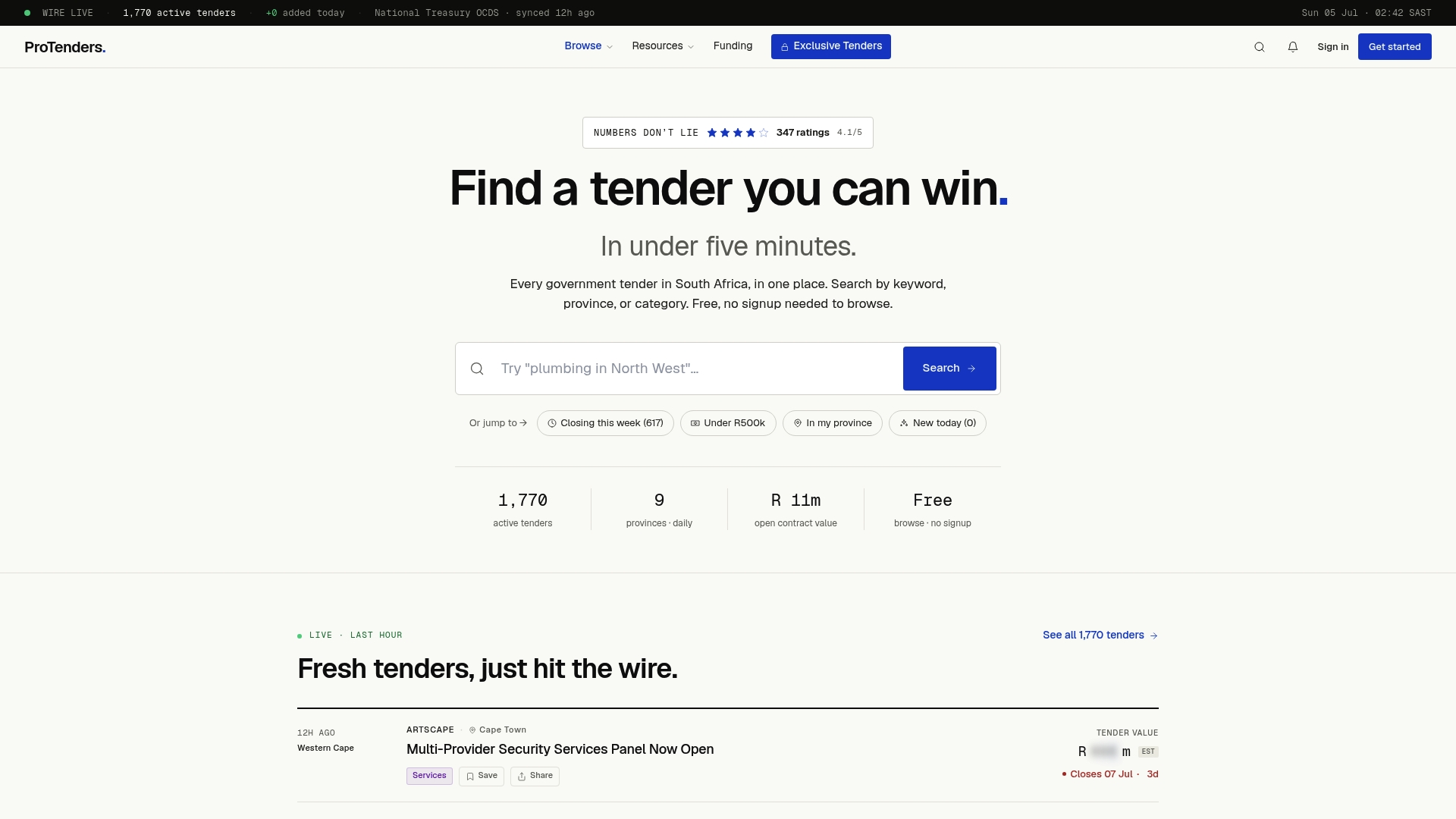
The live South African government tender feed covers all four tiers of government, searchable by keyword, region, or category. Compliance scorecards flag missing documents before you submit. BoQ and pricing schedule templates are pre-formatted to match common government requirements, so you start from a defensible structure rather than a blank spreadsheet. For SMMEs that need working capital to deliver a contract, the funding match service connects you with financing partners who understand the tender cycle.
If you are ready to apply the pricing framework in this guide to a real tender, browse today's published tenders and use Protenders's compliance tools to build your submission with confidence.
*Sources
- PREFERENTIAL PROCUREMENT REGULATIONS, 2022 (Implementation guide) | OCPO (National Treasury)
- Supply chain regulations / preference point rules (PFMA Gazette 22549)
- How to Win Tenders in South Africa: 2026 Strategy Guide | Bekin
FAQ
What are the main tender pricing strategies?
The four most practical approaches are competitive (undercut) pricing, value-based pricing, target costing (reverse-engineering from market rate), and life-cycle pricing based on total cost of ownership. In South African government tenders, the right strategy depends on the tender's evaluation model — specifically whether it uses an 80/20 or 90/10 preference-point system and whether functionality is scored separately.
How do you price a tender in South Africa?
Build a full cost model (direct costs, overheads, contingency, and margin), then calculate your projected price-point score using the tender's formula — Ps = 80 or 90 × (1 – (your price minus the lowest price) / the lowest price) — and model the combined score with your B-BBEE preference points before fixing your submission price.
What are the seven stages of the tender process?
The typical South African government tender process runs: market engagement and planning, advertisement and tender issue, clarification period, submission, functionality evaluation, price and preference evaluation, and award and contract conclusion. Pricing preparation should begin at the clarification stage, not the day before closing.
What makes a tender price "unreasonably low"?
South African procurement regulations allow evaluators to query any price that cannot plausibly cover the scope of work. Bids that cannot be justified may be disqualified.
How do B-BBEE preference points affect the winning price?
Under the 80/20 system (contracts up to R50 million), B-BBEE preference points carry up to 20 of the 100 available points. A Level 2 B-BBEE contributor scores 16 preference points versus 4 for a Level 6 contributor — a 12-point gap that can offset a price difference of several hundred thousand rand on a mid-sized contract.