Tender Scam Warning Signs in South Africa: 12 Red Flags

The clearest warning signs of a tender scam in South Africa are a request to pay before you win, an RFQ sent from a look-alike email domain, urgent deadlines, and delivery to an address that is not the buyer's premises. Fake notices copy real logos and real officials' names, so a convincing document proves nothing. Verify every RFQ or award by phoning the department on a number you found yourself, not one printed on the document.
This guide sets out the red flags that South African departments and regulators themselves describe, how to check a notice before you respond, and what to do if you have already paid or shared your details.
TL;DR
- Genuine government buyers do not ask you to pay to be awarded a tender. Any payment request to secure an outcome is a scam or a bribe.
- Check the sender's email domain, the contact details and any tender or order number against the department's own website.
- Be suspicious of urgent RFQs that ask you to deliver equipment, machinery or vehicles to an address near, but not at, a government building.
- Verify by phoning the department on a number from its official website, then compare the notice with the published tender.
- If you have been scammed, call your bank at once, report to SAPS and send the details to the FIC.
Table of Contents
- How tender scams work in South Africa
- 12 warning signs of a fake tender, RFQ or bid notice
- A quick check table
- How to verify a tender or RFQ before you respond
- Warning signs that a funding or "tender help" offer is not genuine
- What to do if you have paid a scammer or shared information
- Protecting your business as a regular habit
- Start from real listings with ProTenders
- FAQ
- Sources
How tender scams work in South Africa
Most tender scams fall into two types. The first is the fake RFQ or purchase order. A fraudster poses as a department, sends a request for quotation, and waits for you to buy goods you will never be paid for. The second is the fake influence scheme, where someone claims they can get you a tender or release an award for a fee.
The Central Supplier Database (CSD) fraud-awareness page describes the first type well. Fake RFQs may appear to come from government-looking email addresses and carry logos, forms and officials' contact details. They are often urgent, and the delivery point is outside a government building or at an agreed address.
The Financial Intelligence Centre (FIC) covers the second type in its 2025 advisory. It says fraudsters may quote accurate tender details and claim they can influence an outcome in exchange for money. The details being accurate is exactly what makes it believable: tender information is public, so anybody can copy it.

12 warning signs of a fake tender, RFQ or bid notice
Red flags in the sender and the document
1. The email domain is wrong. Real government addresses end in the department's official gov.za domain. The Department of Communications and Digital Technologies (DCDT) warns that a suspicious RFQ may use a domain unlike its official one, such as .gov.org.za, .co.za, .com, .net or .net.za. Read the part after the @ sign letter by letter. Free webmail addresses claiming to be a department are a red flag by themselves. 2. The contact details do not match the website. The Department of Employment and Labour says scammers may use genuine officials' names but incorrect contact details. A real name on a fake phone number is the standard trick. 3. The letterhead or logo looks right but the details are off. Scammers copy logos easily. The same Labour alert mentions counterfeit letterheads and order numbers. Treat branding as decoration, never as proof. 4. The numbering does not follow the department's format. DCDT says its RFQs do not carry tender numbers, and that its order numbers follow an OR- plus five-digit format. An RFQ with a tender number is suspicious there. Each buyer has its own format, so compare the number with a genuine document from that buyer. 5. The tender cannot be found where the buyer publishes. Compare any notice with the buyer's own website or the Tender Bulletin. Employment and Labour advises suppliers to compare tender details with the Tender Bulletin. If it appears nowhere official, stop. 6. It arrives out of the blue. You never registered an interest, never downloaded a document and never attended a briefing, yet you are invited to quote or told you have been selected. Real procurement starts with a published opportunity, and you usually have to respond to it formally. Our guide to compulsory briefing sessions shows how a genuine process works.Red flags in what they ask you to do
7. They ask for money. This is the clearest sign. The FIC says no individual may request payments, bribes or inducements in exchange for favourable consideration in a tender process. SARS states that it will never require payment to secure an award, and that an upfront payment request is attempted supplier fraud. The Department of Justice says its supply chain management unit will never request payment to communicate an intended award. 8. They promise to influence the outcome. Anyone offering an inside track, a guaranteed award or a "fast-track" for a fee is either a fraudster or inviting you into corruption. Evaluation is meant to be merit-based, following established procedures. 9. They push urgency. The CSD lists fake RFQs that are urgent and concluded quickly. Pressure to quote and deliver within a day or two stops you from checking. 10. They order expensive items. The Department of Public Works and Infrastructure (DPWI) said in 2024 that fraudulent orders commonly requested expensive equipment, machinery or vehicles. A first-time order for high-value goods with no formal process is a pattern, not a coincidence. 11. Delivery goes near, but not to, the buyer. In the same DPWI statement, delivery was directed close to, but not inside, official premises. A real department receives goods at its own stores or offices. Be wary of any request to drop goods at a warehouse, a parking area or a nearby address. 12. The invoice goes to a strange email address. DPWI also described invoice requests being sent to a bogus email address after delivery. SARS notes that its official communication comes from a single tender office address, and that awarded tenders are sent on letterhead and published on its website. If the buyer's real award is not published, ask why.
Also watch for banking details in a private person's name. The Labour alert lists private-name banking details among the signs.
A quick check table
| What you see | Why it is a problem | What to do |
|---|---|---|
| Email from .com, .co.za or .net | Not the department's official domain | Find the real domain on the department's website |
| Phone number printed on the RFQ | May ring the scammer | Phone a number from the official website |
| "Pay a fee to secure the award" | Genuine buyers never ask for it | Stop, keep the evidence, report |
| Delivery to an address near the building | Goods are diverted | Ask the department's stores to confirm in writing |
| Real official's name, wrong details | Names are easy to copy | Call that official through the switchboard |
| Tender number or order format looks odd | Counterfeit documents | Compare with a known genuine document |
How to verify a tender or RFQ before you respond
Verification takes minutes and costs nothing. Use the same order each time.
- Do not reply or click yet. Do not open attachments from an unknown sender and do not send company documents.
- Find the department's contact details yourself. The CSD advises calling the respective departments using contact details on their websites. Type the website address in yourself, rather than following a link in the message.
- Ask the supply chain management office to confirm. Give the RFQ number, the name of the official and the item. Ask whether the request is genuine and who should receive the quote.
- Check the published opportunity. Look for the tender or quotation on the buyer's site and in the national tender channels. National Treasury's eTenders portal is the official place for national and provincial advertised bids. Our methodology page explains where our own listings come from, and we always recommend confirming the details with the issuing buyer.
- Check the award. Real awards are normally communicated formally and published by the buyer. The SARS example is a useful pattern: official sending domain, official award letter, and publication on the buyer's website.
- Never use the details on the suspicious document. The Labour alert specifically advises avoiding contact details printed on a suspicious document.
The DPWI case shows why a real name is not enough. Criminals can copy both a name and a logo while redirecting delivery and invoicing away from the department. Independent verification is the only safe test.
Warning signs that a funding or "tender help" offer is not genuine
Scammers also target winners. Once a tender is publicly awarded, your company name and contact details are visible, and fake funders or fixers may call with an offer.
Be careful when someone:
- asks for an "administration", "processing" or "release" fee before funding is paid out;
- guarantees approval without looking at your contract, financials or compliance status;
- insists you use a particular supplier for the goods you need to buy;
- asks for your CSD password, bank PIN or one-time passwords;
- has no verifiable registration, office or track record you can check independently.
Real funders assess your award letter, cash flow and ability to deliver. Our guide on audited financials for tenders explains what a lender or buyer may ask to see. If you want to compare funding routes, start from the business funding programmes listed on our site and check any provider's own application page before sharing documents.
What to do if you have paid a scammer or shared information
Speed matters. Acting in the first hours gives the best chance of stopping a transfer.
- Call your bank's fraud line immediately. Tell them you have been the victim of fraud, give the beneficiary details and ask them to try to recall or flag the payment.
- Lay a charge with SAPS. DPWI says service providers who have been scammed should report the matter to SAPS. Ask for the case number, as your bank may need it.
- Report to the FIC. It directs suspected tender scams to scams@fic.gov.za, its confidential Fraud Hotline on 0800 701 701, or the police.
- Tell the department being impersonated. Its supply chain or ethics office can warn other suppliers and may already know about the scam.
- Protect your accounts. If you shared passwords, change them. If you shared your CSD login, contact the CSD support channel. If you sent company registration documents, ID copies or bank letters, tell your bank and watch for attempted account changes.
- Keep the evidence. Save emails with full headers, the fake RFQ, invoices, delivery notes, bank proofs of payment, WhatsApp messages and call times. Do not delete anything, even if it embarrasses you.
If you delivered goods to a fake buyer, tell your supplier and your insurer promptly. Recovery is never guaranteed, so prevention is worth far more than a cure.
Protecting your business as a regular habit
A few simple routines stop most attempts:
- Keep one verified contact list. Save official switchboard numbers for the buyers you deal with, so you never rely on numbers in an email.
- Give one person authority to approve orders. Nobody else should start purchasing for a new government buyer without a second check.
- Do not buy stock before an official purchase order is verified. Never fund a supplier deposit on the strength of an RFQ alone.
- Treat price requests differently from orders. Quoting is low risk. Buying and delivering is where the loss happens. Our RFQ pricing guide covers quoting properly.
- Check electronic submissions. Use our electronic submission checklist so you submit through the channel named in the real bid document.
- Source tenders from published listings. Browse live opportunities rather than waiting for unsolicited messages. A fake RFQ cannot be matched to a published tender, and you can see that yourself.
## Our perspective
>
We see the same pattern in almost every scam story: the victim was a small business that wanted an opportunity badly and had no easy way to check it. Scammers do not need clever technology. They need an SMME that is short of time and short of a reliable list of what is genuinely open.
>
That is why we built ProTenders around published, live tenders from national, provincial and municipal buyers, searchable without signing up. If you start from a listed opportunity, you start from something a buyer actually advertised, and you can phone that buyer through its official channels before spending a cent.
>
We also believe verification should be a habit, not a reaction. Our compliance scorecards, document templates and bid workspace are designed to keep your own paperwork in order, so that when a real award arrives you are ready and a fake one stands out. Our funding partnerships are designed to connect awarded suppliers to financing options, so nobody has to take a fixer's "release fee" offer seriously.
>
Dolene April
Start from real listings with ProTenders
If you want to find tenders without relying on unsolicited messages, you can search all live South African government tenders on ProTenders by keyword, region or category, with no sign-up needed to browse. You can also set up free daily tender alerts for the categories you serve.
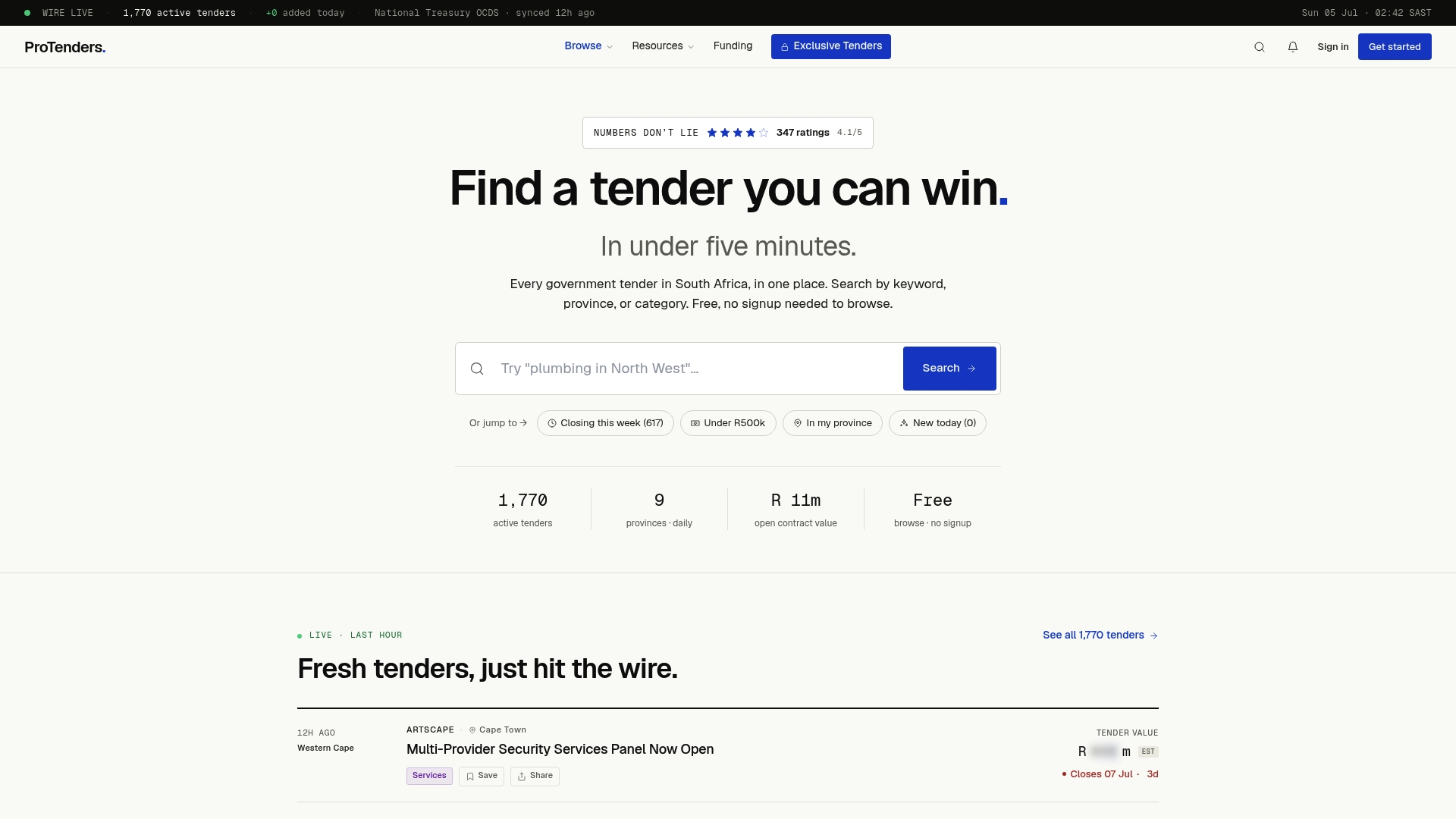
Advanced tools are on paid plans. Pro is R1 990 per year and Business is R3 990 per year, with Enterprise from R999 per month. See the pricing page for what each plan includes. For a step-by-step route into the market, read our guide on how to get government tenders in South Africa.
FAQ
Does a government department ever ask for payment to award a tender?
No. SARS and the Department of Justice both state that they will never ask for payment to secure or communicate an award. The FIC says no individual may request payments or inducements for favourable consideration in a tender process. Treat any such request as fraud and report it.
How can I tell if an RFQ email is real?
Check the sender's domain against the department's official one, then phone the department using a number from its own website. Compare the RFQ number and format with genuine documents and the published tender. If any of these fail, do not quote or deliver.
Where do I report a suspected tender scam?
The FIC directs reports to scams@fic.gov.za or its confidential Fraud Hotline on 0800 701 701, and you can also go to the South African Police Service. If a particular department was impersonated, tell its supply chain management office too, so it can warn other suppliers.
Can I get my money back after paying a tender scammer?
Recovery is not guaranteed, but speed helps. Phone your bank's fraud line straight away so it can try to flag or recall the payment, then lay a charge with SAPS and keep every message and proof of payment. Report to the FIC as well.
Is a tender listing on a website enough to prove it is genuine?
A listing is a starting point, not a guarantee. Scammers copy real tender details, so always confirm the opportunity and the contact person with the issuing buyer through contact details on its official website before you invest money or share documents.
Sources
- Fraud Awareness, Central Supplier Database
- FIC advisory on tender-related scams
- DCDT scam alert
- Department of Employment and Labour tender and RFQ scam alert
- SARS Tender Office fraud warning
- Department of Justice tenders page