Supplier performance evaluation: what buyers actually check

A buyer evaluates your bid in three ordered gates: administrative compliance, then functional (technical) scoring, then price and preference. Miss the first gate and your pricing never gets read. The Preferential Procurement Regulations 2022 (PPR 2022) and the Preferential Procurement Policy Framework Act (PPPFA) govern how those gates work. Protenders maps directly to this process with compliance scorecards, document templates, and live tender alerts.
Gate 1 — Administrative compliance (pass/fail):- Valid CSD registration and active tax clearance
- B-BBEE certificate or sworn affidavit (EME/QSE)
- Company registration documents (CIPC)
- Signed SBD forms (SBD 1, SBD 4, SBD 6.1, SBD 8, SBD 9)
- Proof of attendance at any compulsory briefing session
- Written methodology mapped to each criterion
- Relevant CVs and professional registrations
- Certified copies of previous project completion certificates
- Equipment or resource schedule
- Completed pricing schedule using the prescribed format
- Valid B-BBEE certificate for preference points
- Subcontracting agreements or local content declarations where required
Key takeaways
Passing all three evaluation gates requires administrative completeness first, then credible technical evidence, then competitive and correctly calculated pricing.
| Point | Details |
|---|---|
| Admin compliance is pass/fail | A single missing or unsigned document eliminates your bid before scoring begins. |
| Functionality needs mapped evidence | Mirror the tender's criterion numbering and attach proof on the same page as each claim. |
| Price and preference work together | Competitive pricing plus maximum legitimate B-BBEE points often beats the lowest price alone. |
| Verification can reverse an award | Brief referees in advance and keep a document pack ready before the tender closes. |
| Protenders speeds compliance | The compliance scorecard and bid workspace track returnables and flag deadline risks for SMMEs. |
Table of Contents
- How does supplier performance evaluation work as a process?
- Administrative compliance: the gate most bidders fail
- How functional scoring works and what score you need
- Price points, the 80/20 and 90/10 systems, and preference claims
- What buyers verify after scoring
- Why bids fail and the fastest fixes
- How evaluation panels decide, and what to do if you disagree
- Practical templates and tools to build your submission
- What procurement panels actually value
- Protenders: where to start before the next tender closes
- Sources
- FAQ
How does supplier performance evaluation work as a process?
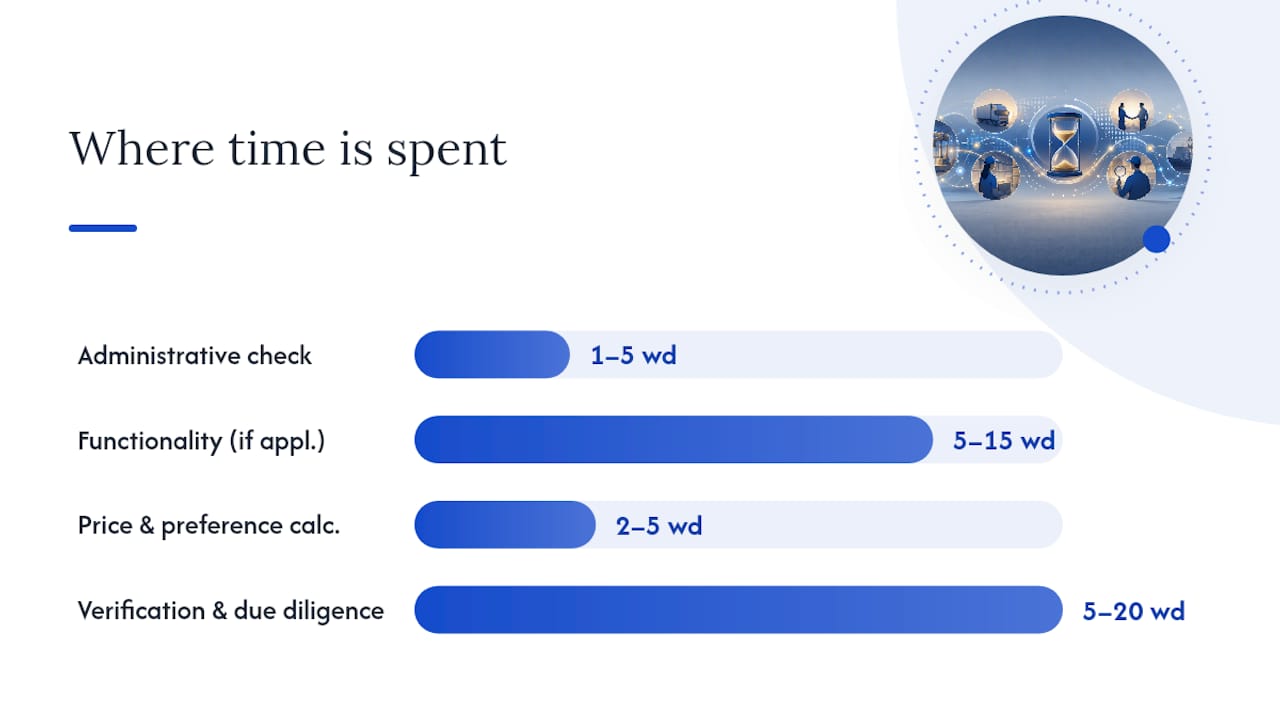
The BENA Good Practice Guidance%20SPF%20GPG%20-%20Bid%20Evaluation,%20%20Negotiation%20and%20Award.pdf) describes the full sequence: administrative check, then functionality scoring where applicable, then price and preference calculation, then verification and due diligence, then award or negotiation. Each stage feeds the next. A bidder eliminated at stage one never reaches stage three.
Buyers choose between a one-envelope approach (all documents submitted together, checked in sequence) and a two-envelope approach (technical and financial envelopes opened separately). Two-envelope is common for complex services where the buyer wants to score technical merit before seeing prices, which prevents price from anchoring the panel's judgement.
Approximate stage durations:- Administrative check: 1–5 working days after closing
- Functionality scoring: 5–15 working days (panel scheduling dependent)
- Price and preference calculation: 2–5 working days
- Verification and due diligence: 5–20 working days
- Clarification requests: typically issued within the first 10 working days
Administrative compliance: the gate most bidders fail
Practitioners confirm that administrative non-responsiveness — missing documents, unsigned forms, late delivery — is the single most common reason bids are eliminated before scoring begins. The panel has no discretion here; a non-responsive bid is set aside. Mandatory document checklist:- CSD supplier number (active, matching the tendering entity)
- SARS tax clearance (original PIN or CSD-linked status)
- B-BBEE verification certificate or EME/QSE affidavit (not expired)
- CIPC company registration certificate
- All SBD forms signed in full, no blanks left
- Proof of compulsory briefing attendance (if applicable)
- Any sector-specific licence or professional registration the tender requires
Use this matrix as a pre-submission self-audit. A compliance scorecard turns this into a repeatable team habit.
Pro Tip: Assign one person to own the admin pack and a second person to check it independently against the tender's returnable schedule — two days before submission, not the night before. Most errors caught at this stage are simple omissions, not complex mistakes.How functional scoring works and what score you need
Not every tender uses functionality scoring. When it does apply, the PPR 2022 Implementation Guide requires the buyer to state the criteria, weightings, and minimum qualifying score in the invitation to tender. Bidders who score below the minimum are excluded from price and preference evaluation entirely.
The Evaluation Model Good Practice Guidance recommends a structured rating scale applied consistently by each panel member. A common format:
Rating scale template:- 0 — No response: criterion not addressed
- 1 — Poor: response addresses criterion but provides no supporting evidence
- 2 — Adequate: some evidence provided, gaps remain
- 3 — Good: criterion fully addressed with supporting evidence
- 4 — Excellent: criterion exceeded with verifiable, detailed evidence
Format your technical response so each criterion gets its own clearly labelled section. Evaluators work through a scoring sheet; if they cannot find your answer quickly, they score low. A winning tender proposal mirrors the criterion numbering from the tender document exactly.
Price points, the 80/20 and 90/10 systems, and preference claims
The PPPFA Gazette sets two systems: 80/20 applies to tenders up to R50 million (80 points for price, 20 for specific goals) and 90/10 applies above R50 million (90 points for price, 10 for specific goals). The lowest acceptable tender receives the full price points; every other bid is scored pro rata using the formula.
Worked price comparison (80/20 system):Bidder A wins on total points despite a lower B-BBEE contribution. Bidder B's strong preference score nearly closes the gap. This is why pricing competitively and maximising legitimate preference claims together matters more than either alone.
Specific goals that attract preference points include: B-BBEE contributor level, subcontracting to designated groups, and local content commitments. Each claim needs irrevocable proof attached to the bid. A B-BBEE certificate must be current and issued by an accredited verification agency. Subcontracting agreements must name the subcontractor, the scope, and the rand value.
Pro Tip: Attach a one-page summary sheet listing every preference claim, the document that proves it, and the page number in your submission. Evaluators verify claims under time pressure; making their job easier reduces the risk of a valid claim being overlooked.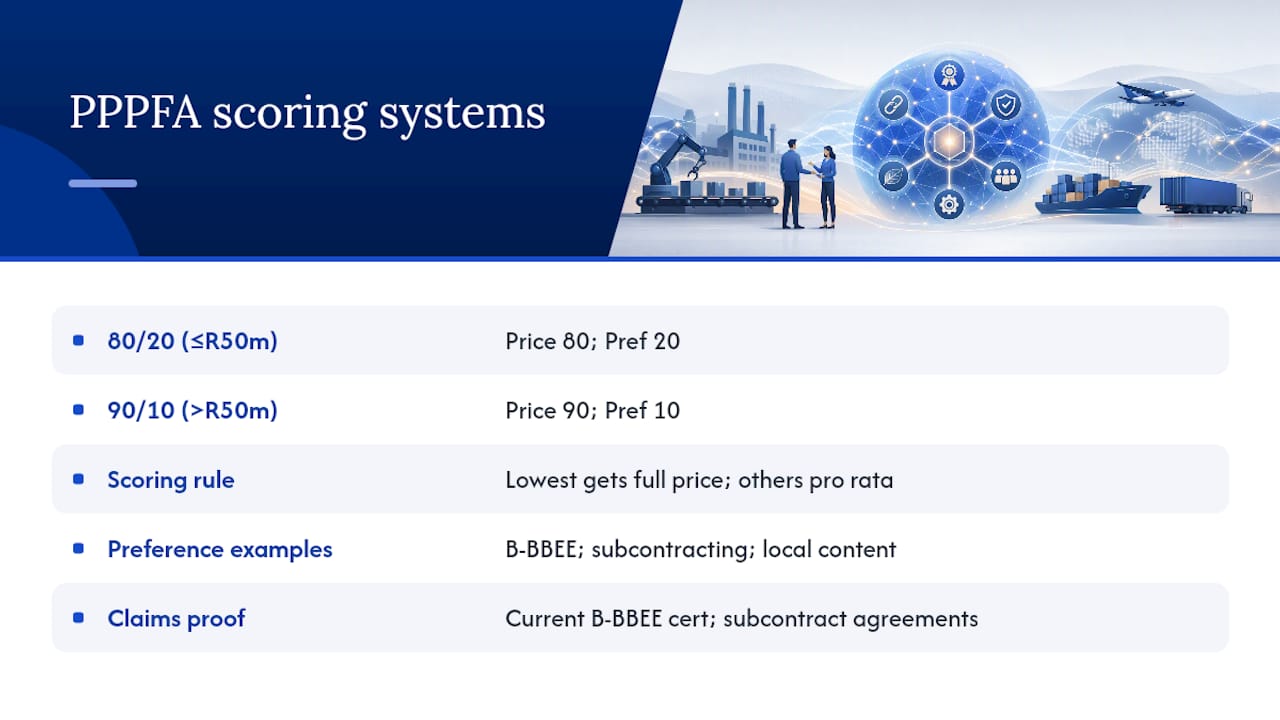
What buyers verify after scoring
Verification follows scoring and can reverse a provisional award. The BENA guidance describes buyers using site visits, reference checks, financial viability assessments, and sample or prototype reviews to confirm that claims in the bid are accurate.
Document pack to prepare before verification:- Audited financial statements (last two years)
- Bank statements (last three months)
- Signed reference letters from previous clients (on letterhead, with contact details)
- Proof of equipment ownership or lease agreements
- Professional registration certificates (originals or certified copies)
- Insurance certificates (public liability, professional indemnity where applicable)
| Verification item | Method | Evidence required |
|---|---|---|
| Financial viability | Bank/auditor review | Statements, audited accounts |
| Technical capacity | Site visit / CV check | Registrations, equipment proof |
| Previous performance | Reference calls | Client letters, completion certs |
| B-BBEE status | Certificate check | Accredited agency certificate |
| Subcontractor capacity | Document review | Signed agreements, CSD numbers |
Why bids fail and the fastest fixes
Most bids are eliminated before scoring — not because of weak pricing or poor technical quality, but because of avoidable administrative errors. The fastest fixes address the highest-frequency failures.
Common failures and corrective actions:- Missing or expired B-BBEE certificate: Set a calendar reminder 30 days before expiry; keep a certified copy in a shared folder.
- Unsigned SBD forms: Print a returnable schedule checklist; each form gets a physical signature tick before filing.
- Pricing arithmetic errors: Use a locked Excel template with formula cells; have a second person verify totals.
- Failure to attend compulsory briefing: Add briefing dates to the team calendar the day the tender is downloaded.
- Wrong entity name on CSD: Cross-check the CSD registration name against the company registration certificate before every submission.
For a complete tender documents checklist, map every returnable to the tender's own schedule so nothing is missed.
How evaluation panels decide, and what to do if you disagree
Panels reach final scores through one of three routes: mathematical averaging of individual scores, moderation (panel members discuss and agree a consensus score), or a formal consensus meeting. The Evaluation Model guidance recommends moderation because it captures team judgement and flags outlier scores for discussion rather than washing them out in an average.
After scoring, buyers may negotiate with the highest-scoring responsive bidder to achieve better value for money. Negotiation does not reopen the competition; it refines scope, price, or delivery terms within the evaluated offer.
A contract may be awarded to a bidder other than the highest-scoring one in specific, documented circumstances — for example, where the highest scorer cannot demonstrate financial capacity to deliver. The buyer must record the reasons in the final evaluation report.
If you believe an evaluation was conducted unfairly:- Request a debriefing in writing within 14 days of notification
- Ask specifically for your scores against each criterion and the panel's reasoning
- Compare the stated evaluation criteria in the tender document against the scores awarded
- If procedural irregularities are evident, lodge a written objection with the accounting officer citing the specific regulation breached
- Keep copies of your original submission, the tender document, and all correspondence
Practical templates and tools to build your submission
Four templates cover the core of every bid response:
- Admin checklist: maps every returnable document to the tender's schedule; owned by one team member, checked by a second
- Rating scale sheet: mirrors the buyer's scoring criteria so you can self-assess before submission
- Verification matrix: lists every claim in your bid and the document that proves it
- Pricing workbook: locked Excel file with formula-driven totals and a preference points calculator
A tender management platform speeds this workflow. Protenders provides live government tender alerts, a compliance scorecard, document templates, and a bid workspace where teams can track document status against deadlines. For SMMEs without a dedicated bid team, the compliance scorecard alone reduces the risk of administrative elimination by turning the returnable schedule into a tracked checklist.
Protenders also aggregates SME-sized opportunities so you spend less time searching and more time preparing a compliant, competitive response.
What procurement panels actually value
The gap between a bid that wins and one that gets set aside is rarely price. It is almost always documentation discipline.
Procurement panels work under time pressure and regulatory scrutiny. They are not looking for the most creative proposal; they are looking for the easiest bid to score and defend. A bid that answers each criterion in the same numbered sequence as the tender document, attaches proof on the same page as the claim, and submits every returnable in the correct order gives the panel exactly what they need to award it confidently.
Small SMMEs compete successfully against larger firms when they treat the tender response as a compliance exam rather than a sales pitch. A Level 1 B-BBEE contributor with a clean admin pack and a well-evidenced technical response will outscore a larger competitor whose submission is incomplete or whose pricing schedule contains arithmetic errors. The PPR 2022 and PPPFA framework was designed partly to create that opening. Use it.
Protenders: where to start before the next tender closes
Protenders gives SMMEs a faster path from tender discovery to compliant submission. The platform aggregates every live government tender across all four tiers, sends deadline alerts, and provides a compliance scorecard that tracks your returnable documents against the tender's own schedule. Templates for admin packs, pricing workbooks, and functionality responses are built in, so you are not starting from a blank page under deadline pressure.
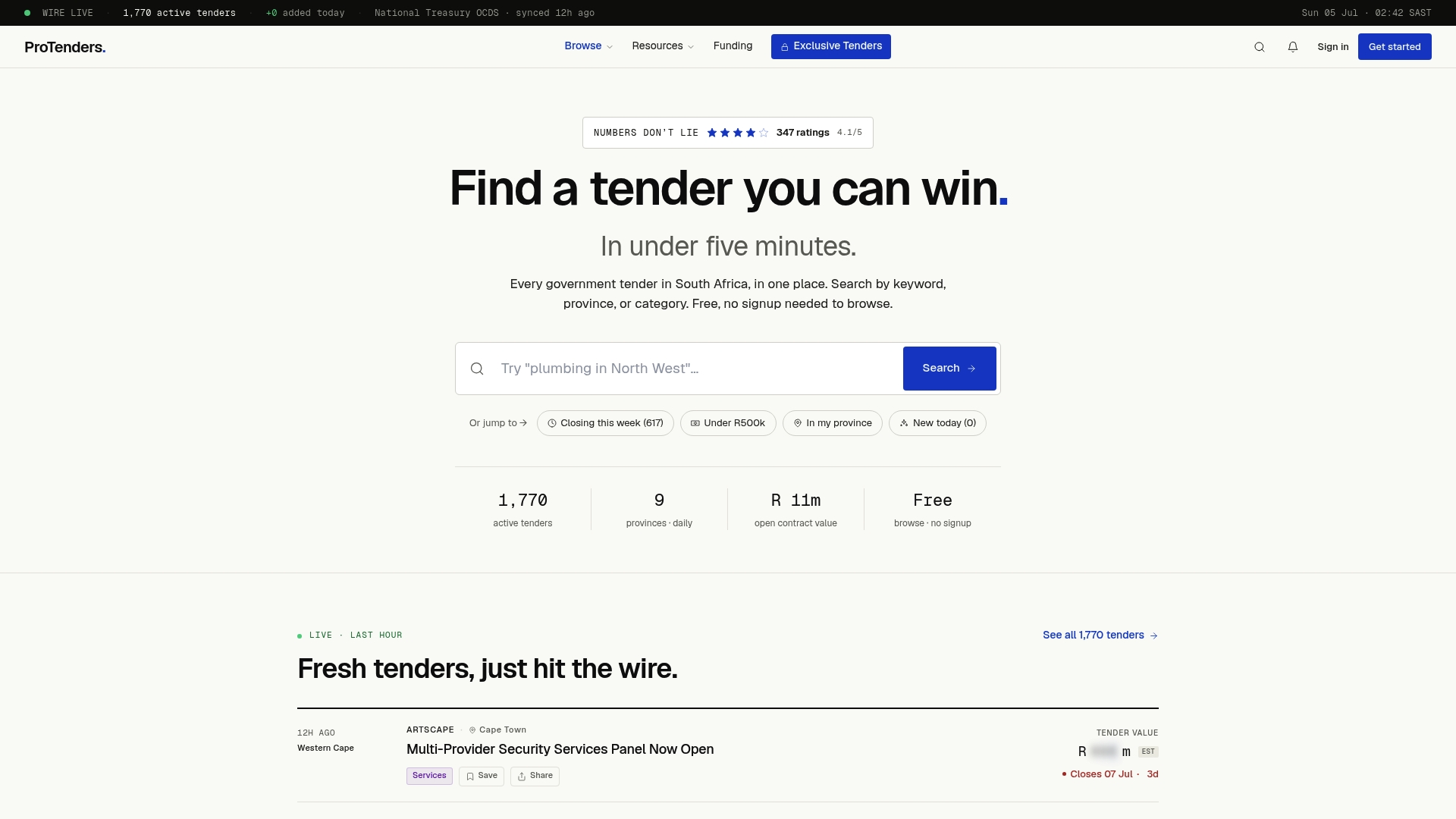
For SMMEs preparing their next bid, the practical starting point is the live tender feed, where you can filter by category, region, or value to find opportunities sized for your business. The compliance scorecard and templates are available from the same workspace. Always verify the specific terms of each tender document — requirements vary by buyer and sector.
Sources
- Implementation guide: Preferential Procurement Regulations (PPR) 2022 - March 2023
- How to Respond to a Tender: A Guide for SA Teams
FAQ
What are the three evaluation gates in a government tender?
Administrative compliance (pass/fail), functional scoring (where applicable, with a minimum qualifying score), and price and preference evaluation using the 80/20 or 90/10 points system.
When does the 90/10 preference system apply instead of 80/20?
The 90/10 system applies to tenders valued above R50 million; the 80/20 system applies to tenders at or below R50 million, as set out in the PPPFA Gazette.
What is the most common reason a bid is disqualified before scoring?
Administrative non-responsiveness: missing mandatory documents, unsigned SBD forms, or expired certificates. These errors eliminate a bid before the panel ever reviews the technical or price sections.
How can a small SMME compete against larger bidders on functionality scoring?
By mirroring the tender's criterion numbering exactly, attaching verifiable evidence (CVs, completion certificates, equipment lists) alongside each answer, and self-scoring against the buyer's rating scale before submission.
How does Protenders help with supplier performance evaluation preparation?
Protenders provides a compliance scorecard that tracks returnable documents against the tender schedule, pre-built templates for admin packs and pricing workbooks, and live tender alerts so SMMEs have enough lead time to prepare a complete, competitive submission.
Recommended
- Procurement market research for SMMEs: win SA tenders | ProTenders
- Compliance Scorecard for Government Tenders: 2026 Guide | ProTenders
- CSD supplier database registration: step-by-step guide for SMMEs | ProTenders
- B-BBEE Tender Requirements South Africa 2026: PPPFA 80/20 & 90/10 Explained | ProTenders